
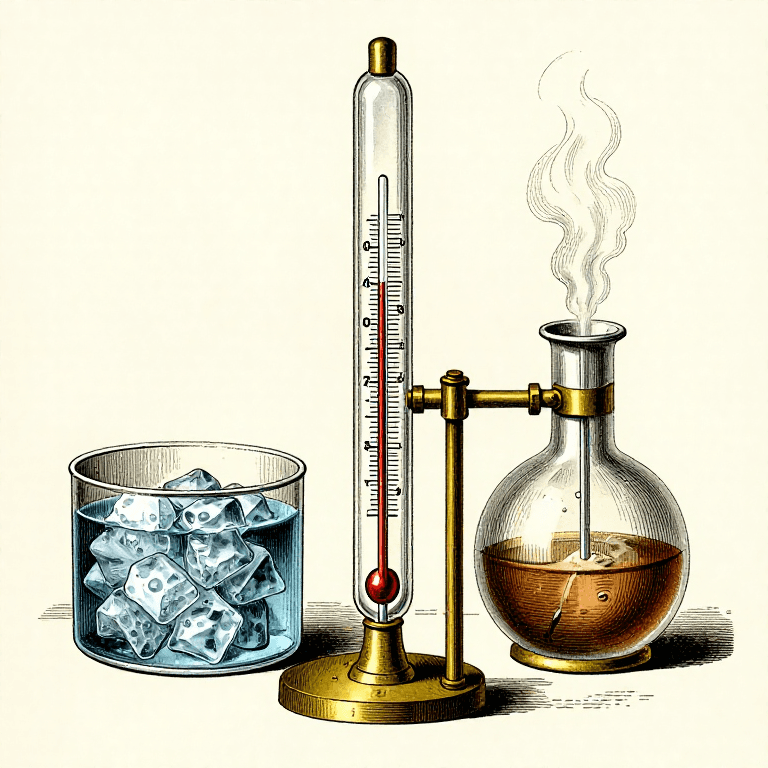
Wedgwood Pyrometer
안내
Make a batch of identical clay test pieces
Make a batch of identical clay test pieces
The instrument only works if every piece starts the same, so consistency is the entire preparation.
- Mix a batch of ball clay to an even, well-wedged consistency — the whole batch at once, never in separate lots.
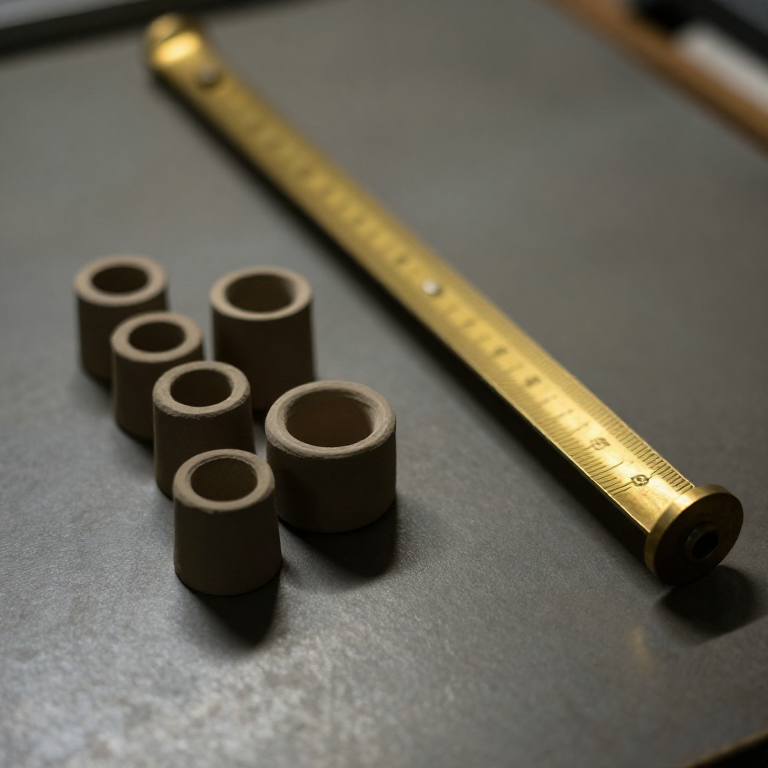
- Form at least twelve cylinders in a single mould, each about 25 mm diameter and 60 mm long.
- Dry them all together, slowly, under the same conditions.
- Measure each dried piece's length and diameter with the caliper and record every reading.
- Discard any that differ noticeably from the rest.
One batch, one mould, one drying schedule. Wedgwood's instrument compares a fired piece against its unfired size, so any variation between pieces is indistinguishable from a temperature difference. He supplied his own standard clay for exactly this reason — the instrument is only meaningful if everyone uses identical material.
Record every dimension before firing. A shrinkage measurement needs a before, and there is no way to recover it afterwards.이 단계의 재료:
 볼클레이1 bag
 볼클레이 가루1 bag
필요한 도구:
 디지털 캘리퍼스 6인치
 조합 직각자
 점토용 절단선과 칼 세트
Build the measuring gauge Wedgwood used
Build the measuring gauge Wedgwood used
A tapering slot, so a shrunken cylinder slides further in — reading small changes as a long travel.
- Take two straight brass or aluminium strips 300 mm long.
- Mount them on a base converging very slightly, so the gap narrows from 26 mm at one end to 20 mm at the other.
- Mark a scale along the length.
- Drop an unfired cylinder in at the wide end and note where it stops.
The taper is a mechanical amplifier. A shrinkage of half a millimetre in diameter moves the cylinder a long way down a shallow taper, turning a measurement too small to read into one anybody can read at a glance. This is exactly the sine bar's trick from batch 69 — spread a small change over a long travel — arriving from the opposite direction.
Make the taper shallow and consistent. A steeper gauge is easier to build and gives correspondingly less resolution, which is the whole trade.이 단계의 재료:
 알루미늄 평각봉1 개
 발트 자작나무 합판1 장
 육각 홈붙이 원통 머리 볼트4 개
 육각 너트4 개
필요한 도구:
 무선 드릴
무선 드릴 드릴 비트 세트
 줄 세트디지털 캘리퍼스 6인치조합 직각자
 육각 렌치 세트
Fire pieces at several known temperatures
Fire pieces at several known temperatures
Build the calibration curve the instrument needs, using a kiln whose temperature you can read independently.
- Fire three cylinders to 700 °C, using a kiln controller or pyrometric cones as the reference.
- Fire three more to 900 °C, and three to 1100 °C.
- Cool each set fully before measuring.
- Measure each fired piece on the taper gauge and with the caliper.
- Plot gauge reading against the known firing temperature.
이 단계의 재료:
 가마(킬른)1 개볼클레이1 bag
필요한 도구:
디지털 캘리퍼스 6인치 적외선 온도계
 스톱워치
스톱워치Find where the scale goes non-linear, and where it dies
Find where the scale goes non-linear, and where it dies
Every proxy measurement has a region where it stops working. Find this one's.
- Look at your plot: is equal shrinkage produced by equal temperature steps?
- Fire another set at 1200 °C and add the point.
- Keep going until the clay begins to vitrify and slump.
- Note the temperature at which shrinkage stops increasing usefully.
이 단계의 재료:
 모눈종이1 pad
필요한 도구:
디지털 캘리퍼스 6인치Measuring the effect instead of the cause, and history
Measuring the effect instead of the cause, and history
Josiah Wedgwood presented his pyrometer to the Royal Society in 1782 and was elected a Fellow the following year, largely on its strength. He was a manufacturer solving a manufacturing problem: his pottery business depended on firing consistently, and without a measurement he was relying on the judgement of experienced firemen watching the colour of the kiln.
The idea is to measure a permanent EFFECT rather than the transient cause. Temperature exists only while the kiln is hot; shrinkage persists. So the instrument records something that has already happened and can be read at leisure, at room temperature, with an ordinary gauge. That is why the same principle survives today as pyrometric cones — which measure heat WORK, the combination of time and temperature, rather than peak temperature alone.
Its honest failure is instructive. The instrument was repeatable, so Wedgwood could compare one firing to another with confidence — that alone transformed his business. But the scale was non-linear and untied to any external standard, so his numbers were precise and inaccurate. Precision without accuracy is genuinely useful for control and genuinely useless for communication, and the distinction matters in every measurement discipline.
Where the chain goes next: the thermocouple later in this batch measures temperature directly, continuously, while the process is running, and can be tied to fixed points. That is the fundamental advance — from a proxy read afterwards to a signal read live — and everything after it in instrumentation follows that direction.
재료
8- 1 bag플레이스홀더
- 1 bag플레이스홀더
- 1 개플레이스홀더
- 1 장플레이스홀더
- 플레이스홀더
- 4 개플레이스홀더
- 1 개플레이스홀더
- 1 pad플레이스홀더
이 블루프린트로 만드는 것

관련 블루프린트
이 블루프린트들은 지식을 공유합니다 — 기술, 재료 또는 원리
CC0 퍼블릭 도메인
이 블루프린트는 CC0로 공개되었습니다. 어떤 목적으로든 자유롭게 복사, 수정, 배포 및 사용할 수 있습니다.
제품 구매를 통해 메이커를 지원하세요. 판매자가 설정한 메이커 커미션 을 받거나, 이 블루프린트의 새로운 반복을 만들어 연결로 포함시킬 수 있습니다.