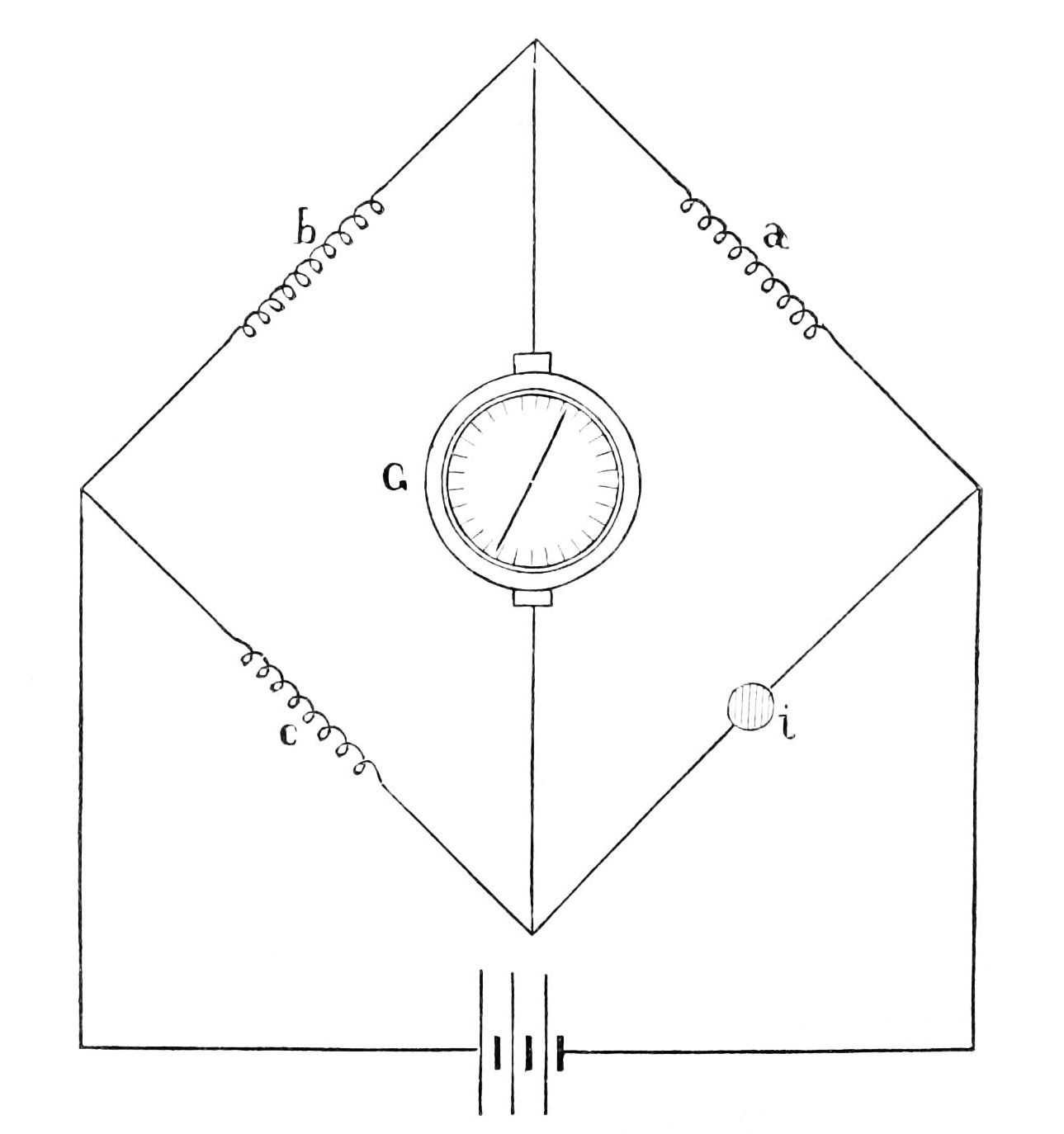


Wheatstone Bridge
안내
Build the diamond
Build the diamond
Four arms meet at four corners. Label them so the maths stays straight.
- Corners A and C are opposite: the supply connects across these.
- Corners B and D are the other pair: the detector goes across these.
- Arms A–B and B–C are the known ratio arms, R1 and R2.
- Arm A–D is the variable arm R3; arm D–C holds the unknown, Rx.
이 단계의 재료:
 1/4 W 저항 키트1 키트
 구리선1 length
Fit the detector across the middle
Fit the detector across the middle
Connect the galvanometer between B and D. This is the instrument that has to be sensitive, not accurate — it only ever has to tell you when the reading is zero.
That distinction is the whole trick. A galvanometer whose scale is wrong by twenty per cent still finds the null perfectly, and the null is where the answer lives.이 단계의 재료:
 아날로그 검류계1 개
Balance the bridge
Balance the bridge
Apply the supply across A and C, then adjust R3 until the detector reads exactly zero.
- Start coarse, then refine.
- Tap the supply on briefly rather than leaving it connected while you hunt — self-heating changes the very resistances you are measuring.
At balance: Rx = R3 × (R2 / R1)
At the null, no current flows through the detector, which means B and D sit at exactly the same potential. Nothing about the supply voltage appears in the answer — that is why a tired battery does not spoil the measurement.Prove it is immune to the supply
Prove it is immune to the supply
The claim above is testable in a minute, so test it.
- Balance the bridge and note R3.
- Swap the supply for one of noticeably different voltage.
- Re-balance. The null should land at the same R3.
이 단계의 재료:
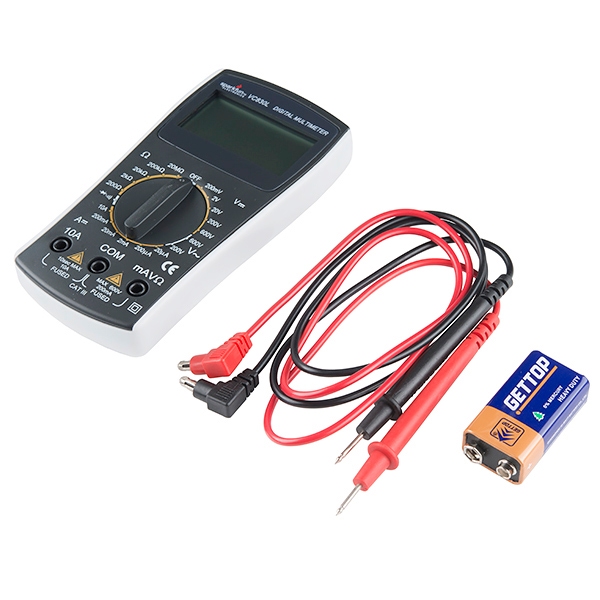 Digital Multimeter - Basic1 개
History and context
History and context
Samuel Hunter Christie published this circuit in 1833 as a way of comparing wires. Charles Wheatstone found it, saw what it was for, developed it into a practical instrument in 1843 — and said plainly in his paper that the arrangement was Christie's. The misattribution in the name was not Wheatstone's doing.
Its first heavy use was the telegraph, where finding the distance to a fault on a buried or submarine line meant measuring resistance accurately in the field, with whatever battery was to hand. The Wheatstone bridge and its variants — the Kelvin double bridge for very low resistances, the Wheatstone-derived AC bridges for capacitance and inductance — carried precision measurement for a century.
It has not retired. Every strain gauge, load cell and pressure sensor works by unbalancing a bridge slightly and reading the difference, which is why a supermarket scale and a 19th-century telegraph fault-finder share a circuit diagram.
재료
4- 1 키트플레이스홀더
- 1 length플레이스홀더
- 1 개플레이스홀더
- Digital Multimeter - Basic10% 수수료1 개₩192
관련 블루프린트
이 블루프린트들은 지식을 공유합니다 — 기술, 재료 또는 원리
CC0 퍼블릭 도메인
이 블루프린트는 CC0로 공개되었습니다. 어떤 목적으로든 자유롭게 복사, 수정, 배포 및 사용할 수 있습니다.
제품 구매를 통해 메이커를 지원하세요. 판매자가 설정한 메이커 커미션 을 받거나, 이 블루프린트의 새로운 반복을 만들어 연결로 포함시킬 수 있습니다.