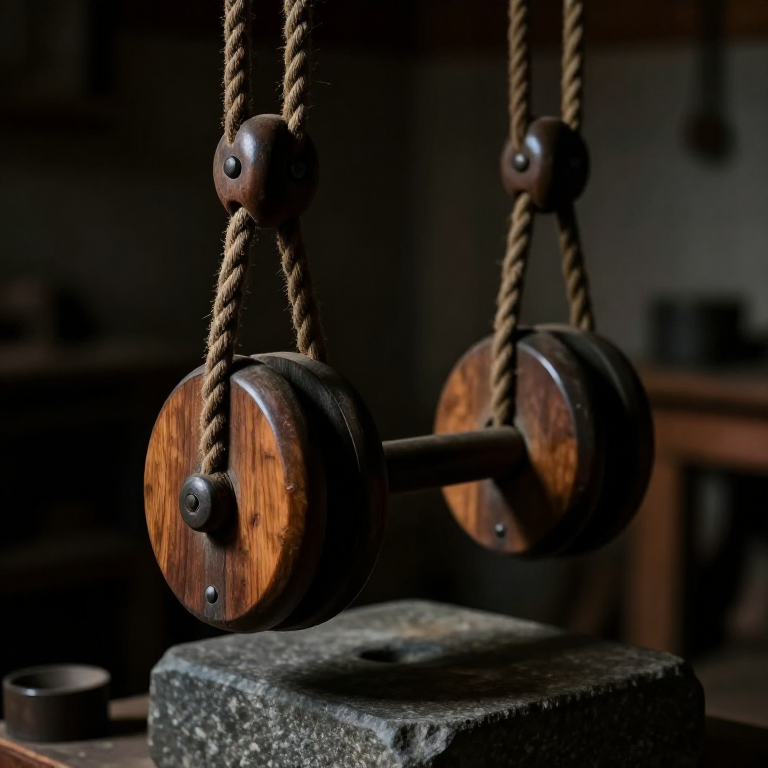


Building a Compound Pulley (Block and Tackle) — Archimedes' Force Multiplier
The compound pulley — called 'block and tackle' in the rigging tradition — is one of the six classical simple machines identified by ancient Greek and Roman engineers. The principle was systematically analysed and exploited by Archimedes of Syracuse (~287–212 BCE), who used multi-sheave compound pulleys to demonstrate that a single person could move enormous loads. According to Plutarch, Archimedes boasted: 'Give me a place to stand and I will move the Earth.' He reportedly demonstrated a compound pulley system to King Hiero II by hauling a fully loaded merchant ship out of harbour and across dry land single-handed.
The mechanical advantage of a block-and-tackle system equals the number of rope segments directly supporting the load (the moveable block). A single fixed pulley changes the direction of force but provides no mechanical advantage. Two pulleys (one fixed, one moveable) with two load-supporting rope segments give a 2:1 advantage — a 100 kg load requires only 50 kg of pull. A system with four rope segments supporting the moveable block gives 4:1 advantage — 25 kg of pull moves the same 100 kg load. The penalty is that the rope must be pulled four times as far as the load moves: mechanical advantage always trades force for distance, never creates energy from nothing.
Archimedes' compound pulleys were used extensively in ancient construction: raising column drums at temple building sites, loading cargo ships, and operating theatre machinery (the 'deus ex machina' theatrical crane that lowered gods onto the stage). The Roman army's artillery — the ballista and catapult — used rope-and-pulley systems to tension torsion springs. Medieval cathedral builders used block and tackle to lift multi-tonne stone blocks to vaulted ceilings. The system remains in daily use aboard sailing ships, in rigging theatres, and in engine hoists.
උපදෙස්
Understand the physics before selecting materials
Understand the physics before selecting materials
Before cutting timber, calculate the mechanical advantage you need and how many sheave wheels that requires. The mechanical advantage (MA) equals the number of rope segments supporting the moveable (lower) block — not the total number of pulleys. A system with two pulleys and a single moveable sheave gives MA = 2. A system with two pulleys in each block (four sheaves total) with four rope segments supporting the lower block gives MA = 4. The load force on the anchor point from which the upper block hangs equals the load weight multiplied by (MA + 1) / MA — so a 4:1 system anchored to a ceiling beam must support 125% of the load weight at the anchor. Size your anchor accordingly.
For this blueprint we build a 4:1 system: two sheave wheels in the upper (fixed) block, two sheave wheels in the lower (moveable) block. This system can lift 200 kg with 50 kg of hand force, making it practical for two people working together on construction.
Select and season timber for the sheave wheels
Select and season timber for the sheave wheels
Each sheave (grooved wheel) must be made from dense, close-grained hardwood that resists splitting under repeated rope loading. Ash, elm, and lignum vitae (when available) are ideal. Avoid straight-grained softwoods — pine and fir split along the grain when stressed by a rope digging into the sheave groove. For a 4:1 system capable of lifting 200 kg, make four sheave wheels each approximately 15–20 cm in diameter and 4 cm thick. Cut wheel blanks from a hardwood plank 5 cm thick, tracing circles with a compass.
If the timber is freshly cut, allow it to air-dry for at least four weeks before shaping — green wood shrinks and splits as it dries, and a cracked sheave under load is dangerous. Drill the axle hole at the exact centre of each blank before shaping the rim — drilling off-centre creates an eccentric wheel that causes the rope to jump the groove.
මෙම පියවර සඳහා ද්රව්ය:
 දැඩි දැව කුට්ටිය4 කැබලි
අවශ්ය මෙවලම්:
 අත් කියත
Shape the sheave wheels and cut the rope grooves
Shape the sheave wheels and cut the rope grooves
With the axle hole drilled at centre, shape the outer rim of each wheel into a smooth circle using a spokeshave or rasp, checking with a compass that the radius is uniform all the way around. Then cut the rope groove around the circumference: a V-shaped groove 1 cm deep and wide enough to accept the rope diameter with 2–3 mm clearance. For 12 mm diameter hemp rope, cut a groove 14–15 mm wide at the rim, tapering to a 5 mm rounded base. The groove must keep the rope centred on the wheel — if the groove is too narrow the rope bunches and jams; too wide and it wanders off-centre and jumps the sheave under load.
Smooth the groove with sandstone or fine abrasive to eliminate splinters that would abrade the rope. Finally, bore the central axle hole to a diameter 1 mm larger than the iron axle pin so the wheel turns freely with minimal wobble.
අවශ්ය මෙවලම්:
 සිදුරු අඬුව
 ඇඹරුම් ගල
Build the upper (fixed) block housing
Build the upper (fixed) block housing
The block housing is the wooden shell that holds two sheave wheels side by side, keeps them aligned, and provides the anchor hook and rope attachment points. Cut two side cheeks from 3 cm hardwood plank, approximately 25 cm tall and 12 cm wide. Between them, cut a central stiffener (the 'shell' block) that spaces the cheeks apart by the combined width of two sheave wheels plus 3 mm running clearance on each side. The sheaves must rotate freely inside the block without rubbing the cheeks.
Clamp and pin the assembly with iron drift pins or wooden treenails (dowels). At the top of the upper block, bore a 12 mm hole through both cheeks and the shell to accept the hook bolt — a threaded iron rod with a hook forged or bent at one end and a nut at the other. This hook is what hangs the entire upper block from the lifting beam or crane.
මෙම පියවර සඳහා ද්රව්ය:
දැඩි දැව කුට්ටිය3 කැබලි යකඩ ඇණ20 කැබලි
Build the lower (moveable) block housing
Build the lower (moveable) block housing
The lower block is constructed identically to the upper block — same cheek dimensions, same spacing — but has a hook at the bottom instead of the top, and a rope becket (an eye or loop of rope) at the top where the standing end of the rope is made fast. This becket attachment is what the running rope returns to when reeving a 4:1 system: the standing end (the 'dead' end) ties off at the lower block, and the running end exits through the upper block and leads down to the hauler's hand.
Fit the lower block with a large load hook — an iron hook with a 10 mm diameter shank, capable of bearing the full rated load of 200 kg. The hook's eye passes through the bottom of the lower block shell and is secured with a nut or cotter pin. Smooth all exterior surfaces and round all corners — a block and tackle under load swings and strikes against structures; sharp edges cut into ropes and injure hands.
මෙම පියවර සඳහා ද්රව්ය:
දැඩි දැව කුට්ටිය3 කැබලියකඩ ඇණ20 කැබලිFit the iron axle pins and mount the sheave wheels
Fit the iron axle pins and mount the sheave wheels
Each pair of sheave wheels (upper block and lower block) shares a single iron axle pin that passes through both cheeks and through the central holes of the two wheels. The pin diameter should be 8–10 mm for a 200 kg system — use the formula: for a pin in single shear, the allowable load in kg ≈ (pin diameter in mm)² × 5. A 10 mm iron pin can handle approximately 500 kg in shear, giving a safety factor of 2.5 over the design load.
Before inserting the pin, coat the sheave axle holes and the pin surface with tallow or beeswax. This acts as a bearing lubricant, reducing friction and heat under continuous use. Secure the pin ends with copper or iron cotter pins through drilled holes — never rely on a press-fit alone. Under repeated loading and vibration, a friction-held pin will walk out.
Select and prepare the rope
Select and prepare the rope
Ancient block-and-tackle systems used rope made from hemp, manila, or papyrus fibre — all natural plant fibres with excellent tensile strength relative to their weight. For a 4:1 system lifting 200 kg, the rope must be rated for at least 200 kg tension (the running end is under the full 200 kg load divided by MA = 4, but the rope itself carries this over its full length). Use a minimum 12 mm diameter three-strand laid hemp rope, which has a safe working load of approximately 200–250 kg and a breaking strength of roughly 1,000–1,200 kg.
Inspect the rope for signs of core rot (a musty smell and easy compression) and surface abrasion. Cut the rope to length: you need the distance between upper and lower blocks (the working height) multiplied by the number of rope parts (4) plus extra length for reeving around the sheaves, the becket attachment, and the tail for hauling. Seize (bind) the cut ends with whipping twine to prevent unravelling.
මෙම පියවර සඳහා ද්රව්ය:
 හණ ලණුව20 මීටර්
Reeve the rope through the block and tackle
Reeve the rope through the block and tackle
Reeving is the process of threading the rope through the sheaves in the correct sequence. For a 4:1 compound pulley with two sheaves in each block: start by making the standing (dead) end fast to the becket at the top of the lower block with a bowline knot. Lead the rope up and over the first sheave of the upper block (left side), down and under the first sheave of the lower block (left side), up and over the second sheave of the upper block (right side), down and under the second sheave of the lower block (right side). The running end exits the lower block downward toward the hauler.
The correct reeving sequence ensures the rope does not cross itself inside the blocks (which would cause grinding and jamming) and that the load is distributed evenly across all four rope parts. When correctly reeved, pulling the running end down with 50 kg of force lifts 200 kg at the lower block hook.
Anchor the upper block to a suitable support
Anchor the upper block to a suitable support
The upper block's hook must be anchored to a structure rated to bear the full load. For a 200 kg working load on a 4:1 system, the anchor point must support 200 kg (load) + the dead weight of the blocks and rope — call it 220 kg total. For a timber beam anchor, use a horizontal oak beam at least 20 cm × 20 cm cross-section, with the hook wrapped around the beam rather than hooking over a single point, to spread the load along the grain.
Never anchor to masonry joints, rusted iron hooks, or timber with visible cracks or rot. When working at height (lifting stone blocks or cargo), add a second safety anchor of equal strength beside the working one. Inspect the anchor point before every lift — load cycling fatigues materials that appear intact under visual inspection alone.
Apply tallow to the sheave grooves and axle pins
Apply tallow to the sheave grooves and axle pins
Lubrication of the sheave-to-axle interface is essential. Without lubrication, a 200 kg load on a 4:1 system creates a side-load on each axle pin of approximately 100 kg. The resulting friction heat can char the wooden sheave housing within minutes of continuous use. Pack rendered animal tallow or beeswax into the axle pin holes before assembly, and re-apply through small lubrication holes drilled through the block cheeks at the axle pin position after the blocks are assembled.
Lubricate the rope-to-sheave interface as well: run the reeved rope sections through a handful of tallow (not tar or grease — these stiffen rope fibres and cause internal wear). A well-lubricated block and tackle runs with a noticeable difference in ease — the difference between a MA of 4:1 and an effective MA closer to 3:1 due to friction losses in a dry system.
Test the system with a graduated load
Test the system with a graduated load
Before committing to a full working load, proof-test the block and tackle at 110% of the rated load. Hang a known weight from the lower block hook (water-filled containers are convenient — 1 litre of water = 1 kg). Raise the test load 10 cm off the ground and hold it for five minutes. Listen for creaking that increases over time (indicating timber deformation), inspect rope strands for tension popping (fibres breaking), and feel the axle pin temperatures through the block cheeks (warmth is acceptable; hot means friction loss is excessive and lubrication has failed).
After passing the proof test at 110%, operate the system through several complete lift-and-lower cycles to allow the rope to bed in (the strands compact and the lay tightens under initial load). The mechanical advantage is best measured directly: hang a calibrated 100 kg load and measure the hand-force required on the running end using a spring balance. A well-built 4:1 system requires 25–28 kg pull — the 3 kg excess over the theoretical 25 kg represents friction losses in the sheaves and rope.
Demonstrate the Archimedean principle with a 4:1 lift
Demonstrate the Archimedean principle with a 4:1 lift
With the system rigged and proof-tested, demonstrate the mechanical advantage to anyone doubting the mathematics. Place a 100 kg stone block on the ground beneath the lower block. Have one person hold a calibrated spring balance on the running rope end. A second person records the balance reading as the first slowly hauls. The balance should read 25–28 kg despite 100 kg being lifted — the compound pulley has reduced the required force to one-quarter. This was Archimedes' demonstration to King Hiero: not magic, but geometry made manifest in wood, rope, and bronze.
Archimedes' compound pulley represents a profound insight: the ratio of forces equals the inverse ratio of distances moved. A 4:1 mechanical advantage means the hauler's hand travels four times as far as the load rises. Energy is conserved — force × distance is constant — but force is traded for distance in whatever ratio the designer chooses. This principle, first articulated precisely by Archimedes in 'On the Equilibrium of Planes', underlies all of classical mechanics and remained the theoretical foundation of machine design until the industrial revolution.
Care and maintenance of the block and tackle
Care and maintenance of the block and tackle
After each use, ease all load off the rope and inspect the full rope length for cuts, abrasion, and kinking. A kinked rope has a permanent reduction in breaking strength at the kink point — cut out the kinked section and re-splice if it cannot be smoothed. Coil the rope in alternating clockwise and counter-clockwise half-turns (a 'figure-eight' coil) to prevent twist accumulation that causes the rope to snarl on deployment.
Store blocks in a dry location away from direct sunlight — UV degrades rope fibres and dries out wooden blocks, causing checking (surface cracks). Re-lubricate the axle pins every 20 hours of use. Inspect the block cheeks annually for delamination or crack propagation from the axle pin holes; replace cheeks if cracks extend more than one-third of the cheek width. A well-maintained block and tackle will serve for a generation without major repair.
ද්රව්ය
4- 10 කැබලිස්ථානගත
- 20 කැබලිස්ථානගත
- 20 මීටර්ස්ථානගත
- 1 කැබැල්ලස්ථානගත
සම්බන්ධිත සැලසුම්වල ද්රව්ය

සම්බන්ධ බ්ලූප්රින්ට්
මෙම බ්ලූප්රින්ට් දැනුම බෙදා ගනී — ශිල්ප ක්රම, ද්රව්ය හෝ මූලධර්ම

CC0 පොදු වසම
මෙම බ්ලූප්රින්ට් CC0 යටතේ නිකුත් කර ඇත. ඔබට අවසර නොමැතිව පිටපත් කිරීම, වෙනස් කිරීම, බෙදා හැරීම සහ භාවිතා කිරීම කළ හැක.
බ්ලූප්රින්ට් හරහා නිෂ්පාදන මිලදී ගැනීමෙන් නිර්මාතෘට සහාය වන්න නිර්මාතෘ කොමිසම විකුණුම්කරුවන් විසින් නියම කළ, හෝ මෙම බ්ලූප්රින්ට්හි නව අනුවාදයක් සාදා ආදායම බෙදා ගැනීමට ඔබේ බ්ලූප්රින්ට්හි සම්බන්ධතාවයක් ලෙස ඇතුළත් කරන්න.