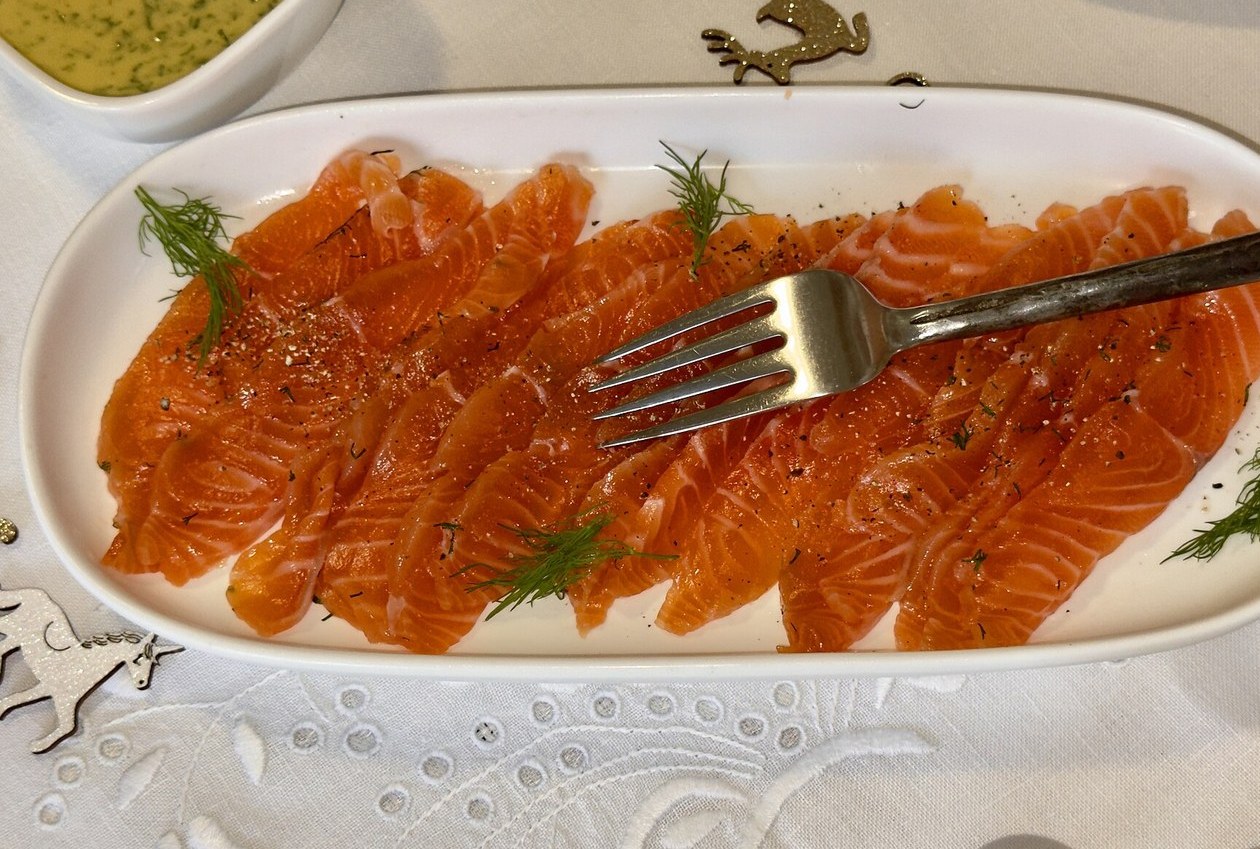


Gravlax
Gravlax means buried salmon. Nordic fishermen packed salmon in salt and buried it above the tideline, and the name outlived the hole in the ground by several centuries.
What the cure actually does is osmosis. Salt outside the fish is at a far higher concentration than the water inside its cells, so water leaves the flesh and salt enters. The tissue firms, the texture changes from raw to dense and silky, and the reduced water activity makes it hostile to most spoilage bacteria. Sugar softens the effect and balances the salt; dill and pepper are flavour.
The whole operation is therefore a controlled dehydration, and it is measurable: weigh the fillet before and after and the mass you lost is the water the salt pulled out. That single number tells you more about how the cure went than any amount of poking.
🔴 The safety point comes first, because the cure does not do what many people assume. A salt-and-sugar cure is not reliable at killing parasites. The only dependable non-heat method is freezing — the FDA specifies -20 °C or below for 7 days, or -35 °C until solid then held at -35 °C for 15 hours. Domestic freezers frequently do not hold -20 °C reliably. Use fish that has been commercially frozen to those conditions, or labelled for raw consumption. This is not optional and no curing time substitutes for it.
උපදෙස්
Start with correctly frozen fish
Start with correctly frozen fish
Buy a centre-cut fillet, skin on, that has been commercially frozen to the parasite-destruction conditions, or is sold for raw consumption. Ask, and do not assume.
Thaw in the refrigerator overnight, never at room temperature.
If you cannot confirm the freezing history, do not make this dish. Everything else here is technique; this step is the safety case.
මෙම පියවර සඳහා ද්රව්ය:
 සැමන් ෆිලේ (හම සහිත, පෙර ශීත කළ)600 ග්රෑ
අවශ්ය මෙවලම්:
 ක්ෂණික කියවීමේ උෂ්ණත්වමානය
Weigh everything, including the fish
Weigh everything, including the fish
Weigh the fillet and record it. Mix the cure at 2 parts salt to 1 part sugar by mass, at roughly 10 % of the fillet's weight in total.
Crush peppercorns coarsely into it.
Cure by percentage of fish weight, not by the spoonful. A fixed recipe over-cures a thin fillet and under-cures a thick one, and thickness varies more than weight does.
මෙම පියවර සඳහා ද්රව්ය:
 රළු මුහුදු ලුණු80 ග්රෑ
 සුදු සීනි40 ග්රෑ
අවශ්ය මෙවලම්:
 ඩිජිටල් මුළුතැන්ගෙයි තරාදිය
Pack it, weight it, and let it drain
Pack it, weight it, and let it drain
Lay a bed of dill in a dish, place the fillet skin-down, cover the flesh completely with the cure and more dill, and cover.
Put a light weight on top and set it in the refrigerator on a tilt so liquid runs away.
The fish must not sit in its own brine. Draining is what keeps it curing rather than pickling, and it is the difference between silky and soggy.
මෙම පියවර සඳහා ද්රව්ය:
 නැවුම් සුවඳ දිල්1 මිටිය
Turn daily and track the mass
Turn daily and track the mass
Turn the fillet every 12 hours, pouring off liquid and re-covering. Weigh it at each turn and plot mass against time.
Expect a steep loss in the first day that flattens out.
Cure for 48-72 hours depending on thickness.
The curve flattening is your signal that the cure has done what it can — an objective endpoint instead of a guessed one.
අවශ්ය මෙවලම්:
ඩිජිටල් මුළුතැන්ගෙයි තරාදිය ප්රස්තාර කඩදාසි
Rinse, dry and rest
Rinse, dry and rest
Rinse the cure off under cold water, pat thoroughly dry, and rest uncovered in the refrigerator for a few hours.
Expect the surface to become slightly tacky.
That rest lets the salt even out through the flesh. Sliced straight from the cure the outer millimetres are markedly saltier than the centre, and a few hours fixes it for free.
Slice thin, and compare against the control
Slice thin, and compare against the control
Slice at a shallow angle, off the skin, as thinly as you can.
Cure a second small piece at half the cure percentage and a third at double, and taste all three side by side.
Expect the light one to be soft and bland and the heavy one firm and aggressively salty.
Your preferred percentage is a number you now own, and it will not be the same as anyone else's recipe.
Compendium — the chemistry, the history and the risk
Compendium — the chemistry, the history and the risk
Water activity is the concept doing the work. Preservation by salt is not about salt being poisonous to microbes; it is about aw, the availability of water. Salt binds water so it is no longer free for microbial use, and below roughly 0.91 most spoilage bacteria stop growing. Gravlax only partly reaches that — it is a light cure, still a high-moisture food, and it is a refrigerated product with a short life, not a shelf-stable one like salt cod. That distinction matters and is often blurred.
The burial in the name was real. Medieval Scandinavian fishermen salted salmon lightly and buried it in the sand above the high-water line, where it fermented slightly as well as cured. Modern gravlax is the cure without the fermentation, and the closest surviving relative of the original is Swedish surströmming and Norwegian rakfisk, which are genuinely fermented and taste nothing like it. Gravlax is the tamed descendant of a much more assertive food.
Why the texture changes without heat. Salt disrupts the protein structure of the muscle, partly unfolding and then re-associating the myofibrillar proteins. The result resembles what heat does — opaque, firm, sliceable — without any cooking. This is the same mechanism as ceviche, where acid rather than salt does the denaturing. In neither case is the fish "cooked", and in neither case does the process make unsafe fish safe.
🔴 The parasite question, stated once more and plainly. Wild salmonids can carry nematode larvae, Anisakis among them, which cause real and painful illness. Salt curing at gravlax strength and duration is not a validated kill step. Freezing is: -20 °C or colder for 7 days, or -35 °C until solid, then held at -35 °C for 15 hours. Most home freezers run around -18 °C and cycle, which is why the standard advice is to buy fish already frozen commercially to those conditions. Farmed salmon raised on formulated feed is generally considered much lower risk, but "lower" is not "none", and the freezing requirement is the answer either way.
Also worth knowing. Pregnant people, young children, the elderly and anyone immunocompromised are usually advised against raw and lightly-cured fish altogether — Listeria is the concern there rather than parasites, and it grows at refrigerator temperatures. Keep the cure below 4 °C throughout, use clean boards kept away from other foods, and eat within a few days. Cured is not preserved.
ද්රව්ය
4- 600 ග්රෑස්ථානගත
- 80 ග්රෑස්ථානගත
- 40 ග්රෑස්ථානගත
- 1 මිටියස්ථානගත
අවශ්ය මෙවලම්
3- ස්ථානගත
- ස්ථානගත
- ස්ථානගත
සම්බන්ධිත සැලසුම්වල ද්රව්ය

මෙම සැලසුම සාදන්නේ
සම්බන්ධ බ්ලූප්රින්ට්
මෙම බ්ලූප්රින්ට් දැනුම බෙදා ගනී — ශිල්ප ක්රම, ද්රව්ය හෝ මූලධර්ම

CC0 පොදු වසම
මෙම බ්ලූප්රින්ට් CC0 යටතේ නිකුත් කර ඇත. ඔබට අවසර නොමැතිව පිටපත් කිරීම, වෙනස් කිරීම, බෙදා හැරීම සහ භාවිතා කිරීම කළ හැක.
බ්ලූප්රින්ට් හරහා නිෂ්පාදන මිලදී ගැනීමෙන් නිර්මාතෘට සහාය වන්න නිර්මාතෘ කොමිසම විකුණුම්කරුවන් විසින් නියම කළ, හෝ මෙම බ්ලූප්රින්ට්හි නව අනුවාදයක් සාදා ආදායම බෙදා ගැනීමට ඔබේ බ්ලූප්රින්ට්හි සම්බන්ධතාවයක් ලෙස ඇතුළත් කරන්න.