
Janney Coupler
Railway wagons used to be joined by a link and a pin. To couple two cars, a brakeman stood between them holding an oval link steady while several tonnes of rolling wagon closed the gap, then dropped a pin through it. Miss the moment and you lost fingers, a hand, or your life. Experienced brakemen were recognisable by their missing fingers.
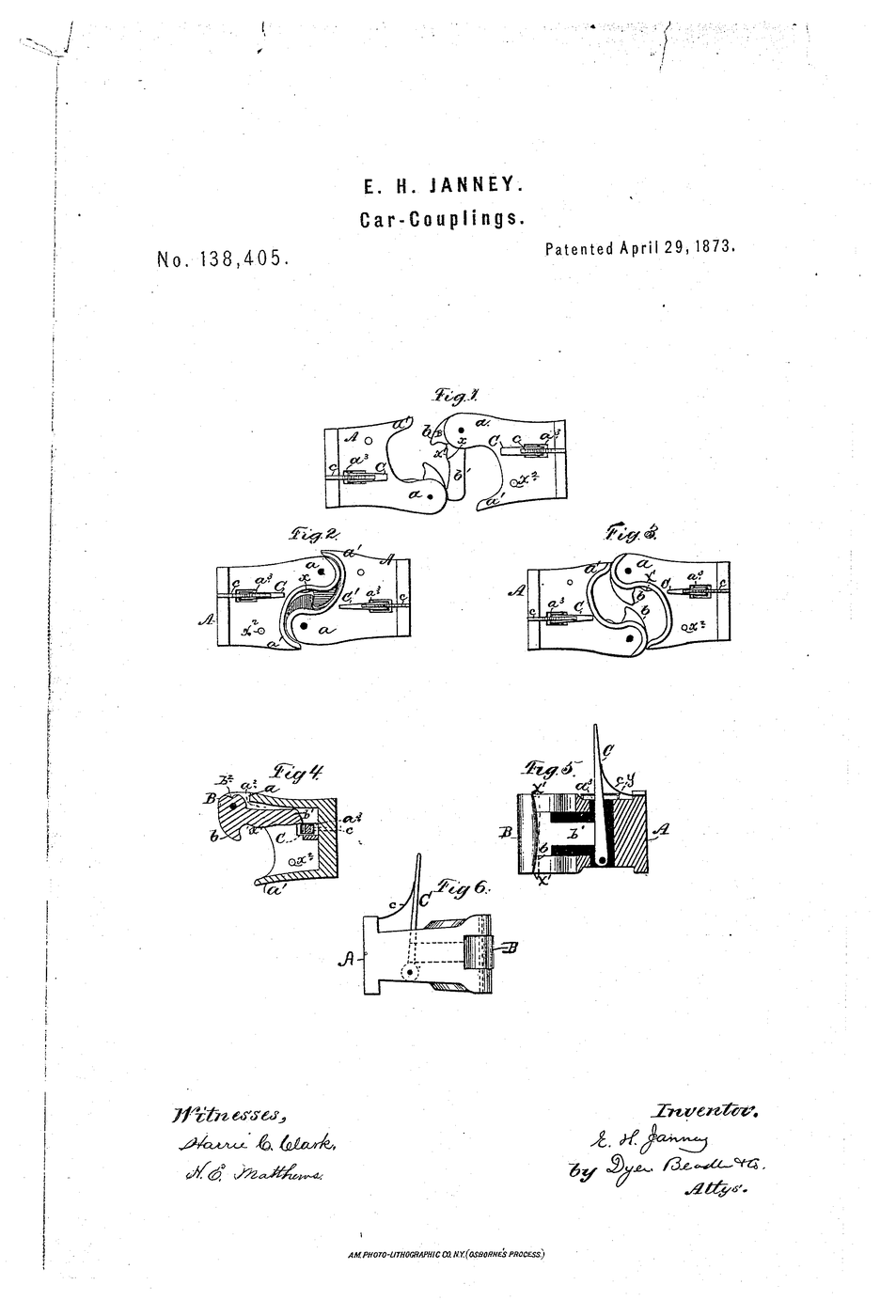
Janney's coupler removes the man from the gap. Each car carries a pivoting hook — a knuckle — held by a catch. Roll two cars together and the knuckles turn each other aside, snap past, and lock: coupled, automatically, with nobody between them. To part them, a lever at the side of the car lifts the catch.
What Janney actually claims is the combination of the hook and catch with a GUARD ARM. The guard arm is the fixed jaw beside the knuckle: it guides a misaligned car in, stops the coupling being twisted apart on a curve, and takes the buffing shock. The hook faces are curved so the cars can rise and fall over uneven track without unlocking.
US Patent 138,405, "Improvement in car-couplings", granted 29 April 1873 (filed 1 April 1873) to Eli H. Janney of Alexandria, Virginia.
උපදෙස්
Read the claim: hook plus catch plus guard arm
Read the claim: hook plus catch plus guard arm
Janney claims the combination — not the hook alone. Write down all three parts: pivoting hook, catch that holds it, and the fixed guard arm beside it.
Build the old link-and-pin first
Build the old link-and-pin first
Cut two card wagon ends with a slot in each. Make a wire link and two pins. This is the system Janney replaced — build it so you can feel the problem.
මෙම පියවර සඳහා ද්රව්ය:
 රැළි සහිත කාඩ්බෝඩ් තහඩු1 පත්රය
 සින්ක් ආලේපිත වානේ කම්බිය1 මීටර්
අවශ්ය මෙවලම්:
 අත්කම් පිහිය
Try to couple it with one hand in the gap
Try to couple it with one hand in the gap
Hold the link level in the slot and push the second wagon in, then drop the pin. Note how long your fingers must stay between the two wagons — that is the whole safety problem.
Cut two knuckles
Cut two knuckles
From heavy card cut two identical knuckles: a rounded nose with a hooked inner jaw, like a cupped hand, with a pivot hole at the back.
මෙම පියවර සඳහා ද්රව්ය:
 ඝන කඩදාසි2 පත්ර
අවශ්ය මෙවලම්:
අත්කම් පිහියCut two draw-heads with a guard arm
Cut two draw-heads with a guard arm
Cut two draw-head bodies, each with a fixed jaw — the guard arm — standing alongside where the knuckle will pivot.
මෙම පියවර සඳහා ද්රව්ය:
ඝන කඩදාසි2 පත්රඅවශ්ය මෙවලම්:
අත්කම් පිහියPivot each knuckle in its draw-head
Pivot each knuckle in its draw-head
Pin each knuckle with a brass fastener so it swings freely from fully open to closed against the guard arm.
මෙම පියවර සඳහා ද්රව්ය:
 පිත්තල කඩදාසි ඇමිණුම්2 කැබලි
Add the catch and its lifter
Add the catch and its lifter
Fit a small wire catch that drops behind each closed knuckle and locks it. Run a wire lever from the catch out to the side of the draw-head.
මෙම පියවර සඳහා ද්රව්ය:
සින්ක් ආලේපිත වානේ කම්බිය1 මීටර්Mount both on rolling wagons
Mount both on rolling wagons
Glue each draw-head to a card wagon on dowel axles so both roll freely on the table.
මෙම පියවර සඳහා ද්රව්ය:
රැළි සහිත කාඩ්බෝඩ් තහඩු2 පත්ර දැව කණු1 කැබැල්ල
අවශ්ය මෙවලම්:
 උණුසුම් ඇලවුම් තුවක්කුව
Couple them with no hands in the gap
Couple them with no hands in the gap
Open one knuckle, leave the other shut, and roll the wagons together. They turn each other, snap past and lock — hands nowhere near. Compare with step 3.
Pull hard on the coupling
Pull hard on the coupling
Tug the wagons apart by hand. The two hooks pull into each other — the harder the pull, the tighter the lock. A train's weight cannot open it.
Test the guard arm on a curve
Test the guard arm on a curve
Swing one wagon 20° off line and pull. The guard arm takes the side load and holds the knuckles square. Now cut one guard arm off and repeat — it twists and releases.
අවශ්ය මෙවලම්:
අත්කම් පිහිය කෝණමානය / කෝණ සොයනය
Test the vertical play
Test the vertical play
Lift one wagon 15 mm and lower it, coupled. The curved hook faces let the cars rise and fall over rough track without unlocking.
Uncouple from the side
Uncouple from the side
Pull the side lever to lift the catch, then roll the wagons apart. Every operation is now done from beside the train, never between the wagons.
History & Context — the coupler that stopped maiming brakemen
History & Context — the coupler that stopped maiming brakemen
The patent. US 138,405, "Improvement in car-couplings", granted 29 April 1873 to Eli H. Janney of Alexandria, Virginia, filed 1 April 1873. Janney states plainly that the invention "consists mainly in the combination of the hook and catch with a guard arm, and in certain details of construction" — the design couples under most circumstances and cannot uncouple except by deliberate action. Janney had patented an earlier version in 1868 and kept refining it; this is the one that mattered.
What it replaced was genuinely lethal. The link-and-pin coupler required a man to stand in the gap between closing wagons, guiding an iron link by hand (step 3). Crushed hands and fingers were so routine that they were treated as an ordinary cost of the job, and fatalities were common. Janney's knuckle let the cars couple themselves on impact and be released from the side (steps 9, 13). The comparison is not subtle, which is exactly why you build the old one first.
Why the guard arm is in the claim. Two hooks alone would couple, but they would also be free to twist off each other whenever the train took a curve or a wagon leaned (step 11), and every buffing shock would land on the pivot. The fixed guard arm funnels a misaligned car into place, resists the side loads on curves, and shares the compression. The curved faces then allow vertical movement without release (step 12). It is a good lesson in reading claims: the memorable part is the knuckle, but the patentable part was the combination.
How it became universal. A coupler is only useful if the wagon it meets has a compatible one, so this needed a standard, not just a good design. The Master Car Builders' Association adopted a Janney-type contour, and the US Safety Appliance Act of 1893 made automatic couplers and power brakes compulsory on American railroads — the same law that mandated the air brake. Janney reportedly allowed the contour to be used freely to help standardisation, which is a large part of why his shape won.
Where it sits. Go and look at a modern freight wagon: the AAR knuckle coupler on it is a direct descendant of this drawing, in cast steel, with the same knuckle, catch and guard arm. Much of the world's freight rolling stock still couples by pushing two of these together — and no railway worker has to put a hand between the wagons to do it.
ද්රව්ය
5- 3 පත්රස්ථානගත
- 1 මීටර්ස්ථානගත
- 2 පත්රස්ථානගත
- 2 කැබලිස්ථානගත
- 1 කැබැල්ලස්ථානගත
අවශ්ය මෙවලම්
3- ස්ථානගත
- ස්ථානගත
- ස්ථානගත
සම්බන්ධිත සැලසුම්වල ද්රව්ය

CC0 පොදු වසම
මෙම බ්ලූප්රින්ට් CC0 යටතේ නිකුත් කර ඇත. ඔබට අවසර නොමැතිව පිටපත් කිරීම, වෙනස් කිරීම, බෙදා හැරීම සහ භාවිතා කිරීම කළ හැක.
බ්ලූප්රින්ට් හරහා නිෂ්පාදන මිලදී ගැනීමෙන් නිර්මාතෘට සහාය වන්න නිර්මාතෘ කොමිසම විකුණුම්කරුවන් විසින් නියම කළ, හෝ මෙම බ්ලූප්රින්ට්හි නව අනුවාදයක් සාදා ආදායම බෙදා ගැනීමට ඔබේ බ්ලූප්රින්ට්හි සම්බන්ධතාවයක් ලෙස ඇතුළත් කරන්න.