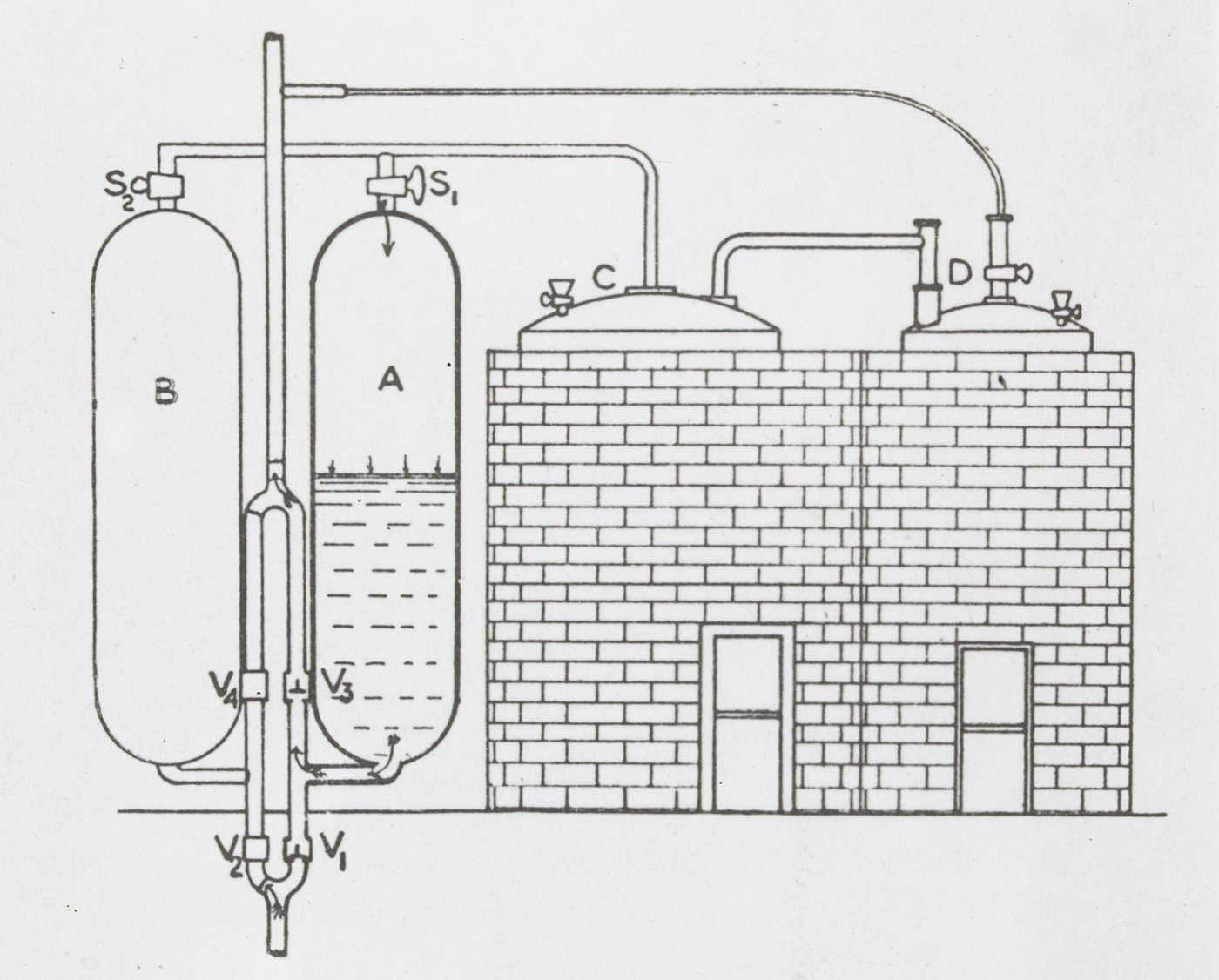


Savery's Miner's Friend
The first commercially offered steam engine had no piston, no beam, no flywheel and no moving parts at all except its taps. Thomas Savery's machine of 1698 raised water in two ways at once: it condensed steam in a closed vessel to make a vacuum that atmospheric pressure filled by pushing water up a suction pipe — and then it admitted steam again at pressure to force that same water out and upward.
Suction can only lift water about ten metres, and never that in practice. Everything above the vessel had to be pushed by steam pressure, in boilers that were soldered, unreliable and dangerous. That is the reason the machine that made Savery famous was a poor pump for the deep mines it was named after.
This blueprint builds the vacuum half at bench scale, which is safe, and explains the pressure half, which is not. No sealed vessel is ever heated here.
උපදෙස්
Read the safety rule that governs the whole build
Read the safety rule that governs the whole build
Never seal a vessel that is being heated. Everything here is either open to atmosphere or removed from the heat before it is closed. Steam scalds worse than boiling water because it gives up its latent heat on your skin.
Set up a flask, a stopper and a tube
Set up a flask, a stopper and a tube
Fit a 250 ml borosilicate flask with a stopper carrying one glass or steel tube long enough to reach well below the water in a bowl. This flask is Savery's working vessel.
මෙම පියවර සඳහා ද්රව්ය:
 Borosilicate Flask1 කැබැල්ල
අවශ්ය මෙවලම්:
 Safety Goggles
Boil 30 ml of water in the open flask
Boil 30 ml of water in the open flask
Put 30 ml of water in the flask and boil it with the stopper off until steam has been streaming out for a full minute. The point is to drive the air out and leave the flask full of steam.
අවශ්ය මෙවලම්:
 Kitchen Thermometer
Take it off the heat, then stopper it
Take it off the heat, then stopper it
Remove the flask from the heat first, then fit the stopper and put the free end of the tube under the water in the bowl. Order matters: heat off, then close.
Cool the flask and watch the water climb
Cool the flask and watch the water climb
Wet the outside of the flask with a cold cloth. The steam condenses, the pressure inside collapses, and atmospheric pressure drives water up the tube into the flask. Nothing pulls it — the outside air pushes.
Measure how much water was lifted
Measure how much water was lifted
Measure the volume drawn in and the height it climbed. Write both down: that volume times that height is the useful work one condensation stroke did.
අවශ්ය මෙවලම්:
 Measuring Cup
Repeat with a slower cooling
Repeat with a slower cooling
Run it again but let the flask cool in still air instead of with a cloth. It lifts the same water far more slowly. Savery's engines had their outsides doused with cold water for exactly this reason — condensation rate sets the cycle time.
Find the suction limit on paper
Find the suction limit on paper
Atmospheric pressure supports a column of water about 10.3 m high at sea level, and a real system with an imperfect vacuum and friction manages far less. Calculate it, then note what it means: the suction stroke alone could never empty a deep mine.
Add the second vessel on paper
Add the second vessel on paper
Sketch the full engine: a boiler, two working vessels and taps between them. While one vessel is condensing and drawing water up, the other is receiving steam and forcing its water out. Alternating them gives something close to continuous delivery.
Trace the cycle valve by valve
Trace the cycle valve by valve
Write out the four positions of the taps in order: steam to vessel, steam shut and vessel cooled, water drawn up, steam readmitted to force it out. The engine has no other moving parts, so this list is the entire machine.
Mark where the pressure danger sits
Mark where the pressure danger sits
On the sketch, mark the boiler and the forcing vessel. These are the parts that had to hold pressure, in an age of soldered seams and no reliable safety valve — and they are the reason the real machine is documented here rather than built.
History & Context
History & Context
1698, and a very broad patent. Thomas Savery patented his engine for "raising water by the impellent force of fire" in 1698 and published The Miner's Friend setting out its use. Parliament later extended the patent's life by statute, and its wording was wide enough to cover essentially any engine raising water by fire. That single legal fact shaped British engine building for a generation.
Newcomen worked under it. Thomas Newcomen's atmospheric engine of 1712 is a different and far better machine — it has a piston, a beam, and separates the water being pumped from the steam doing the work — but it fell inside Savery's patent, so Newcomen never held a patent of his own and worked in partnership with the Savery interest. The commonly repeated "Newcomen's patent" is a myth, and it is worth correcting whenever the story is told.
Why the Miner's Friend was a poor friend to miners. The suction stroke is capped by atmospheric pressure at around ten metres in theory and less in practice. Anything deeper had to be lifted by steam pressure directly on the water surface, which meant boiler pressures the metallurgy of 1700 could not safely hold. Savery engines burst. They were also thermally wasteful, because every cycle heated and cooled the same vessel. They found real use pumping water in waterworks and on a modest scale, not clearing deep mines.
What it contributed anyway. Savery's machine is the first steam engine sold as a product rather than demonstrated as a curiosity, and it established the central move that the whole eighteenth century built on: condense steam, get a vacuum, let the atmosphere do the work. Newcomen put a piston in that vacuum. Watt then noticed that condensing in the working cylinder wastes most of the heat, and put the condenser somewhere else. Each step is a direct answer to a flaw in the one before, and the chain starts here.
ද්රව්ය
1- 1 කැබැල්ලස්ථානගත
අවශ්ය මෙවලම්
3- ස්ථානගත
- ස්ථානගත
- ස්ථානගත
CC0 පොදු වසම
මෙම බ්ලූප්රින්ට් CC0 යටතේ නිකුත් කර ඇත. ඔබට අවසර නොමැතිව පිටපත් කිරීම, වෙනස් කිරීම, බෙදා හැරීම සහ භාවිතා කිරීම කළ හැක.
බ්ලූප්රින්ට් හරහා නිෂ්පාදන මිලදී ගැනීමෙන් නිර්මාතෘට සහාය වන්න නිර්මාතෘ කොමිසම විකුණුම්කරුවන් විසින් නියම කළ, හෝ මෙම බ්ලූප්රින්ට්හි නව අනුවාදයක් සාදා ආදායම බෙදා ගැනීමට ඔබේ බ්ලූප්රින්ට්හි සම්බන්ධතාවයක් ලෙස ඇතුළත් කරන්න.