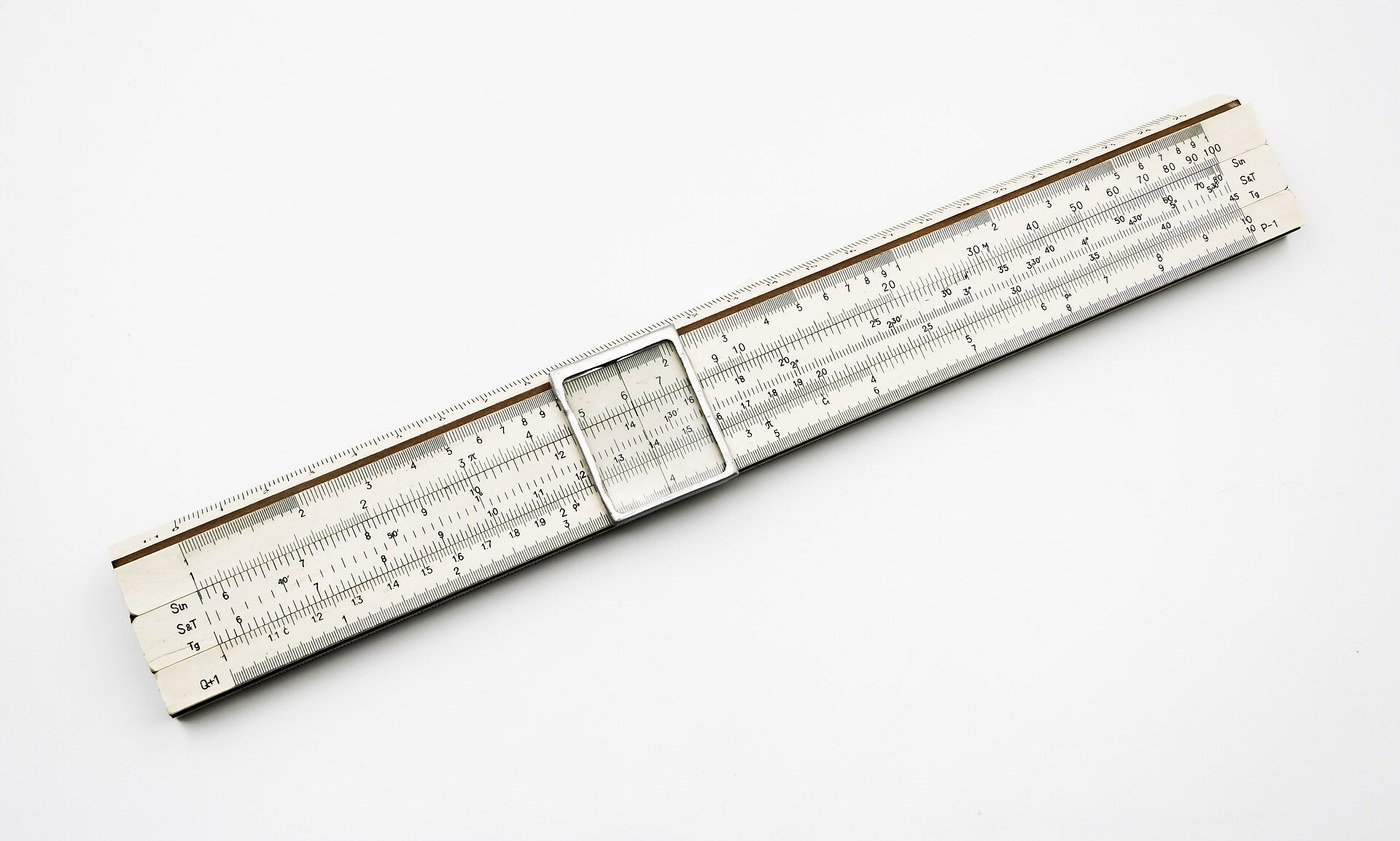


Slide Rule
Adding two lengths is trivial: lay one ruler against another and read off the total. The slide rule's insight is that if the marks are spaced by the logarithm of each number instead of by the number itself, then physically adding two lengths multiplies the numbers they represent.
The machine does not know any arithmetic. It cannot add, it has no moving parts beyond a sliding strip, and it needs no power. It converts multiplication into sliding, because logarithms convert multiplication into addition — and that identity is doing all the work.
Every aircraft, bridge and rocket up to about 1975 was designed on one of these. Apollo astronauts carried them. Make one and the trick stops being abstract.
උපදෙස්
Choose a scale length and stick to it
Choose a scale length and stick to it
Pick a working length — 250 mm is a good size. Every mark on every scale is measured from this one number, so decide it now.
අවශ්ය මෙවලම්:
 රූලක්
රූලක්Compute the position of each mark
Compute the position of each mark
The mark for a number n sits at L × log₁₀(n) from the left end. For n = 2 on a 250 mm scale that is 250 × 0.301 = 75.3 mm.
Tabulate positions for 1 through 10
Tabulate positions for 1 through 10
Work out and write down all the main positions before marking anything. Note that 1 lands at 0 mm and 10 at the full length — the scale is one decade.
Notice the marks crowd toward the right
Notice the marks crowd toward the right
The gap from 1 to 2 is huge; from 9 to 10 it is tiny. That uneven spacing IS the logarithm, drawn to scale, and it is the whole reason the device works.
Subdivide each interval
Subdivide each interval
Add intermediate marks — tenths between 1 and 2, coarser divisions higher up. Each subdivision also goes at L × log of its value, never evenly spaced.
Cut three strips of hardwood or acrylic
Cut three strips of hardwood or acrylic
Cut two outer strips and one slider, all the same length, with the slider a snug running fit between the outer two.
මෙම පියවර සඳහා ද්රව්ය:
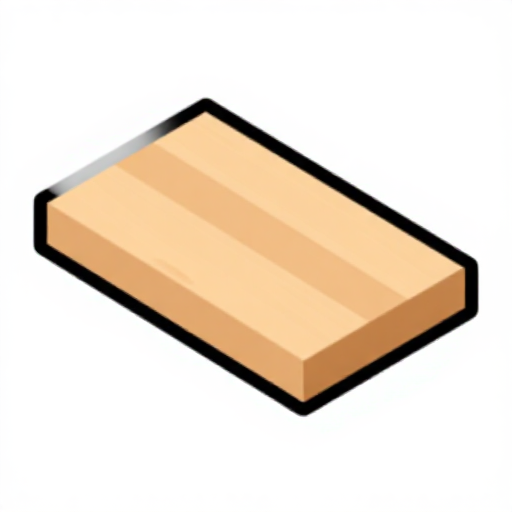 දෘඪ දැව පුවරුව1 කැබැල්ල
Groove the outer strips to capture the slider
Groove the outer strips to capture the slider
Cut a shallow rebate along each outer strip so the slider is held but moves freely. Tight enough not to rattle, loose enough not to bind.
Mark identical scales on body and slider
Mark identical scales on body and slider
Transfer the same scale onto the fixed body (the D scale) and onto the slider (the C scale), aligned along the meeting edge.
Label both ends of every scale
Label both ends of every scale
Mark 1 at each end — the left index and the right index. You will need both, and knowing which you used decides the answer.
Multiply: slide index to the first number
Multiply: slide index to the first number
To find 2 × 3, put the slider's left index against 2 on the body scale.
Read the answer under the second number
Read the answer under the second number
Find 3 on the slider and read what lies beneath it on the body: 6. You have physically added log 2 and log 3.
Use the other index when you run off the end
Use the other index when you run off the end
For 4 × 6 the answer falls past the right end. Slide the RIGHT index to 4 instead and read under 6 — you get 2.4, meaning 24.
Track the decimal point yourself
Track the decimal point yourself
The rule gives digits, never magnitude — 2.4, 24 and 240 look identical on it. Estimate the size in your head; this is the discipline every engineer who used one had to keep.
Divide by running the process backwards
Divide by running the process backwards
Set the divisor on the slider against the dividend on the body, then read the quotient at the slider's index. Subtracting lengths divides.
Compendium — arithmetic turned into geometry
Compendium — arithmetic turned into geometry
The identity underneath. log(a × b) = log(a) + log(b). Napier published logarithms in 1614 precisely to convert multiplication into addition, because addition is enormously easier by hand. Edmund Gunter turned that into a physical scale around 1620 — a logarithmic line you worked with dividers. The step to two sliding scales, so no dividers are needed, is credited to William Oughtred around 1622.
The priority quarrel is real. Oughtred's pupil Richard Delamain published a description of a circular slide rule in 1630, before Oughtred published his own in 1632, and the two accused each other of theft in print for years. Oughtred is generally credited on the strength of earlier unpublished work; Delamain published first. Presenting either as the sole undisputed inventor misrepresents the record.
Precision, and its cost. A slide rule gives about three significant figures — you read between the marks by eye. That was accepted because engineering inputs are rarely known better than that, and because the alternative was hours with log tables. The blind spot is the decimal point: the device tracks ratios and not magnitudes, so the user must keep the order of magnitude in their head. Engineers of the era were consequently very good at estimation, a skill the pocket calculator quietly removed.
How it ended. The slide rule ran the technical world for three and a half centuries and died in about five years. HP's HP-35 pocket scientific calculator arrived in 1972, and by 1975 slide rule production had essentially stopped. Keuffel & Esser reportedly donated its last rule to the Smithsonian. Few technologies with that long a run have been displaced that abruptly.
සම්බන්ධිත සැලසුම්වල ද්රව්ය

මෙම සැලසුම සාදන්නේ
CC0 පොදු වසම
මෙම බ්ලූප්රින්ට් CC0 යටතේ නිකුත් කර ඇත. ඔබට අවසර නොමැතිව පිටපත් කිරීම, වෙනස් කිරීම, බෙදා හැරීම සහ භාවිතා කිරීම කළ හැක.
බ්ලූප්රින්ට් හරහා නිෂ්පාදන මිලදී ගැනීමෙන් නිර්මාතෘට සහාය වන්න නිර්මාතෘ කොමිසම විකුණුම්කරුවන් විසින් නියම කළ, හෝ මෙම බ්ලූප්රින්ට්හි නව අනුවාදයක් සාදා ආදායම බෙදා ගැනීමට ඔබේ බ්ලූප්රින්ට්හි සම්බන්ධතාවයක් ලෙස ඇතුළත් කරන්න.