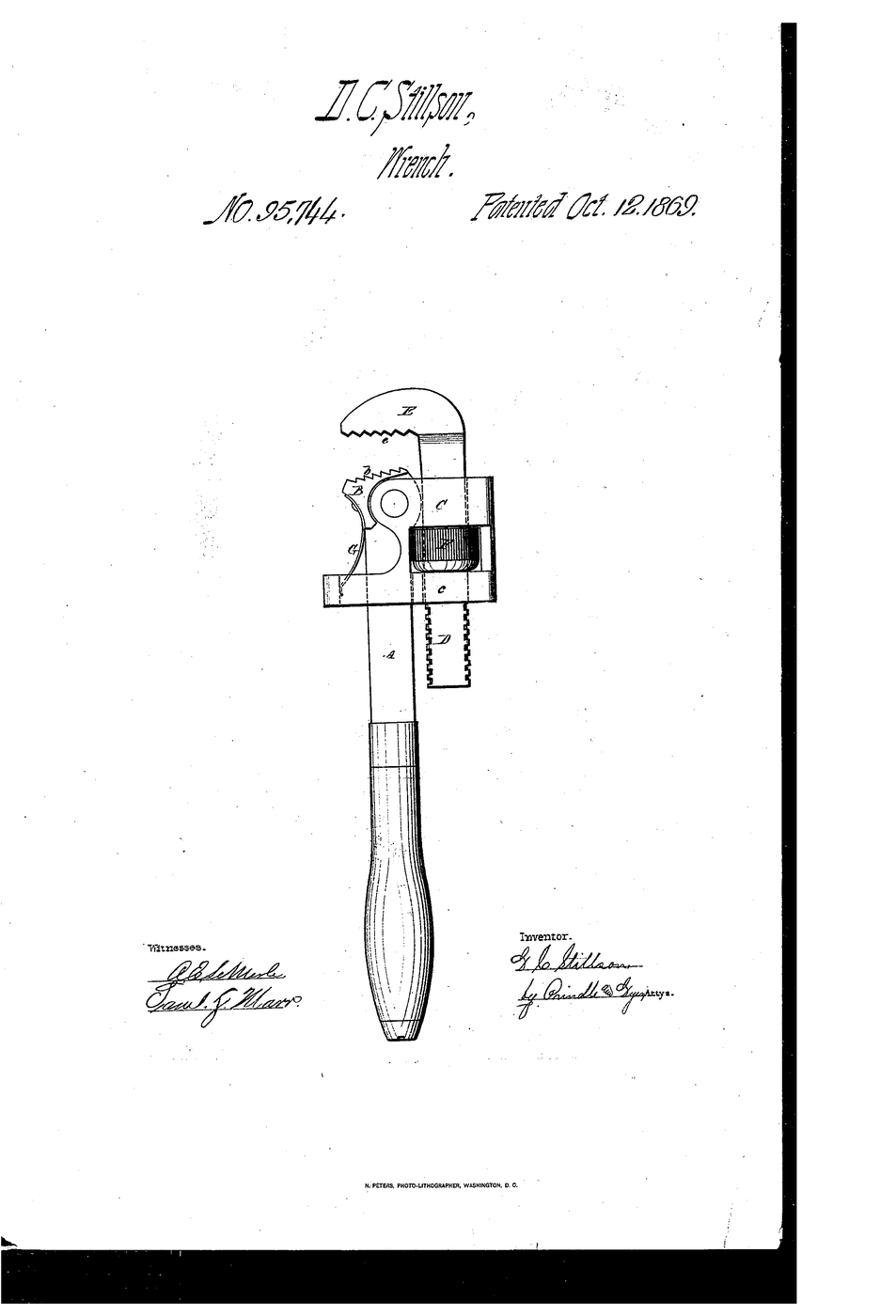


Stillson Pipe Wrench
A spanner grips a nut by its flats. A pipe has no flats — it is a smooth cylinder, and anything that grips it must bite into it. Grip too gently and the wrench spins uselessly round the pipe; grip hard enough not to slip and you crush the pipe flat before it turns.
Stillson's wrench solves this by being deliberately loose. The movable jaw is not clamped rigid; it sits in a frame free to rock backwards. Pull on the handle and that rocking cants the jaws towards each other, so the harder you pull, the harder it bites — and when you release, it lets go.
The grip is proportional to the load, and nobody has to judge it. Light pressure to position, heavy pressure to turn, and no setting in between to get wrong.
US Patent 95,744, modestly titled "Improvement in wrench", granted 12 October 1869 to Daniel C. Stillson. He claims a pivoting frame whose recess lets it "swing to the rear, by which means the relative angles of the inner faces of the jaws are changed".
උපදෙස්
Read US 95,744 and find the word swing
Read US 95,744 and find the word swing
Stillson claims a frame recessed so it can swing to the rear, changing the angle between the jaw faces. The looseness is claimed on purpose — it is not slop.
Try to turn a pipe with an adjustable spanner
Try to turn a pipe with an adjustable spanner
Clamp a smooth tube and attack it with a parallel-jawed spanner. It slips. Tighten until it does not slip and inspect the tube — you have started to flatten it.
Cut the shank and fixed jaw
Cut the shank and fixed jaw
Form a steel bar into a handle with a fixed jaw at the head. This jaw's teeth will rake forwards, toward the handle.
මෙම පියවර සඳහා ද්රව්ය:
 මෘදු වානේ වටකුරු දණ්ඩ1 කැබැල්ල
අවශ්ය මෙවලම්:
 පැතලි කට සන්නස
Cut teeth into the fixed jaw
Cut teeth into the fixed jaw
File angled teeth leaning towards the handle. They must dig in when the pipe tries to rotate backwards out of the jaw.
අවශ්ය මෙවලම්:
 ඉඳිකටු කටු කට්ටලය
Make the movable jaw with opposite rake
Make the movable jaw with opposite rake
Cut a second jaw with teeth raking rearwards, the other way. The two jaws bite in opposing directions, which is what stops the pipe rotating either way inside them.
Thread the movable jaw's shank
Thread the movable jaw's shank
Give the movable jaw a threaded stem and fit an adjusting nut so it slides up and down to suit different pipe diameters.
Build the frame with a deliberate recess
Build the frame with a deliberate recess
Make the frame that carries the movable jaw, and recess its lower portion so the frame can rock backwards a few degrees. Do not build this tight — a rigid frame will not work.
Fit the return spring
Fit the return spring
Add a light spring that holds the frame forward at rest. It only has to reset the jaw when the load comes off.
මෙම පියවර සඳහා ද්රව්ය:
 තෙරපුම් කම්බි කට්ටලය1 කට්ටලය
Set the jaws loosely on a pipe
Set the jaws loosely on a pipe
Adjust the nut so the wrench slips onto the tube with visible play. It should feel too loose to work.
Pull the handle and watch the jaws close
Pull the handle and watch the jaws close
Apply force. The frame rocks, the jaw angle changes, and the teeth bite. Nothing was tightened by hand — the load did it.
Measure the grip against the pull
Measure the grip against the pull
Pull with a spring scale at two different forces and note when the pipe starts to turn. Grip rises with load, which is the claim.
අවශ්ය මෙවලම්:
 බල මානය (කම්බි තරාදිය)
Pin the frame rigid and try again
Pin the frame rigid and try again
Wedge the frame so it cannot rock, then pull. It slips or crushes, exactly like step 2. Remove the wedge before continuing.
Release and lift it off
Release and lift it off
Let go of the handle. The spring returns the frame, the jaws relax, and the wrench lifts off without adjustment — the other half of the self-tightening bargain.
Turn the wrench the other way round
Turn the wrench the other way round
Try to drive the pipe in the opposite direction. It ratchets and slips: the tooth rake makes the wrench directional, and you reposition rather than reverse.
Inspect the pipe for tooth marks
Inspect the pipe for tooth marks
Look at the tube. It is scored but round. The wrench bit locally instead of squeezing globally — that is the difference between marking a pipe and ruining it.
History & Context — the inventor who was actually paid
History & Context — the inventor who was actually paid
The patent. US 95,744, "Improvement in wrench", granted 12 October 1869 to Daniel C. Stillson. Application and grant share a date, so only the grant is cited.
Why looseness is the invention. Every intuition says a gripping tool should be rigid and tight. Stillson's is neither, and that is precisely why it works on a cylinder. A rigid parallel jaw has to be tightened by judgement to a force that is simultaneously enough to prevent slip and little enough not to deform the pipe — a window that is narrow, varies with wall thickness, and cannot be felt through a handle. The rocking frame replaces judgement with geometry: applied torque cants the jaws, cant increases bite, so grip is always proportional to what is being asked of it. Step 12 is the decisive test, and it is worth doing, because the failure of the rigid version is what makes the loose version look like a good idea rather than a sloppy one.
The two tooth rakes are the second half. Teeth on the fixed jaw lean one way and teeth on the movable jaw lean the other, so the pipe is caught between opposed bites. That is also why the tool is directional — step 14 — and why plumbers reposition a Stillson rather than reversing it. It is a ratchet made of friction rather than pawls.
Stillson made money, and that is rare in this collection. He was a steamfitter at the Walworth Manufacturing Company in Boston. The often-repeated account is that he showed the idea to the firm, was told to build a prototype and to twist it until something broke, and produced a wrench that tore the pipe apart while the tool survived. Walworth manufactured it under licence and Stillson is reported to have received royalties amounting to something on the order of $80,000 — a substantial fortune for the period. Set that against Simon Ingersoll selling his rock-drill rights for enough to buy a market stall, or Langstroth failing to defend his hive patent, both elsewhere in this programme. Having a good patent and being paid for it are separate achievements, and Stillson managed both.
What has changed since. Almost nothing. The modern pipe wrench is the same tool in better steel, and the geometry in your hand is Stillson's. Its descendants — the chain wrench, the strap wrench, the one-way roller clutch — all reuse the same principle of load-proportional grip. Its limitations are also unchanged: it marks the work, it is directional, and it is the wrong tool for anything with flats or a finished surface, which is why using a Stillson on a chromed fitting is a recognised way to identify someone in a hurry.
ද්රව්ය
2- 1 කැබැල්ලස්ථානගත
- 1 කට්ටලයස්ථානගත
අවශ්ය මෙවලම්
3- ස්ථානගත
- ස්ථානගත
- ස්ථානගත
මෙම සැලසුම සාදන්නේ
සම්බන්ධ බ්ලූප්රින්ට්
මෙම බ්ලූප්රින්ට් දැනුම බෙදා ගනී — ශිල්ප ක්රම, ද්රව්ය හෝ මූලධර්ම
CC0 පොදු වසම
මෙම බ්ලූප්රින්ට් CC0 යටතේ නිකුත් කර ඇත. ඔබට අවසර නොමැතිව පිටපත් කිරීම, වෙනස් කිරීම, බෙදා හැරීම සහ භාවිතා කිරීම කළ හැක.
බ්ලූප්රින්ට් හරහා නිෂ්පාදන මිලදී ගැනීමෙන් නිර්මාතෘට සහාය වන්න නිර්මාතෘ කොමිසම විකුණුම්කරුවන් විසින් නියම කළ, හෝ මෙම බ්ලූප්රින්ට්හි නව අනුවාදයක් සාදා ආදායම බෙදා ගැනීමට ඔබේ බ්ලූප්රින්ට්හි සම්බන්ධතාවයක් ලෙස ඇතුළත් කරන්න.