ART
BEAUTY & WELLNESS
CRAFT
CULTURE & HISTORY
ENTERTAINMENT
ENVIRONMENT
FOOD & DRINKS
GREEN FUTURE
REVERSE ENGINEERING
SCIENCES
SPORTS
TECHNOLOGY
WEARABLES

Understanding Scandium from Thortveitite — The Rare Metal That Strengthens Aluminum
මධ්යම
Instructions
1
1
Understand Scandium's Place in the Periodic Table
Scandium (Sc, atomic number 21) is the first transition metal and the lightest rare earth element. Lars Fredrik Nilson discovered it in 1879 from euxenite and gadolinite ores, confirming Mendeleev's 1871 prediction of 'eka-boron.' Despite being more abundant than lead in Earth's crust, scandium rarely concentrates into minable deposits — it disperses across hundreds of minerals at trace levels.
2
2
Identify Thortveitite
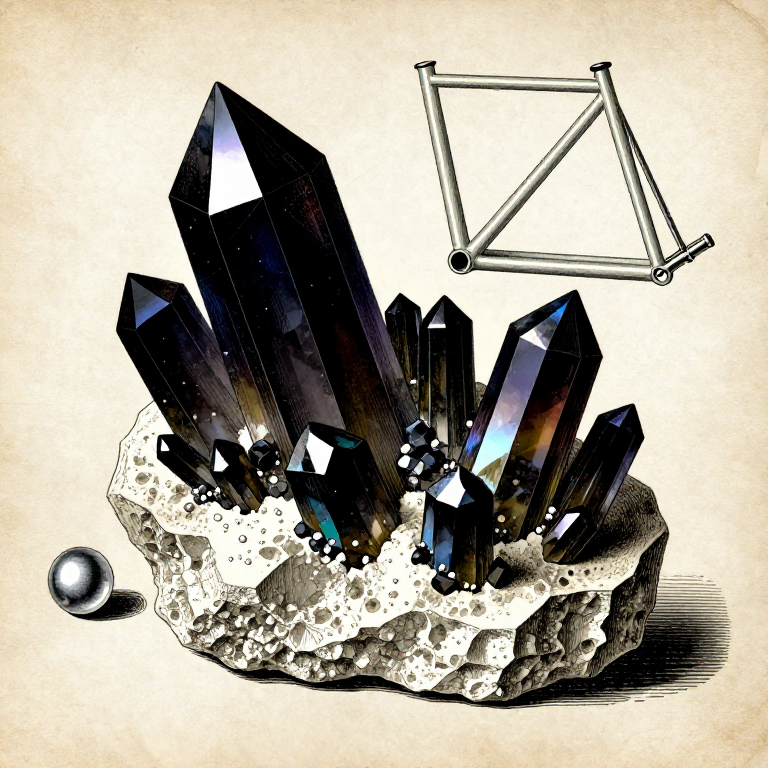
Thortveitite (Sc₂Si₂O₇) is the only mineral with scandium as a major component, containing up to 45% Sc₂O₃. It forms gray-green to black prismatic crystals in granite pegmatites, often alongside beryl and columbite. First described in 1911 from Iveland, Norway, it remains extremely rare — most specimens come from Scandinavia, Madagascar, and parts of Central Asia. Mohs hardness is 6.5.
Tools needed:
Hand Lens (10x Magnification)3
3
Survey Alternative Scandium Sources
Most commercial scandium comes as a byproduct of other mining operations, not from thortveitite. Red mud (bauxite refining waste) contains 50-100 ppm scandium. Uranium mill tailings, titanium dioxide production waste, and nickel laterite ores all carry recoverable scandium. China, the Philippines, and Russia produce most of the world's scandium — total global production is only 15-25 tonnes per year.
4
4
Test Mineral Hardness and Streak
If you have a thortveitite or euxenite specimen, test hardness: thortveitite scratches feldspar (6) but is scratched by quartz (7). Its streak is white to pale gray. Under shortwave UV light, some scandium minerals fluoresce weak yellow-green. Density is notably high at 3.57 g/cm³ — heavier than most silicates, which helps distinguish it from similar-looking minerals.
Tools needed:
Hand Lens (10x Magnification)
Streak Plate (Unglazed Porcelain)
Precision Scale (0.01g)5
5
Understand Acid Leaching Extraction
Industrial scandium extraction uses acid leaching: ore or byproduct material is dissolved in hydrochloric or sulfuric acid, then scandium is separated by solvent extraction using organophosphorus compounds (D2EHPA or TBP). The key challenge is separating scandium from chemically similar elements — iron, aluminum, and other rare earths. Multiple extraction stages are needed to reach 99.9% purity.
Materials for this step:
Hydrochloric Acid (10% dilute)
Sulfuric Acid (96% concentrated)Tools needed:
Chemical Splash Goggles
Chemical-Resistant Gloves6
6
Learn Scandium-Aluminum Alloy Properties
Adding just 0.1-0.5% scandium to aluminum creates alloys with remarkable properties: grain refinement eliminates hot cracking during welding, yield strength increases 50-100%, and corrosion resistance improves significantly. Al-Sc alloys can be welded without losing strength — unlike most aerospace aluminum alloys. The Soviets pioneered this technology for MiG-29 and MiG-31 fighter aircraft in the 1980s.
7
7
Examine Solid Oxide Fuel Cell Applications
Scandia-stabilized zirconia (ScSZ) is the highest-performing electrolyte material for solid oxide fuel cells (SOFCs). Adding 10 mol% Sc₂O₃ to ZrO₂ creates an ionic conductor that operates efficiently at 600-800°C — about 200°C lower than yttria-stabilized zirconia. This temperature reduction doubles cell lifespan and allows cheaper steel interconnects instead of exotic ceramics.
8
8
Understand Scandium in Lighting
Scandium iodide (ScI₃) is added to metal halide lamps to produce light that closely matches natural sunlight — with a color rendering index above 95. Stadium floodlights, film studio lighting, and high-end aquarium lamps use scandium-doped bulbs. The scandium atoms emit across the visible spectrum when excited, producing the most natural artificial light available before LED technology.
9
9
Compare Scandium Economics
Scandium oxide (Sc₂O₃) trades at $1,500-4,000 per kilogram — roughly 10 times the price of gold by weight. This extreme price limits adoption: only applications where tiny amounts create transformative improvements justify the cost. A bicycle frame using Al-Sc alloy adds only 10 grams of scandium but gains 20% more stiffness. As production scales from laterite ores, prices are expected to fall below $1,000/kg.
10
10
Document Findings and Future Potential
Record specimen characteristics, hardness, streak, and density measurements. Scandium sits at the intersection of aerospace materials, clean energy, and advanced manufacturing. With only 25 tonnes produced annually but reserves estimated at millions of tonnes in laterites and red mud, scandium's constraint is economics, not geology. As extraction technology improves, this element may transform aluminum the way chromium transformed steel.
Tools needed:
Precision Scale (0.01g)Materials
2- ස්ථානගත
- ස්ථානගත
Tools Required
5- ස්ථානගත
- ස්ථානගත
Connected Blueprint Materials
CC0 Public Domain
This blueprint is released under CC0. You are free to copy, modify, distribute, and use this work for any purpose, without asking permission.
Support the Maker by purchasing products through their Blueprint where they earn a Maker Commission set by Vendors, or create a new iteration of this Blueprint and include it as a connection in your own Blueprint to share revenue.