
Recognizing Silicon in Nature — From Flint Nodules to Quartz Crystals
Silicon (Si, element 14) is the second most abundant element in Earth's crust after oxygen, making up 27.7% by mass. Together, silicon and oxygen form silicates — the mineral family that constitutes over 90% of all rocks. Yet silicon is never found as a free element in nature because it bonds so strongly to oxygen. Every grain of sand, every piece of flint, every quartz crystal, every clay particle is a silicon compound. Humans have used silicon minerals since the very first stone tools over 3 million years ago, making silicon the element with the longest continuous use in human history.
The element was first isolated by Jöns Jacob Berzelius in 1824 by heating potassium fluorosilicate (K₂SiF₆) with metallic potassium. He named it 'silicium' from Latin 'silex' (flint). The pure element is a hard, brittle, steel-grey metalloid with a diamond cubic crystal structure — each silicon atom bonds to four neighbors in a tetrahedral arrangement, creating the semiconductor properties that power every computer chip on Earth. But silicon's importance began long before electronics.
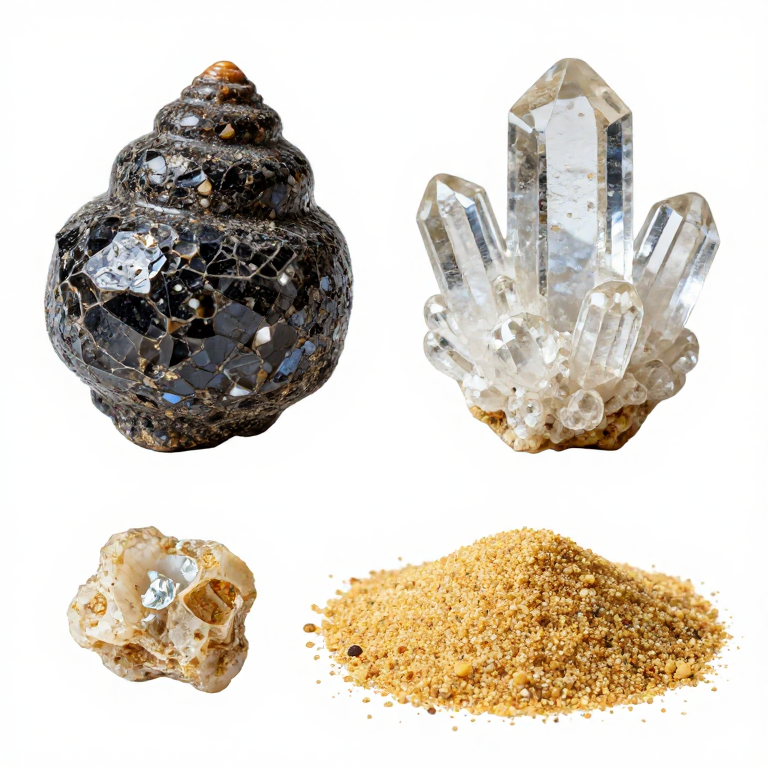
This blueprint teaches you to identify silicon's three most important natural forms — flint (cryptocrystalline SiO₂), quartz (crystalline SiO₂), and sand (weathered quartz grains) — and understand why each form behaves differently despite being the same chemical compound. These three materials gave humanity cutting tools, fire-starting, glass, ceramics, concrete, and eventually the semiconductor revolution.
ညွှန်ကြားချက်များ
Understand silicon's properties and place in the periodic table
Understand silicon's properties and place in the periodic table
Silicon (Si, element 14) sits in Group 14 (carbon group), Period 3. It has an atomic weight of 28.086 and electron configuration [Ne] 3s² 3p². As a metalloid, silicon shares properties with both metals and nonmetals: it is hard and brittle like a nonmetal, but conducts electricity (poorly) like a metal — this makes it a semiconductor. Pure silicon has a density of 2.33 g/cm³, melts at 1414 °C, and crystallizes in the same diamond cubic structure as carbon (diamond).
Silicon forms four covalent bonds, identical to carbon, but silicon-oxygen bonds (Si–O, 452 kJ/mol) are among the strongest in nature. This is why SiO₂ (silica) is so stable and so ubiquitous. In nature, silicon occurs almost exclusively as silicon dioxide (SiO₂) or silicates (SiO₄⁴⁻ tetrahedra linked in chains, sheets, or frameworks). The incredible variety of silicate minerals — from feldspars to micas to clays to zeolites — arises from different ways of connecting these SiO₄ tetrahedra and substituting aluminum, iron, calcium, and other cations into the structure.
Locate and identify flint nodules in chalk or limestone formations
Locate and identify flint nodules in chalk or limestone formations
Flint is cryptocrystalline silicon dioxide — SiO₂ in microscopic quartz crystals cemented together with amorphous silica. It forms as nodules within chalk and limestone deposits, created when silica from dissolved sponge spicules and diatom shells precipitated around organic nuclei on the ancient seafloor. Flint nodules are typically dark grey to black (colored by organic inclusions), with a rough white cortex (weathered rind) on the outside.
Look for flint in exposed chalk cliffs, limestone quarries, river gravels downstream from chalk formations, and plowed agricultural fields in chalk-bedrock regions. Flint is distinctively heavy for its size (density 2.6 g/cm³), has a waxy to glassy luster on fresh surfaces, and produces sharp-edged conchoidal fractures when struck — the property that made it humanity's most important toolmaking material for over 3 million years.
ဤအဆင့်အတွက် ကုန်ကြမ်းများ:
 မီးကျောက်တုံး
လိုအပ်သော ကိရိယာများ:
 ဘူမိဗေဒတူ
Break a flint nodule to examine its conchoidal fracture
Break a flint nodule to examine its conchoidal fracture
Place a flint nodule on a firm surface outdoors. Strike it firmly with a hammerstone or geological hammer. Flint breaks with conchoidal fracture — smooth, curved surfaces radiating from the point of impact, like the inside of a seashell (Latin 'concha'). This fracture pattern occurs because flint has no crystal planes for cracks to follow; instead, the fracture front radiates as a cone from the impact point.
Examine the fresh fracture surface: it should be smooth, glassy, and translucent at thin edges. The color ranges from dark grey to brown to honey-yellow depending on trace mineral content. Hold a thin flake up to light — quality flint is semi-translucent. This conchoidal fracture is what allowed our ancestors to create razor-sharp edges by controlled flaking, a technique called knapping.
SAFETY: Flint flakes are sharper than surgical steel. Wear eye protection. Handle fresh flakes by their thick edges only.
ဤအဆင့်အတွက် ကုန်ကြမ်းများ:
မီးကျောက်တုံးလိုအပ်သော ကိရိယာများ:
 ရိုက်ကျောက်
 ဓာတုစင်ကာကွယ်ရေးမျက်မှန်
Strike flint against steel to produce sparks
Strike flint against steel to produce sparks
Hold a piece of flint with a sharp edge in one hand and strike it downward against a piece of high-carbon steel (a file, the back of a knife blade, or a traditional fire steel). Hot sparks fly from the steel — not the flint. The sharp, hard flint edge (Mohs 7) shaves tiny particles off the softer steel (Mohs 5-6). These microscopic steel shavings are heated by friction above their ignition temperature and burn in air as they fly, creating the visible sparks.
This is why flint and steel fire-starting works: the sparks are burning iron particles at approximately 1500 °C. Before steel existed, Neolithic peoples used iron pyrite (FeS₂) against flint — the same principle, but with pyrite sparks instead of steel sparks. The flint-and-steel method dominated fire-starting from the Iron Age through the early 19th century, when friction matches replaced it.
ဤအဆင့်အတွက် ကုန်ကြမ်းများ:
မီးကျောက်တုံးFind and identify crystalline quartz
Find and identify crystalline quartz
Quartz is crystalline silicon dioxide — the same SiO₂ as flint, but with atoms arranged in a long-range ordered crystal lattice rather than a cryptocrystalline mass. Look for quartz in igneous and metamorphic rocks: granite contains 20–60% quartz as glassy, translucent grains; quartz veins (white to clear streaks) cut through many rock types; and free-standing quartz crystals grow in cavities (geodes) and along vein walls.
Quartz crystals are hexagonal prisms terminated by six-sided pyramids — this distinctive shape reflects the internal trigonal crystal symmetry. Pure quartz is colorless and transparent (rock crystal); trace impurities create amethyst (purple, from iron), citrine (yellow, from iron), rose quartz (pink, from titanium or manganese), and smoky quartz (brown-grey, from natural irradiation). All are SiO₂. Quartz has Mohs hardness 7 — it scratches glass (5.5) and steel (5-6) easily, which is a reliable field identification test.
ဤအဆင့်အတွက် ကုန်ကြမ်းများ:
 ကွာ့ဇ်သဲ
လိုအပ်သော ကိရိယာများ:
ဘူမိဗေဒတူTest quartz hardness by scratching glass
Test quartz hardness by scratching glass
Take a quartz crystal or a piece of flint and drag its point firmly across a piece of ordinary glass (window glass, a glass bottle). Both quartz and flint will leave a visible scratch in the glass surface. This confirms the mineral is at least Mohs 7 hardness. Glass is approximately Mohs 5.5, so anything harder than glass will scratch it. If your mineral does NOT scratch glass, it is not quartz — it may be calcite (Mohs 3), which looks similar but is calcium carbonate, not silicon dioxide.
This hardness is why quartz sand is the primary abrasive in sandpaper, why quartz-rich sandstone was used as millstones for grinding grain, and why SiO₂ dust is dangerous to lungs — the hard particles cannot be dissolved or broken down by the body.
Examine sand as weathered quartz grains
Examine sand as weathered quartz grains
Collect a handful of sand from a beach, riverbank, or desert. Most sand is weathered quartz — SiO₂ grains that have survived millions of years of erosion because quartz is so chemically resistant. Other minerals (feldspars, micas, ferromagnesians) weather and dissolve over time; quartz persists. Spread sand on a flat surface and examine the grains closely: quartz grains are translucent, glassy, and rounded by abrasion. Dark grains may be magnetite (Fe₃O₄); white opaque grains may be feldspar fragments; shell fragments are calcium carbonate.
This quartz sand is the raw material for glassmaking. When heated above 1700 °C, pure SiO₂ melts into a viscous liquid that, when cooled rapidly, forms glass — an amorphous solid with no crystal structure. Adding fluxes (soda, Na₂CO₃, or potash, K₂CO₃) lowers the melting point to approximately 1000 °C, making glassmaking practical with ancient fuel sources. Every window, bottle, and optical lens is melted quartz sand.
ဤအဆင့်အတွက် ကုန်ကြမ်းများ:
 သဲသိမ်
Test silicon dioxide's acid resistance
Test silicon dioxide's acid resistance
Place a piece of quartz or flint and a piece of limestone side by side. Drop vinegar (acetic acid) on both. The limestone fizzes vigorously as acid dissolves calcium carbonate (CaCO₃ + 2H⁺ → Ca²⁺ + H₂O + CO₂↑). The quartz shows no reaction at all — silicon dioxide is essentially inert to all acids except hydrofluoric acid (HF), which attacks the Si–O bond directly.
This acid resistance is why quartz sand survives geological weathering while other minerals dissolve, why glass can hold acids safely, and why silicosis (lung disease from inhaled SiO₂ dust) is so dangerous — the body cannot dissolve or remove the quartz particles. It is also why ancient Egyptian faience beads (ground quartz + soda + copper) have survived 5000 years in desert tombs with their blue glaze intact.
ဤအဆင့်အတွက် ကုန်ကြမ်းများ:
မီးကျောက်တုံး သန့်ရှင်းရေးသုံး ရှာလကာရည်ဖြူ
 ကယ်လ်စီယမ်ကာဗွန်နိတ် — ကြေမွထုံးကျောက်
Identify clay as weathered aluminosilicate
Identify clay as weathered aluminosilicate
Find clay at a riverbank, road cut, or construction excavation. Wet it and roll it between your fingers — true clay is smooth, plastic, and sticky when wet, and dries hard. Clay minerals (kaolinite, montmorillonite, illite) are hydrated aluminosilicates — silicon-oxygen tetrahedra bonded to aluminum-oxygen octahedra in sheet structures, with water molecules between the sheets. The formula of kaolinite is Al₂Si₂O₅(OH)₄.
Clay forms when feldspar minerals (KAlSi₃O₈, NaAlSi₃O₈, CaAl₂Si₂O₈) in granite and similar rocks are chemically weathered by water and carbonic acid over thousands of years. The silicon-oxygen framework partially breaks down, aluminum is liberated, and the rearranged atoms crystallize as tiny flat clay particles. These particles, typically less than 2 micrometers across, give clay its plasticity because water films between the flat sheets let them slide over each other.
ဤအဆင့်အတွက် ကုန်ကြမ်းများ:
 မြစ်ကမ်းမှ ရွှံ့စေးအကြမ်း
Understand silicon's connections to civilization
Understand silicon's connections to civilization
Silicon compounds underpin every major era of human technology. Stone Age (3.3 million years ago – 3300 BCE): Flint and obsidian (volcanic glass, also SiO₂) were the primary toolmaking materials — their conchoidal fracture allowed controlled knapping of blades sharper than modern steel scalpels. Ceramics (29,000 BCE–): Clay (aluminosilicate) fired at 600–1200 °C produces pottery, bricks, tiles — the first synthetic materials in human history. Glass (3500 BCE–): Melting quartz sand with soda flux created the transparent material that enables optics, chemistry, and architecture. Concrete (300 BCE–): Roman pozzolanic concrete mixed volcanic silica with lime, creating structures (the Pantheon, harbors) that have endured 2000 years. Semiconductors (1947–): Ultra-pure silicon crystals (99.9999999% pure, 'nine nines') form the substrate for every transistor in every computer, phone, and solar cell on Earth.
From the first hand axe to the latest microprocessor, silicon's story spans the entire arc of human technology. No other element has been so continuously essential for so long.
ပစ္စည်းများ
6- 1 ခုနေရာယူပစ္စည်း
- 1 ခုနေရာယူပစ္စည်း
- 1 ခုနေရာယူပစ္စည်း
- နေရာယူပစ္စည်း
- နေရာယူပစ္စည်း
- နေရာယူပစ္စည်း
CC0 အများပိုင်
ဤအစီအစဉ်ကို CC0 အောက်တွင် ထုတ်ဝေထားသည်။ ခွင့်ပြုချက်မလိုဘဲ ကူးယူ၊ ပြင်ဆင်၊ ဖြန့်ဝေ နှင့် အသုံးပြုနိုင်သည်။
အစီအစဉ်မှတစ်ဆင့် ကုန်ပစ္စည်းများဝယ်ယူ၍ လက်မှုပညာရှင်ကို ပံ့ပိုးပါ လက်မှုပညာရှင် ကော်မရှင် ရောင်းချသူက သတ်မှတ်သည်၊ သို့မဟုတ် ဤအစီအစဉ်၏ ဗားရှင်းအသစ်ဖန်တီး၍ ဝင်ငွေခွဲဝေရန် သင့်အစီအစဉ်တွင် ချိတ်ဆက်မှုအဖြစ် ထည့်သွင်းပါ။