

Sandblasting
To cut glass or dress stone you normally need something harder than the workpiece, pressed against it and moved. That means a tool, and a tool has a shape, so it can only reach where its shape allows and it blunts as it works.
A grain of sand is not harder than steel, and it cuts steel anyway. Fire it fast enough and the energy arrives in a spot so small that the surface fractures locally. Every grain takes an invisible chip. There is no tool edge, so there is nothing to blunt and nothing to reach around — the abrasive goes wherever the stream goes, and follows any shape.
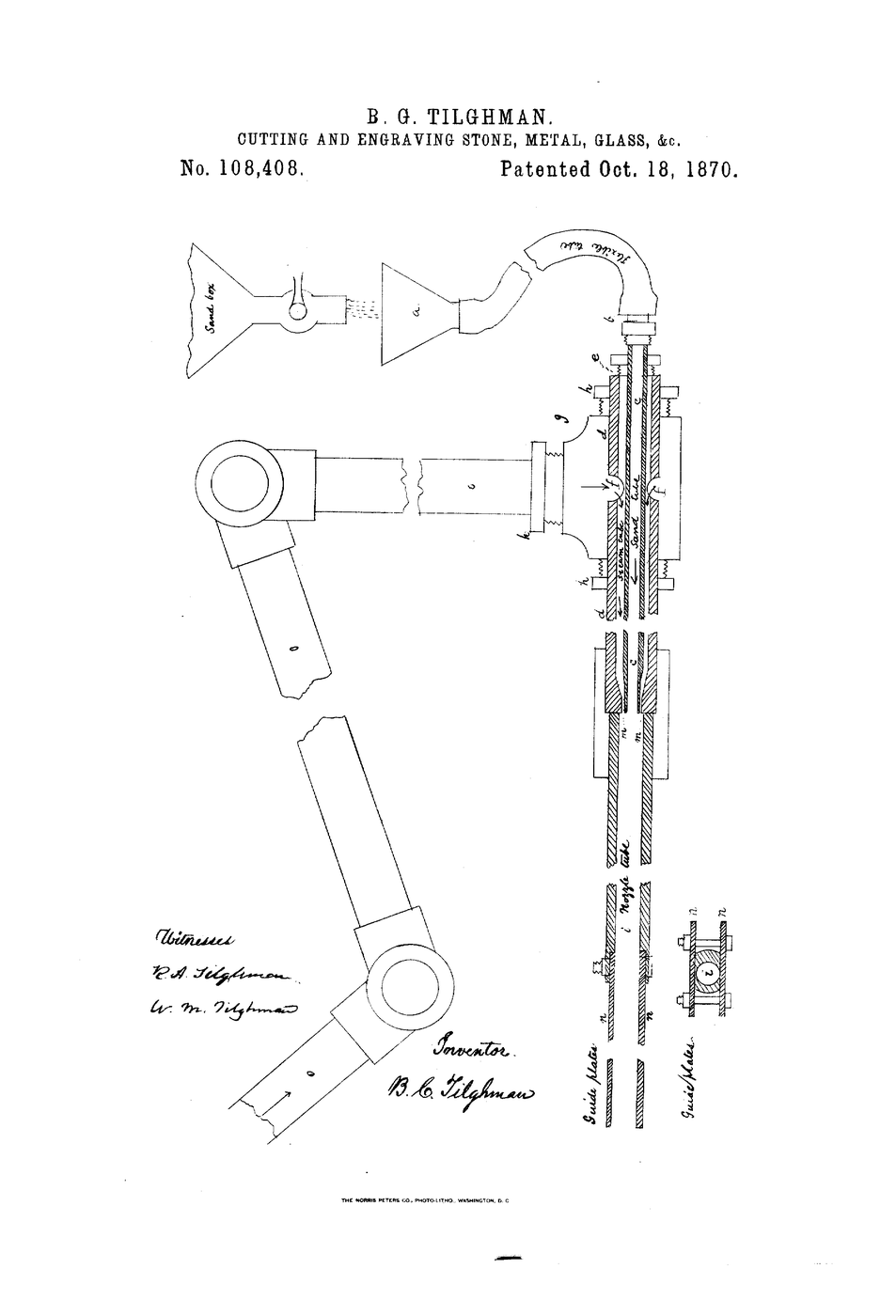
US Patent 108,408, "Improvement in Cutting and Engraving Stone, Metal, Glass", granted 18 October 1870 to Benjamin Chew Tilghman of Philadelphia. He claims working hard materials "by means of a stream of sand or grains of quartz", driven by a steam jet he preferred to run above 300 pounds per square inch.
Read the safety step before you buy anything. This blueprint deliberately does NOT use Tilghman's quartz sand.
ညွှန်ကြားချက်များ
Never use silica sand — this is the whole safety story
Never use silica sand — this is the whole safety story
Tilghman specified quartz sand. Respirable crystalline silica causes silicosis and is a recognised human carcinogen. Use garnet, aluminium oxide or glass bead instead. This is not optional and it is not caution — silica blasting is restricted or banned in many countries.
Work enclosed, and wear a respirator and eye protection
Work enclosed, and wear a respirator and eye protection
Blast only inside a closed box with a viewing window and gloved ports. Wear a fitted P3/N100 respirator and sealed goggles even so. Rebounding abrasive travels in every direction.
Read US 108,408 and note how wide the claim is
Read US 108,408 and note how wide the claim is
Tilghman claims "cutting, boring, grinding, dressing, pulverizing, and engraving stone, metal, glass, wood". One mechanism, six operations, four material classes.
Scratch glass with a loose grain by hand
Scratch glass with a loose grain by hand
Press a single abrasive grain against scrap glass and drag it. Almost nothing happens. Hardness alone does not cut — record that before adding speed.
လိုအပ်သော ကိရိယာများ:
 အလူမီနီယမ်အောက်ဆိုဒ် ပွတ်တိုက်အမှုန်
Build the blast box
Build the blast box
Make a sealed plywood box roughly 400 × 300 × 300 mm with a clear window in the lid and two sleeve holes. Line the far wall with rubber to kill ricochet.
ဤအဆင့်အတွက် ကုန်ကြမ်းများ:
 သစ်သားအလွှာပြား1 ရွက်
Build Tilghman's nested nozzle
Build Tilghman's nested nozzle
Fit a narrow abrasive tube inside a wider air tube so the air passes around it as an annulus. The patent's arrangement: the jet accelerates grain fed into its centre.
လိုအပ်သော ကိရိယာများ:
 နှုတ်ခမ်းပြား ညှပ်
Feed abrasive from a hopper by gravity
Feed abrasive from a hopper by gravity
Mount a small funnel above the inner tube. Grain must arrive steadily — a surge chokes the nozzle, a gap makes the stream cut nothing.
Cut a resist stencil and stick it to glass
Cut a resist stencil and stick it to glass
Cut a simple shape from self-adhesive vinyl and press it onto scrap glass. The stream cuts everything not covered — the resist is the drawing.
Blast for 20 seconds at 100 mm
Blast for 20 seconds at 100 mm
Hold the nozzle 100 mm from the glass, moving steadily. Stop and inspect: the exposed glass should be evenly frosted, the masked area untouched.
Peel the resist and examine the edge
Peel the resist and examine the edge
Lift the vinyl. The boundary is sharp because the resist absorbed the grains. A soft material can defeat a stream that cuts glass — energy goes into deforming it, not fracturing it.
Halve the distance and repeat
Halve the distance and repeat
Blast a second panel at 50 mm for the same 20 seconds. The etch is deeper and narrower — grains lose speed to air drag over distance.
Try it on steel and on wood
Try it on steel and on wood
Blast a steel offcut and a wood offcut for 20 seconds each. Steel dulls and cleans; wood erodes its soft spring growth first and comes up grained. Tilghman claimed both.
Blast a curved object
Blast a curved object
Frost a bottle or a rounded stone. The stream follows the form with no tooling change — the property that no shaped cutter has.
Collect and inspect the spent abrasive
Collect and inspect the spent abrasive
Sweep up the used grit and look at it. The grains are visibly broken down. The abrasive is consumed, not the tool — that is the trade Tilghman made.
History & Context — the invention and the disease
History & Context — the invention and the disease
The patent. US 108,408, "Improvement in Cutting and Engraving Stone, Metal, Glass", granted 18 October 1870 to Benjamin Chew Tilghman of Philadelphia (1821-1901). Application and grant carry the same date on the document, so only the grant date is cited. His name is printed three different ways across the record — the drawing sheet's header reads "B. G. TILGHMAN", his own signature beneath it reads "B. C.", and Google Patents' metadata says "Benjamin J.". The signature is right: he was Benjamin Chew Tilghman. A reminder that even the primary document can carry a typo, and that the inventor's own hand is the better authority. The claim is unusually broad and it earned it: a single mechanism that cuts, bores, grinds, dresses, pulverises and engraves, across stone, metal, glass and wood.
Why speed substitutes for hardness. Conventional abrasion needs the tool harder than the work, because material is removed by ploughing. A blasted grain does not plough; it arrives with kinetic energy concentrated on a contact patch of a few microns, and brittle materials fail locally under that stress regardless of the bulk hardness ratio. This is why sand — quartz, around 7 on Mohs — will frost hardened steel, and why step 4 matters: the same grain pressed by hand does essentially nothing. The variable that does the work is velocity, which is why the patent is really about the nozzle rather than the sand.
Tilghman's own account of the idea is worth repeating. He is said to have noticed windows in desert regions frosted on the windward side by blown sand, and reasoned that the process could be driven deliberately and much harder. Whether or not the anecdote is exact, it describes the invention correctly: this is a natural weathering process put under pressure.
The part the patent could not know. Tilghman specified quartz. Free crystalline silica, inhaled as respirable dust, causes silicosis — irreversible lung scarring — and is classified as carcinogenic to humans. Sandblasting is an efficient generator of exactly the particle size that reaches the deep lung, and it killed and disabled workers for a century; abrasive blasting with silica sand is now prohibited or tightly controlled in much of the world, and the industry runs on garnet, aluminium oxide, steel grit, glass bead and slag. This blueprint uses a substitute deliberately, and the substitution changes nothing about the mechanism being demonstrated. The honest lesson is not that Tilghman was careless — the link to silicosis was not established for decades — but that a process can be completely correct as engineering and still need replacing on its materials.
Where it went. The same principle scaled in both directions: shot-peening to compress and strengthen metal surfaces, hydro-blasting for concrete, soda blasting for delicate restoration, micro-abrasive units that cut semiconductor wafers, and abrasive waterjets that cut steel plate to a fraction of a millimetre. All of them are Tilghman's claim with a different carrier and a different grain.
ပစ္စည်းများ
1- 1 ရွက်နေရာယူပစ္စည်း
လိုအပ်သော ကိရိယာများ
2- နေရာယူပစ္စည်း
- နေရာယူပစ္စည်း
ဆက်စပ် အစီအစဉ်များ
ဤအစီအစဉ်များသည် အသိပညာမျှဝေသည် — နည်းပညာ၊ ပစ္စည်း သို့မဟုတ် မူများ
CC0 အများပိုင်
ဤအစီအစဉ်ကို CC0 အောက်တွင် ထုတ်ဝေထားသည်။ ခွင့်ပြုချက်မလိုဘဲ ကူးယူ၊ ပြင်ဆင်၊ ဖြန့်ဝေ နှင့် အသုံးပြုနိုင်သည်။
အစီအစဉ်မှတစ်ဆင့် ကုန်ပစ္စည်းများဝယ်ယူ၍ လက်မှုပညာရှင်ကို ပံ့ပိုးပါ လက်မှုပညာရှင် ကော်မရှင် ရောင်းချသူက သတ်မှတ်သည်၊ သို့မဟုတ် ဤအစီအစဉ်၏ ဗားရှင်းအသစ်ဖန်တီး၍ ဝင်ငွေခွဲဝေရန် သင့်အစီအစဉ်တွင် ချိတ်ဆက်မှုအဖြစ် ထည့်သွင်းပါ။