
The Ceramic Candle Filter
Slow sand filtration cleans water for a city and needs weeks to mature. A household needs clean water this afternoon, from whatever source it has, with no power and no maintenance schedule.
The ceramic candle answers that by going back to the mechanism the sand filter famously does not use: it genuinely strains the water. The trick is making pores small enough to matter, which is a ceramics problem rather than a plumbing one.
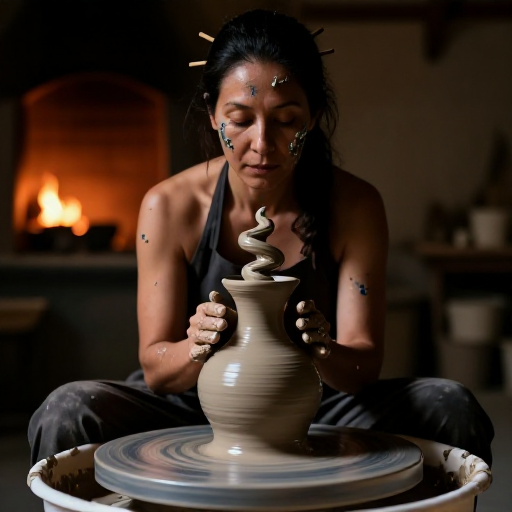
Fire a clay body with a burnable filler mixed through it — sawdust, rice husk, coffee grounds — and the filler burns away in the kiln, leaving a connected network of voids where each particle used to be. The pore size is set by the size of the filler, so the recipe controls the filtration, and a potter can tune it by sieving the sawdust.
Get those pores down to roughly 0.2 to 1 micron and bacteria — which are one to a few microns — physically cannot pass. They are not killed and not chemically removed. They simply do not fit.
The candle shape is not decorative either. A tube closed at one end has far more surface than a flat disc of the same footprint, and the filter's flow rate depends entirely on area, because you cannot push water through faster without enlarging the pores you carefully made small.
Зааварчилгаа
Size the filler, because it sizes the pores
Size the filler, because it sizes the pores
Sieve sawdust or rice husk ash into two grades — one as fine as you can achieve, one coarse — and examine both under a loupe.
Record the particle sizes.
Each particle will become a void. Coarse filler gives a fast filter that stops very little; fine filler gives a slow filter that stops bacteria.
Write the intended pore target now: under about 1 micron to exclude bacteria. Then note the honest difficulty — you cannot sieve to a micron, so the pore network is a distribution, and the next steps are about proving what you actually made rather than what you intended.
Энэ алхмын материал:
 Модны үртэс2 кг
Шаардлагатай багаж:
 Нарийн утсан торт шигшүүр
Blend, form and fire the candle
Blend, form and fire the candle
Mix clay with the fine filler by volume — around 1 part filler to 3 parts clay is a common starting ratio — and wedge it thoroughly so the filler is evenly dispersed. Form a tube closed at one end, wall thickness about 10 mm.
Dry slowly and completely, then fire to your clay's normal bisque temperature.
Expect the piece to be lighter than solid clay and to smell of burning during the firing as the filler leaves.
Fire in a well-ventilated kiln. The burnout produces smoke and carbon monoxide.
Энэ алхмын материал:
 Ваар хийх шавар5 кг
Test it before trusting it — the bubble point
Test it before trusting it — the bubble point
Saturate the fired candle with water, seal it to an air line, and immerse it. Raise the air pressure slowly and record the pressure at which the first steady stream of bubbles appears.
That is the bubble point, and it tells you the size of your largest pore — higher pressure means finer pores.
This is the measurement that matters, because a filter is only as good as its biggest hole. An average pore size of half a micron is worthless if one channel is twenty.
Note where the first bubbles emerge and inspect that spot: it is usually a crack or a poorly wedged inclusion, not the pore network.
Measure flow, and watch it fall
Measure flow, and watch it fall
Fit the candle and measure the litres per hour it delivers with clean water. Then run turbid water through it and re-measure every hour.
Expect a steady decline as the outer surface blinds with sediment.
Now clean it — scrub the outside gently with a brush under running water, never with soap and never from the inside.
Expect most of the flow to return. You are removing a surface cake, not unblocking the ceramic. Pre-settling muddy water before it reaches the candle multiplies the interval between cleanings enormously, which is why household units have a settling stage above.
Find what it does not remove
Find what it does not remove
Pass salty water through the candle and taste — carefully, with clean salt water you prepared — then pass water coloured with dye.
Expect the salt to pass straight through, and much of the dye too.
The filter is a sieve, and dissolved substances are molecules, thousands of times smaller than the pores. Salt, nitrate, arsenic, fluoride and most chemical contamination pass unaffected. Viruses, at tens of nanometres, are also far smaller than the pores.
This is why silver is often impregnated into these ceramics as a bacteriostat, and why a candle filter is correctly described as a bacterial filter and not a purifier.
History & Context
History & Context
Two names, and the honest attribution. Porous ceramic filtration was commercialised in Britain by the Doulton pottery for households drawing water from polluted rivers, and developed in France by Charles Chamberland, working in Pasteur's laboratory, as the Chamberland filter. Chamberland's version was a laboratory instrument, and it did something no household filter aims at: it let researchers make a liquid that was demonstrably free of bacteria.
That laboratory use discovered viruses. When infectious material was passed through a Chamberland filter and the filtrate remained infectious, the conclusion was inescapable — something was causing disease that was smaller than any bacterium. The term "filterable agent" came first, and virology grew out of it. A ceramic pot with the right pore size did not just clean water; it proved by exclusion that an entire class of life existed. The step-5 limitation is precisely the discovery.
Why a potter is the right maker. The filtration performance is decided by the clay body recipe and the firing, not by any assembly. That puts it within reach of local ceramics production anywhere, which is exactly how the modern versions are made — potters' cooperatives producing filters locally for their own regions, with quality control by bubble-point testing rather than imported instruments. The supply chain is a clay pit and a kiln.
Where it sits among the other answers. Slow sand filtration is municipal, biological and patient. Chlorination is chemical and protects the water in transit. The ceramic candle is physical, immediate and household-scale, and it protects nothing after the tap. They are complements, not competitors, and the sensible household arrangement is often ceramic filtration followed by a disinfectant residual for storage.
Honest limits. Slow — litres per hour, not per minute. Fragile, and a crack is invisible and catastrophic, which is what the bubble-point test exists to catch. It removes bacteria and protozoa well, viruses poorly, and dissolved chemicals not at all. And it needs regular cleaning, which means it needs a user who understands why — the failure mode of every filter ever given to someone without its reasoning.
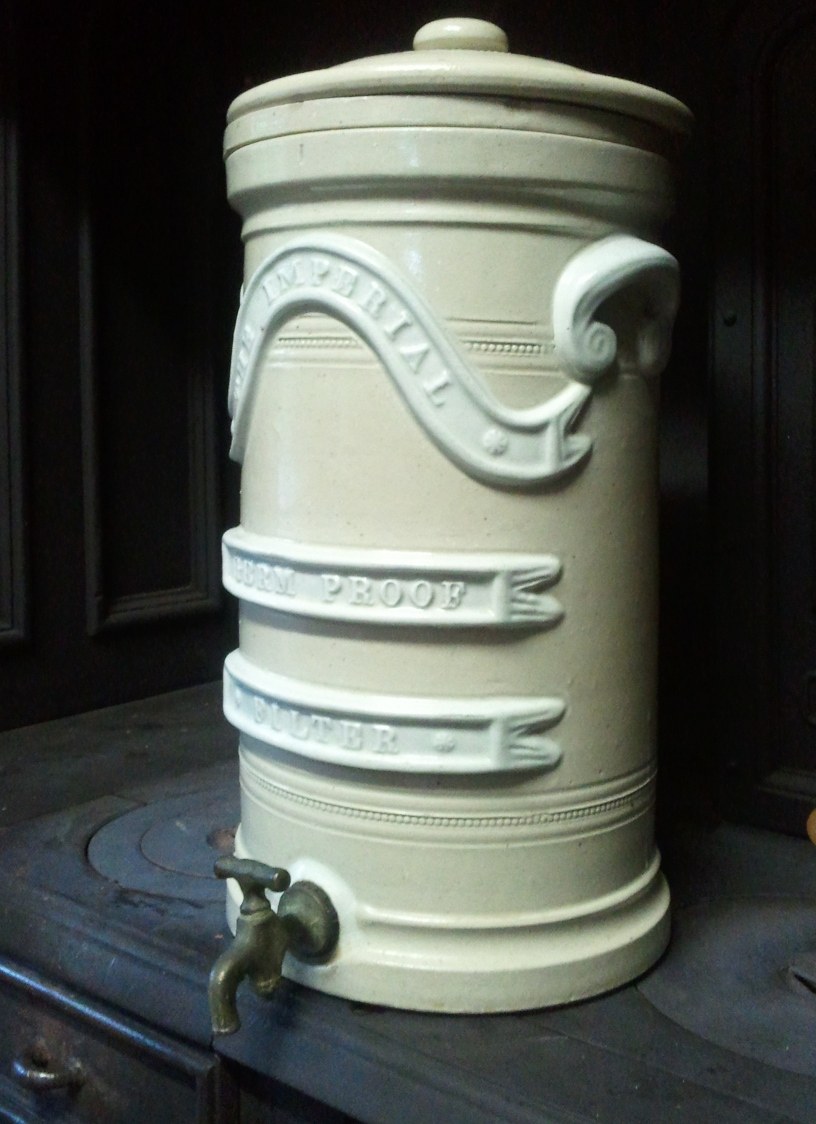
The hero image is a Victorian stoneware filter with GERM PROOF moulded into its side. Read that against step 5. It removes bacteria well and viruses poorly, and it removes nothing dissolved at all — so the claim was marketing, made before anyone knew viruses existed, on an object that was about to help prove they did. Worth keeping in view: the confident label and the honest limitation are on the same pot.
Материал
4- 2 кгТүр орлуулагч
- 5 кгТүр орлуулагч
- 10 литрТүр орлуулагч
- 1 баглааТүр орлуулагч
Шаардлагатай багаж
5- Түр орлуулагч
- Түр орлуулагч
- Түр орлуулагч
- Түр орлуулагч
- Түр орлуулагч
Холбогдсон загварын материал

Энэ загвараар хийдэг

Холбоотой загварууд
Эдгээр загварууд мэдлэг хуваалцдаг — арга техник, материал эсвэл зарчим

CC0 Нийтийн домэйн
Энэ загвар CC0 дор гаргагдсан. Та зөвшөөрөл авахгүйгээр хуулах, өөрчлөх, түгээх, ашиглах боломжтой.
Загвараар дамжуулан бүтээгдэхүүн худалдаж авч Бүтээгчийг дэмжээрэй Бүтээгчийн шимтгэл Борлуулагчаар тогтоосон, эсвэл энэ загварын шинэ хувилбар үүсгэж орлогоо хуваахын тулд өөрийн загварт холбоос болгон оруулна уу.