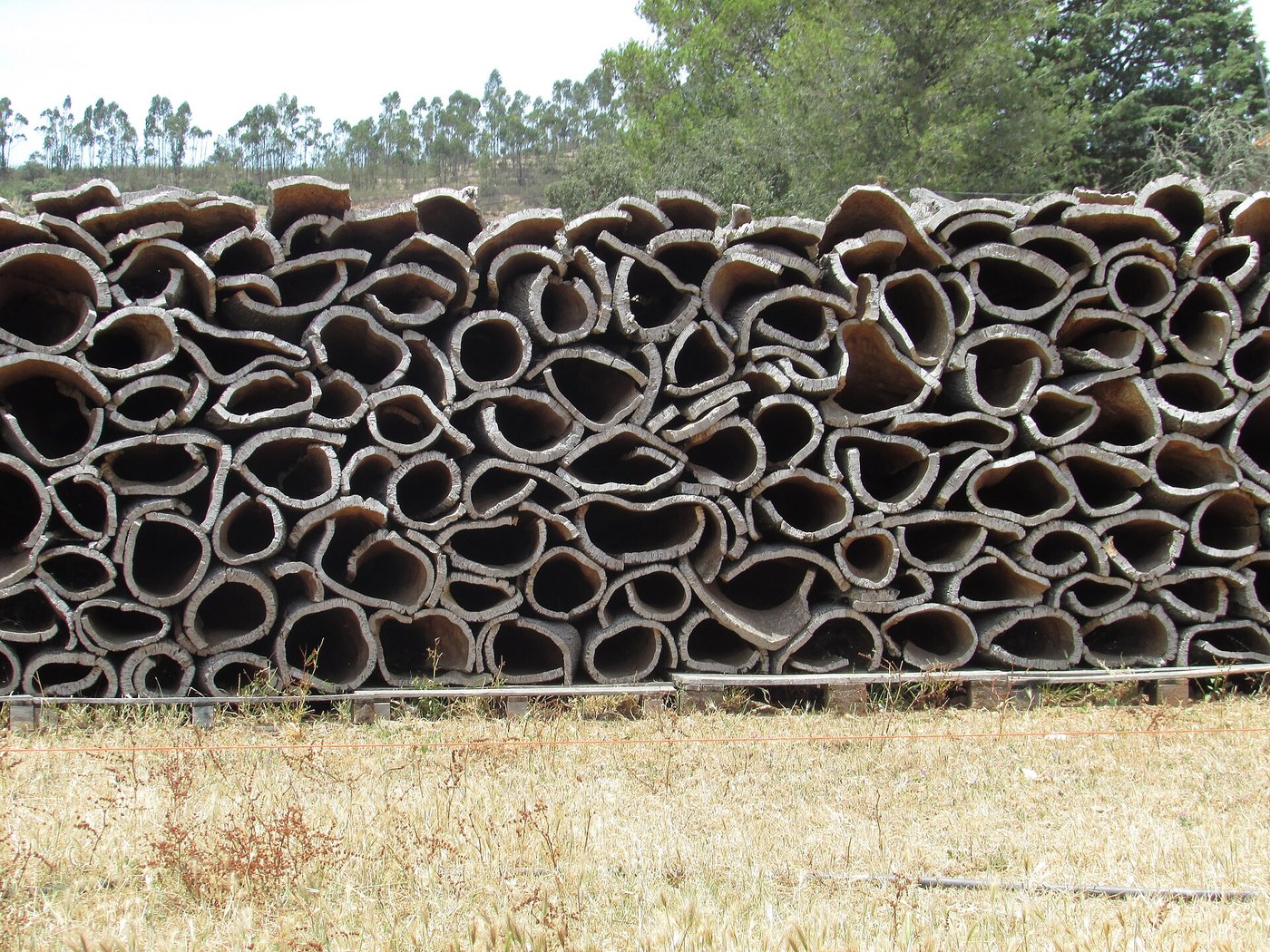


Cork and Sawdust Insulation
Ask what the best cheap insulator is and the honest answer is still air. Air conducts heat about twenty times worse than water and hundreds of times worse than metal. The catch is that air will not stay still — warm it and it rises, and convection carries heat far faster than conduction ever would.
So every insulating material is really a scaffold for the same trick: divide air into pockets small enough that it cannot circulate.
That is what cork is. Its cells are tiny sealed gas-filled boxes, which is why cork bark works so well and why the solid it is made of barely matters. Sawdust, straw, wool, feathers and modern foams are the same idea at different scales.
Two consequences follow and both are counter-intuitive.
Density has an optimum, not a direction. Too loose and the pockets are large enough to convect; too compressed and you have squeezed out the air and are conducting through solid. There is a best packing, and it can be measured.
Water destroys everything. A wet insulator conducts roughly twenty times better than a dry one, so damp sawdust is barely insulation at all — which is why the ice-house blueprint puts drainage above every other feature.
Зааварчилгаа
Build a fair test before comparing anything
Build a fair test before comparing anything
Make a rig you can trust: a jar of hot water inside a box, with a fixed thickness of the material under test all round, a thermometer inside and one in the room. Log the cooling curve.
Run the same material twice to see how repeatable it is.
Expect a spread between identical runs — that spread is your noise floor, and any difference smaller than it means nothing.
Establish the noise before you start ranking materials, or you will confidently report that wool beats sawdust on a difference your rig cannot actually see.
Энэ алхмын материал:
 Хөндлөвчтэй картон хавтан4 ширхэг
Шаардлагатай багаж:
 Термометр
Rank the materials, then rank them by cost
Rank the materials, then rank them by cost
Test cork, sawdust, wood shavings, straw, wool and crumpled paper at equal thickness.
Expect them to be closer together than you assumed, and cork to lead modestly.
Now weigh each and note what it would cost or where it comes from.
Expect sawdust and straw to be free by-products.
Write the ratio of performance to cost. That ratio, not raw conductivity, decided the history — the ice trade shipped in sawdust because it was waste from the sawmill next door, not because it beat cork.
Find the density that is neither too loose nor too tight
Find the density that is neither too loose nor too tight
Take one material and test it at several packing densities, from barely settled to firmly compressed, weighing each fill.
Plot performance against density.
Expect a curve with a peak, not a straight line.
Loose fill convects internally; compressed fill has had its air squeezed out.
Then check for the slow failure: leave a loose fill vertically for days and watch it settle and leave a gap at the top. A void at the top of a wall is a chimney, and it undoes the whole cavity — the reason blown insulation is a specified density rather than 'as much as fits'.
Wet it and watch the insulation disappear
Wet it and watch the insulation disappear
Test your best material dry, then damp, then thoroughly wet, weighing the water added.
Expect performance to collapse, and to collapse faster than the amount of water suggests.
Water does two things: it conducts far better than the air it displaced, and when it evaporates on the warm side and condenses on the cold side it carries latent heat across the wall as well.
Any insulation specification without a moisture strategy is fiction. This is the single most common real-world failure, and it is why cork — which is naturally water-resistant — outlived sawdust in permanent buildings.
Add a shiny face and see what it does and does not fix
Add a shiny face and see what it does and does not fix
Repeat the test with a sheet of foil on the warm face, first touching the insulation and then with a small air gap behind it.
Expect little benefit when touching and a real benefit with a gap.
Foil works by reflecting infrared, and that requires a gap for radiation to cross; pressed against the material it simply conducts.
Bulk insulation fights conduction and convection; a reflective face fights radiation. They are different heat paths, so they add — and neither substitutes for the other, whatever the packaging claims.
History & Context
History & Context
Cork's insulating use is ancient and its industrial use is Victorian. Cork oak bark had been used for stoppers, floats and shoes for millennia; expanded cork board — cork granules baked so their own resins bind them — arrived in the late nineteenth century and became the standard insulation for cold stores, breweries and refrigerated ships. The refrigerated-ship blueprint already in this corpus floated on cork.
Sawdust insulated a global trade by accident. New England ice was packed in sawdust from the region's timber mills, and the combination made it possible to land usable ice in Calcutta. A waste stream that happens to be a good insulator is worth more than a better material that must be bought, and that logic still drives insulation from recycled paper, hemp shiv and mineral-wool slag today.
The physics was formalised much later than the practice. Fourier's law of conduction dates from the 1820s, and the idea of quoting a material by its conductivity — and an assembly by its total resistance — is later still. Builders had known for centuries that straw, wool and shavings kept heat in; what changed was being able to compare them numerically and design to a target rather than to a tradition.
The trapped-air insight is the durable one. Modern foams, aerogels and vacuum panels are all the same argument pushed further: make the pockets smaller than the distance a gas molecule travels between collisions, or remove the gas altogether. The Dewar flask elsewhere in this corpus is the limit case — no gas at all, plus a silvered face for radiation, which is steps 4 and 5 taken to their conclusion.
Honest limits. Loose organic fills settle, absorb moisture, and are food and habitat for insects and rodents. Most are combustible — sawdust in a wall cavity is a genuine fire risk, which is why it was progressively banned in construction. Performance is destroyed by damp, so they demand a dry, ventilated assembly. And they are bulky: reaching a modern insulation standard with straw or shavings means a very thick wall, which is a floor-area cost that thin synthetic boards do not impose.
Материал
10- 4 ширхэгТүр орлуулагч
- 4 ширхэгТүр орлуулагч
- 5 литрТүр орлуулагч
- 1 хуудасТүр орлуулагч
- 2 кгТүр орлуулагч
- 2 кгТүр орлуулагч
- 2 кгТүр орлуулагч
- Түр орлуулагч
- 1 боодолТүр орлуулагч
- 1 боодолТүр орлуулагч
Шаардлагатай багаж
2- Түр орлуулагч
- Түр орлуулагч
Холбогдсон загварын материал

Холбоотой загварууд
Эдгээр загварууд мэдлэг хуваалцдаг — арга техник, материал эсвэл зарчим

CC0 Нийтийн домэйн
Энэ загвар CC0 дор гаргагдсан. Та зөвшөөрөл авахгүйгээр хуулах, өөрчлөх, түгээх, ашиглах боломжтой.
Загвараар дамжуулан бүтээгдэхүүн худалдаж авч Бүтээгчийг дэмжээрэй Бүтээгчийн шимтгэл Борлуулагчаар тогтоосон, эсвэл энэ загварын шинэ хувилбар үүсгэж орлогоо хуваахын тулд өөрийн загварт холбоос болгон оруулна уу.