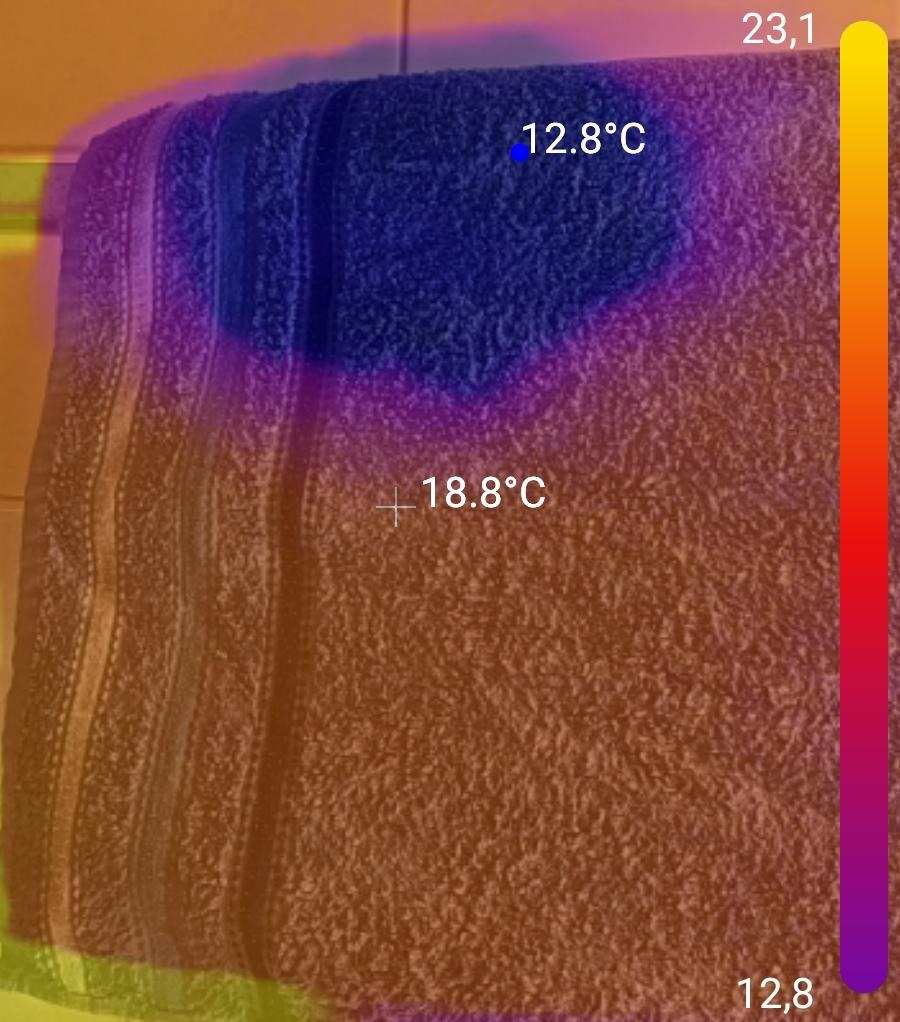


The First Artificial Cold
Before 1755, every cold thing humans had ever used was found, not made. Ice was cut from a lake, snow was carried down a mountain, a cellar was dug deep. Cold was a place you went to.
William Cullen, at Glasgow, made cold where there was none — with no ice anywhere in the room. He put ether in a vessel, pumped the air out above it, and the ether boiled at room temperature. Boiling costs energy; the ether took that energy from its own surroundings; and a small quantity of ice formed on the outside of the vessel.
The reasoning is worth being precise about, because it is the foundation of every machine in this batch. A liquid does not need heating to boil — it needs its vapour pressure to reach the pressure above it. Lower the pressure enough and the liquid boils cold. And boiling always draws latent heat from whatever is nearest, which is why evaporation is the only cooling process nature gives away free.
Cullen demonstrated it and published it. He built no machine, sold nothing, and patented nothing — he had shown that cold is something you can manufacture, and left it there for eighty years until Perkins closed the loop.
William Cullen, University of Glasgow, 1755. Not a patent — a demonstration, and the one everything else rests on.
Зааварчилгаа
Measure the cooling that evaporation gives free
Measure the cooling that evaporation gives free
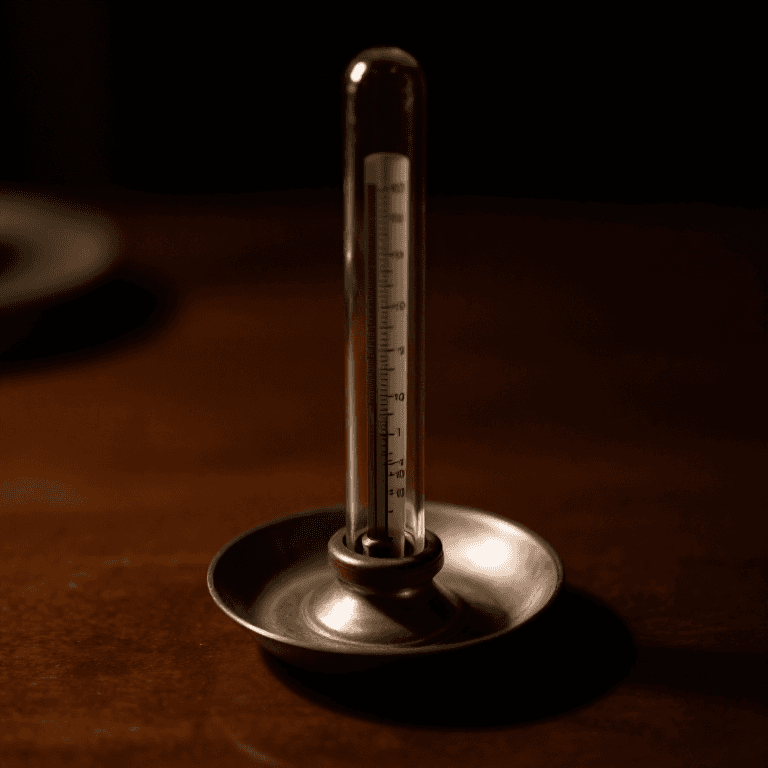
Wrap two thermometer bulbs in cotton. Wet one with water, leave the other dry, and fan both equally.
Log both every 30 seconds for five minutes.
Expect the wet one to settle several degrees below room temperature and stay there while it is still wet.
Nothing cold touched it. The drop is entirely the cost of turning liquid water into vapour, paid out of the thermometer's own heat.
Шаардлагатай багаж:
 Термометр
Change the liquid and change the answer
Change the liquid and change the answer
Repeat step 1 with surgical spirit instead of water.
Expect a faster and deeper drop.
Alcohol evaporates more readily at room temperature than water does — it has a higher vapour pressure — so it takes its latent heat quicker.
Record both curves on the same axes. You have just done the experiment that every refrigerant selection since 1834 is a more careful version of: the fluid is not incidental, it is the design decision.
Шаардлагатай багаж:
 Изопропилийн спирт
Lower the pressure and boil something cold
Lower the pressure and boil something cold
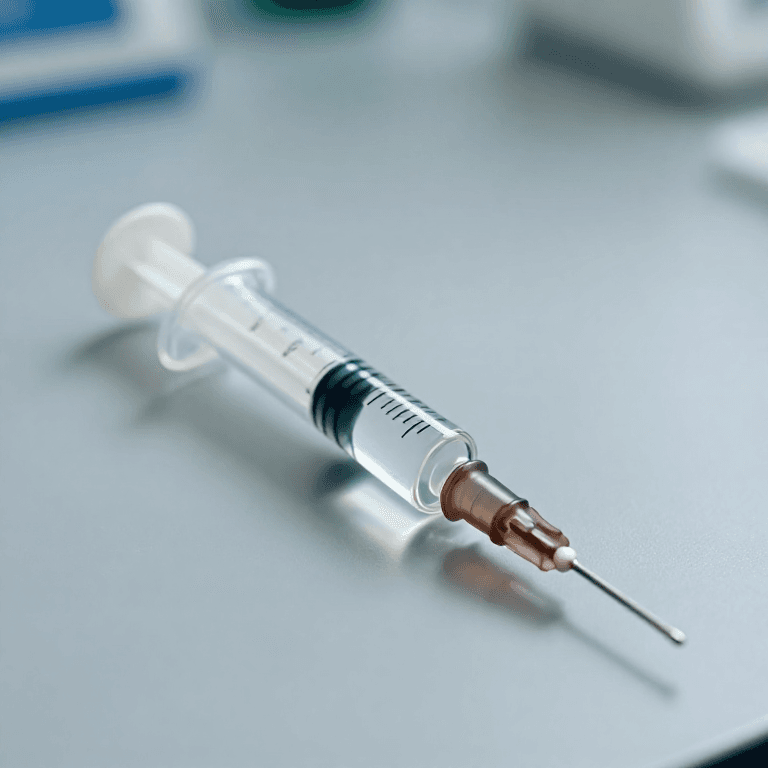
Put warm water in a syringe, seal the tip, and pull the plunger back hard.
Bubbles appear. The water is boiling — at a temperature you could put your finger in.
This is Cullen's move, and it is worth stating exactly what it overturns: boiling is not about being hot. It is about the liquid's vapour pressure matching the pressure above it. Take the pressure away and the boiling point comes down to meet the liquid.
Шаардлагатай багаж:
 Тариурын багц
Combine the two and drive the temperature down
Combine the two and drive the temperature down
Now put the two halves together. Wrap a small water-filled vessel in wet cloth, place it in a jar you can evacuate, and pump the pressure down while logging its temperature.
Expect a much steeper fall than fanning ever gave you — the low pressure makes the water evaporate far faster, and faster evaporation means heat leaving faster.
With a laboratory pump and ether, this reaches freezing. That is precisely Cullen's 1755 apparatus, and the ice he made formed on the outside of the vessel, from room air.
Find why this alone is not a refrigerator
Find why this alone is not a refrigerator
Keep pumping and watch what happens over ten minutes.
The cooling slows and stops. Your liquid is running out, and the vapour you have pumped away is gone.
That is the gap between a demonstration and a machine. Cullen's apparatus cools until the ether is spent, and then you must refill it.
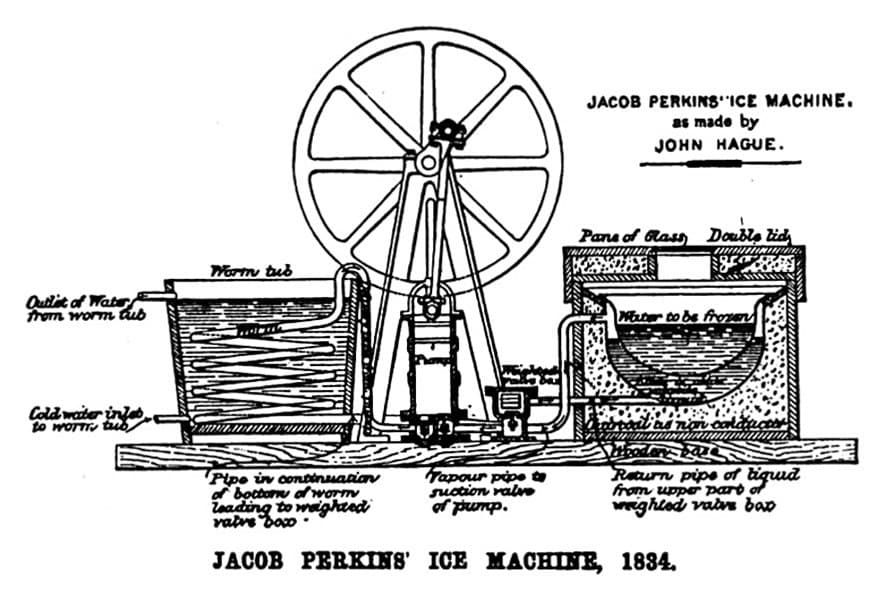
To cool continuously you must catch that vapour and turn it back into liquid — which needs a compressor to raise its pressure and a condenser to take the heat away. Eighty years later, that is exactly what Perkins added, and nothing else.
History & Context
History & Context
The demonstration. William Cullen, professor at Glasgow, showed artificial refrigeration in 1755 by evaporating ether under reduced pressure and forming a small amount of ice. It is generally taken as the first documented instance of cold produced deliberately rather than collected. He published; he did not patent, did not build a working machine, and did not pursue it commercially.
Why nothing happened for eighty years. Cullen had the physics complete and the economics against him. Natural ice was abundant and, once Wyeth's ice plough arrived in 1825, extremely cheap. There was no market to disturb. The idea sat in the literature until city populations, brewing and meat shipping created a demand that lakes could not meet — at which point Perkins' cycle and Linde's ammonia machine had something to be better than.
Cullen was a physician, and it shows. He came to the problem through medicine and chemistry rather than engineering, which is probably why he framed it as a phenomenon to be understood rather than a device to be sold. He is better remembered in medicine than in refrigeration, and his students included Joseph Black, whose work on latent heat a few years later gave the effect its proper name and measurement.
The same physics, everywhere. Sweating is Cullen's experiment run by your own body. The unglazed zeer pot and the Spanish botijo keep water cool in hot dry air by exactly this route, with no moving parts at all. A modern vacuum freeze-dryer is Cullen's apparatus with better pumps. And every refrigerant in this batch is a search for a liquid whose boiling behaviour is convenient — which is the question Cullen's experiment first made askable.
What it does not do. Evaporative cooling fails in humid air, because the air is already carrying as much vapour as it can and the liquid will not leave. That is why swamp coolers work in Arizona and not in Singapore, and why the whole approach eventually had to be sealed into a closed loop where the machine, not the weather, decides the conditions.
Шаардлагатай багаж
3- Түр орлуулагч
- Түр орлуулагч
- Түр орлуулагч
Холбогдсон загварын материал

Холбоотой загварууд
Эдгээр загварууд мэдлэг хуваалцдаг — арга техник, материал эсвэл зарчим

CC0 Нийтийн домэйн
Энэ загвар CC0 дор гаргагдсан. Та зөвшөөрөл авахгүйгээр хуулах, өөрчлөх, түгээх, ашиглах боломжтой.
Загвараар дамжуулан бүтээгдэхүүн худалдаж авч Бүтээгчийг дэмжээрэй Бүтээгчийн шимтгэл Борлуулагчаар тогтоосон, эсвэл энэ загварын шинэ хувилбар үүсгэж орлогоо хуваахын тулд өөрийн загварт холбоос болгон оруулна уу.