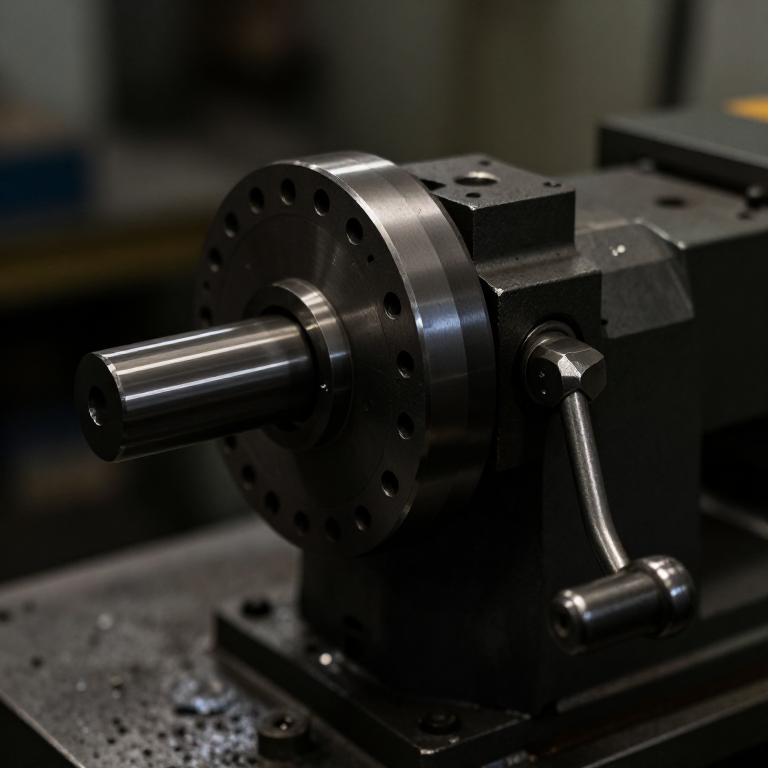


Dividing Head
Зааварчилгаа
Understand the 40:1 arithmetic before building
Understand the 40:1 arithmetic before building
The ratio decides which divisions are possible. Work it out first.
- With a 40:1 worm, crank turns per division = 40 ÷ (number of divisions).
- For 8 divisions: 40 ÷ 8 = 5 full turns — no index plate needed.
- For 24 divisions: 40 ÷ 24 = 1 and 2/3 turns — needs a plate with holes divisible by 3.
- For 7 divisions: 40 ÷ 7 = 5 and 5/7 turns — needs a circle of 7, 14, 21 or 28 holes.
- Tabulate the crank movement for 3, 4, 5, 6, 8, 10, 12, 16, 20, 24 and 32 divisions.
Why 40 became standard. Forty factorises well — 2, 4, 5, 8, 10, 20 all divide it exactly — so a large number of common divisions need whole turns or simple fractions. That is a deliberate choice by whoever settled the convention, not an accident.
Your table tells you which hole circles the index plates must carry. Build the plates to the table, not the other way round.Энэ алхмын материал:
 Нүдэлсэн цаас1 pad
Шаардлагатай багаж:
 Дижитал штангенциркуль 6 инч
 Хосолсон өнцөг хэмжигч
Build the worm and wheel
Build the worm and wheel
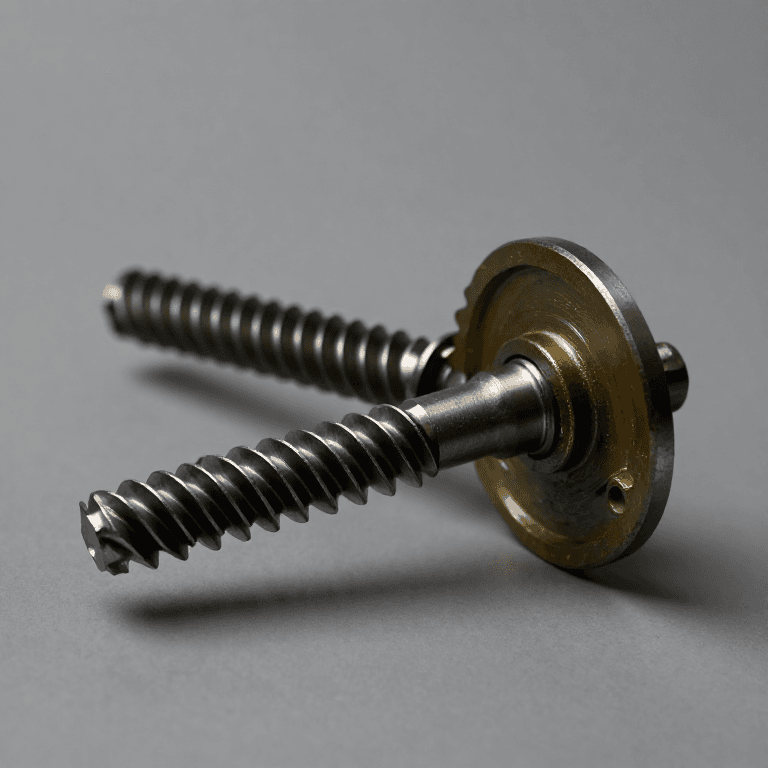
Forty teeth on the wheel, one start on the worm.
- Cut a 120 mm wheel blank from 18 mm plywood faced with 6 mm aluminium.
- Mark 40 teeth around it — 9 degrees apart — and cut the tooth spaces.
- Use a length of M12 threaded rod as the worm: a single-start thread is exactly what a worm is.
- Mount the worm in two 608 bearings in plywood blocks so it meshes with the wheel rim.
- Fix the blocks with M5 × 40 socket head cap screws × 4, M5 flat washers × 8 and M5 hex nuts × 4, using slotted holes to set mesh depth.
Modern build spec (derived). M12 threaded rod as a worm is a genuinely useful shortcut — the thread pitch sets the tooth pitch, so cut the wheel teeth to match your rod's pitch rather than to a nominal figure. Commercial heads use a hardened ground worm and a bronze wheel, chosen because bronze wears in preference to the expensive worm.
Slotted mounting holes for mesh depth, exactly as on the rack and pinion. Adjustable is not a luxury here — the correct depth is found by feel with the mechanism assembled.Энэ алхмын материал:
 Фанер хуудас1 хуудас
 Хавтгай хөнгөн цагаан баганз1 ширхэг
 Бөмбөлөгт холхивч4 ширхэг
 Хавтгай угаагуур8 ширхэг
 Зургаан талт эрэг4 ширхэг
Шаардлагатай багаж:
 Хөрөө (лобзик)
 Муруй хөрөө
 Гилбэрийн иж бүрдэл
 Утасгүй өрөм
 Өрмийн үзүүрийн иж бүрдэлДижитал штангенциркуль 6 инч
Drill the index plates accurately
Drill the index plates accurately
The plate holes carry the fractional turns, so their spacing is the instrument's accuracy.
- Cut two 140 mm discs from 6 mm aluminium.
- On the first, lay out concentric circles of 15, 16, 17, 18, 19 and 20 holes.
- On the second, 21, 23, 27, 29, 31 and 33 holes.
- Step each circle round using dividers set to the chord length rather than measuring angles.
- Centre-punch every hole, then drill 3.2 mm.
Why step with dividers. Walking a divider round a circle distributes the closing error over the whole circle instead of dumping it into the last space, and it lets you detect the error — if the last step does not land on the first mark, adjust and walk again. Measuring each angle separately accumulates error exactly as the protractor does.
The prime-numbered circles are the valuable ones. 7, 11, 13, 17 and 19 divisions are impossible without a hole circle that is a multiple of them, and those are precisely the divisions you cannot fudge by eye.Энэ алхмын материал:
Хавтгай хөнгөн цагаан баганз1 ширхэгШаардлагатай багаж:
 Төвлүүлэх цүүцУтасгүй өрөмӨрмийн үзүүрийн иж бүрдэлДижитал штангенциркуль 6 инчХосолсон өнцөг хэмжигчГилбэрийн иж бүрдэл
Add the crank, detent pin and sector arms
Add the crank, detent pin and sector arms
The sector arms are what stop you miscounting holes, and everyone who omits them regrets it.
- Fit a crank to the worm shaft with an M6 × 30 hex bolt and M6 flat washers × 2.
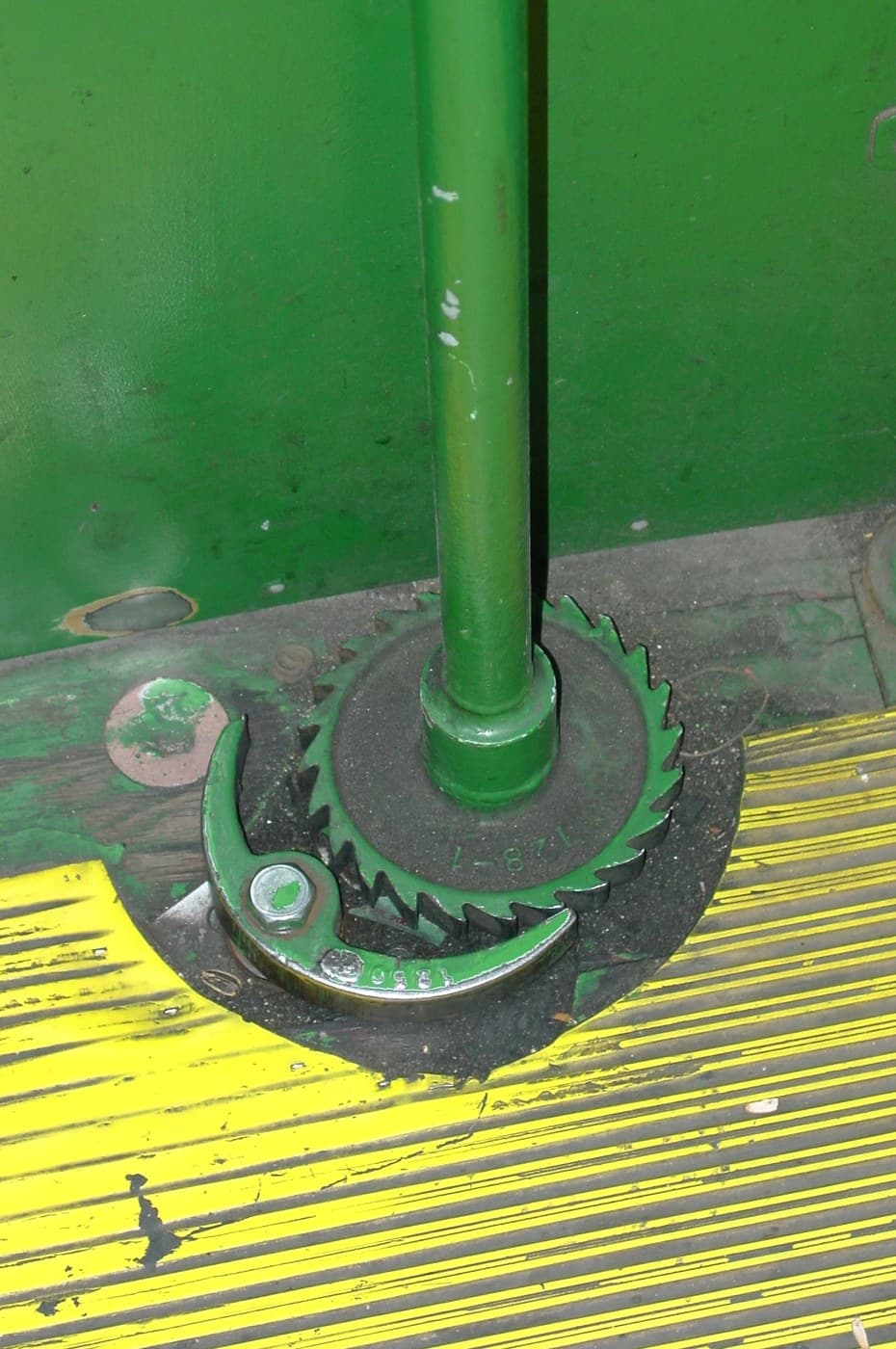
- Mount a spring-loaded detent pin on the crank to drop into the plate holes.
- Make two thin sector arms pivoting on the plate's centre, clamped together by an M5 × 20 socket head cap screw and M5 flat washer with light friction.
- Set the arms to span the required number of holes PLUS the one you start in.
Plus one. To advance 7 holes you set the sector arms to enclose 8 holes, because the hole you are sitting in counts as the boundary, not as a step. This off-by-one is the single commonest error in dividing work and it produces a part that is subtly, consistently wrong.
After each division, swing the trailing arm up against the pin, ready for the next. That way you never count holes twice and never lose your place mid-job.Энэ алхмын материал:
Хавтгай хөнгөн цагаан баганз1 ширхэг Шахалтын пүршний иж бүрдэл1 багцХавтгай угаагуур4 ширхэгЗургаан талт эрэг2 ширхэг
Шаардлагатай багаж:
Утасгүй өрөмӨрмийн үзүүрийн иж бүрдэл Зургаан талт түлхүүрийн иж бүрдэлГилбэрийн иж бүрдэл
 Төмөр хөрөөний хүрээ ба ир
Prove errors do not accumulate, and history
Prove errors do not accumulate, and history
The closing test — the only test that matters.
- Mount a disc on the spindle and scribe a mark.
- Index through all 24 divisions, scribing each.
- The 24th step must bring you exactly back to the first mark.
- Now repeat the same 24 divisions using a protractor and 15 degree steps, and compare where the last mark lands.
History. Accurate circular division is one of the hardest problems in early instrument making, and it gated astronomy and navigation directly: a sextant is worthless if its arc is not divided truly. Jesse Ramsden's dividing engine of the 1770s automated it and was so important that the Board of Longitude paid him to publish the design. The workshop dividing head is the same idea in a form a machinist can use.
Its siblings: a protractor reads any angle instantly and accumulates error when stepped. A sine bar sets one angle very accurately but does not step at all. A dividing head steps exactly but only into the divisions its plates allow. Three approaches to angle, and this batch holds all three so the trade can be compared directly.
Honest limit: divisions requiring a prime factor with no matching hole circle are simply impossible on a plain head — that is what differential indexing exists to solve, by gearing the plate itself to rotate slowly as the crank turns.
Шаардлагатай багаж:
Дижитал штангенциркуль 6 инчХосолсон өнцөг хэмжигчМатериал
7- 1 padТүр орлуулагч
- 1 хуудасТүр орлуулагч
- 1 ширхэгТүр орлуулагч
- Түр орлуулагч
- 12 ширхэгТүр орлуулагч
- 6 ширхэгТүр орлуулагч
- Түр орлуулагч
Шаардлагатай багаж
10- Түр орлуулагч
- Түр орлуулагч
- 1 vendor sell this, none ship to you yetТүр орлуулагч
- Түр орлуулагч
- Түр орлуулагч
- 1 vendor sell this, none ship to you yetТүр орлуулагч
- Түр орлуулагч
- Түр орлуулагч
- Түр орлуулагч
- Түр орлуулагч
Энэ загвараар хийдэг
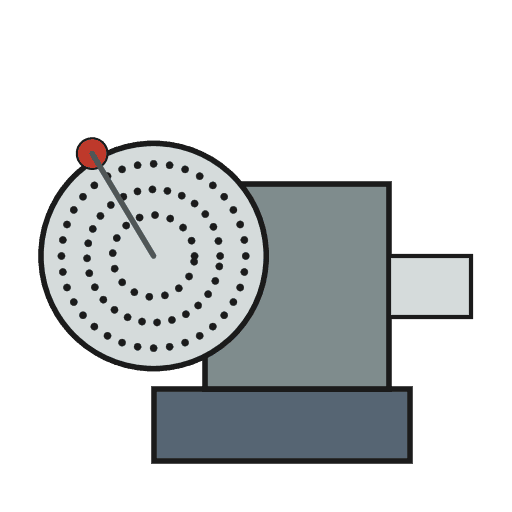
Холбоотой загварууд
Эдгээр загварууд мэдлэг хуваалцдаг — арга техник, материал эсвэл зарчим
CC0 Нийтийн домэйн
Энэ загвар CC0 дор гаргагдсан. Та зөвшөөрөл авахгүйгээр хуулах, өөрчлөх, түгээх, ашиглах боломжтой.
Загвараар дамжуулан бүтээгдэхүүн худалдаж авч Бүтээгчийг дэмжээрэй Бүтээгчийн шимтгэл Борлуулагчаар тогтоосон, эсвэл энэ загварын шинэ хувилбар үүсгэж орлогоо хуваахын тулд өөрийн загварт холбоос болгон оруулна уу.