УРЛАГ
ГОО САЙХАН БА ЭРҮҮЛ МЭНД
ГАРААР ХИЙСЭН
СОЁЛ БА ТҮҮХ
ҮЗВЭР НААДАМ
БАЙГАЛЬ ОРЧИН
ХООЛ БА УНДАА
УРВУУ ИНЖЕНЕРЧЛЭЛ
ШИНЖЛЭХ УХААН
СПОРТ
ТЕХНОЛОГИ
ӨМСДӨГ ХЭРЭГСЭЛ
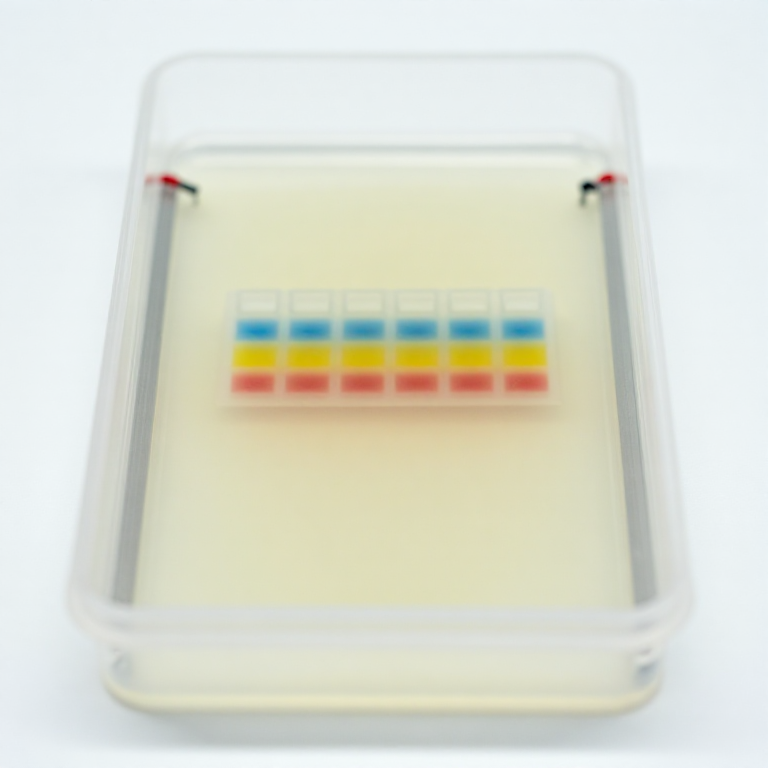

Gel Electrophoresis: Separating by Charge and Size
Every rung so far has moved the sample with a flowing solvent. This one holds the liquid still and pulls the molecules through it with an electric field instead.
Charged molecules migrate toward the opposite electrode, and if they must squeeze through a gel to get there, the small ones thread the mesh easily while the large ones are held back. So the gel sorts by size, and the field sorts by charge, both at once. Oliver Smithies got there in 1955 with a starch gel he made in his own kitchen, looking for protein variants nobody else could see.
The version here needs a power supply, a plastic box and some agarose, and it separates the dyes in ordinary food colouring into their components — a real separation you can watch happen over half an hour, with no biological material and nothing to stain.
Дунд шат
1 day
Зааварчилгаа
1
1
Build the tank
Build the tank
Take a shallow plastic box a little longer than your gel will be. Run a platinum or stainless wire across each end, just clear of the bottom, and bring a lead out through the wall of the box above the liquid line.
The electrodes must be at opposite ENDS and parallel, so the field runs straight down the gel; angled electrodes bend the lanes. Bring the leads out above the liquid, never through a hole below it. Platinum is worth it because it does not corrode; stainless will work for a few runs and then start dissolving into your buffer.
Энэ алхмын материал:
 Хуванцар хадгалах сав (агаар нэвтрүүлэхгүй)1 ширхэг
 Платин утас30 см
Шаардлагатай багаж:
 Матан хавчаартай туршилтын утас
2
2
Mix a buffer that carries current without cooking the gel
Mix a buffer that carries current without cooking the gel
Dissolve about 5 grams of baking soda in a litre of water. That is your running buffer, in the tank and in the gel both.
The buffer has two jobs: it conducts, and it holds the pH steady so your molecules keep the charge they started with. Plain water barely conducts and the run never finishes. Strong salt conducts too well, draws a large current and turns the tank into a heater — a gel that gets hot goes cloudy, the lanes smear and in the worst case it melts. Sodium bicarbonate is the forgiving middle, and it is in every kitchen.
Энэ алхмын материал:
 Хоолны сод5 г
Шаардлагатай багаж:
 Дижитал жин
 Боросиликат хундага
3
3
Cast the gel, and get the wells right
Cast the gel, and get the wells right
Heat 1 gram of agarose in 100 ml of buffer until it is completely clear, let it cool until the flask is merely hot, pour it into a level tray to about 5 mm deep, and set a comb in one end to form the wells.
Pour it too hot and the tray warps; pour it too cool and it sets lumpy with a visible seam. It must be CLEAR before pouring — undissolved specks become obstacles that deflect a lane. Leave the comb until the gel is fully set and firm to a fingertip, then lift it straight up and slowly; pulling it at an angle tears the well walls and your sample leaks sideways into its neighbour.
Энэ алхмын материал:
 Агарозын нунтаг1 г
Шаардлагатай багаж:
 Халаах хавтанБоросиликат хундагаДижитал жин
4
4
Load the samples under the buffer
Load the samples under the buffer
Cover the set gel with buffer to a few millimetres, mix each sample with an equal volume of glycerol, and deliver it into the well with a fine tip held just inside the mouth.
The glycerol is why the sample stays put: it makes the drop denser than the buffer so it sinks and fills the well instead of drifting away in a coloured cloud. This is the same trick as the loading dye in a molecular biology laboratory. Do not push the tip through the bottom of the well — a punctured well leaks the sample under the gel where it runs as a useless smear.
Энэ алхмын материал:
 Глицерол20 мл
 Хүнсний будагч1 лонх
Шаардлагатай багаж:
 Шилэн хялгасан хоолой
5
5
Run it — and get the polarity right the first time
Run it — and get the polarity right the first time
Connect the electrode NEAREST the wells to the negative terminal and the far one to positive, and apply about 5 volts per centimetre of gel length. Watch for fine bubbles at both wires: that is the water electrolysing, and it tells you current is flowing.
Most dyes and all nucleic acids carry a net negative charge, so they run TOWARD the positive electrode — away from the wells. Reverse the leads and your samples march straight off the near end of the gel in the first two minutes and are gone. Check the polarity before you walk away, not after.
Шаардлагатай багаж:
 Шууд урсгалын тэжээлийн үүсгүүр
 МультиметрМатан хавчаартай туршилтын утас
6
6
Watch the food colouring come apart
Watch the food colouring come apart
Over twenty to forty minutes the loaded spots stretch into bands and move down their lanes at visibly different speeds. A green food colouring separates into a blue band and a yellow one, because it was never a green dye — it was a mixture sold as one.
That is the whole lesson of this batch in one visible result, and it needs no stain and no ultraviolet. Stop the run before the fastest band reaches the far end; anything that runs off the gel is lost and you cannot tell afterwards how many bands left.
Шаардлагатай багаж:
 Секунд хэмжигч
 Шугам
Шугам7
7
Mobility, sieving and the heat you must not make
Mobility, sieving and the heat you must not make
Jupyter дэвтэр ачаалж байна…
Шаардлагатай багаж:
Мультиметр8
8
Photograph it wet, and measure from the well
Photograph it wet, and measure from the well
Lift the gel onto a light background and photograph it straight away with a ruler beside it, then measure each band's distance from the FRONT EDGE OF ITS WELL, not from the edge of the gel.
Agarose dries into a brittle film within hours and the bands diffuse and fade long before that, so a wet photograph is the only permanent record. Measuring from the well is what makes two lanes comparable when the comb was not perfectly square — and comparing lanes is the entire reason for running more than one.
Шаардлагатай багаж:
ШугамМатериал
6- Түр орлуулагч
- 30 смТүр орлуулагч
- 5 гТүр орлуулагч
- Түр орлуулагч
- 20 млТүр орлуулагч
- 1 лонхТүр орлуулагч
Шаардлагатай багаж
9- Түр орлуулагч
- Түр орлуулагч
- Түр орлуулагч
- Түр орлуулагч
- Түр орлуулагч
- Түр орлуулагч
- Түр орлуулагч
- Түр орлуулагч
- Түр орлуулагч
Энэ загвараар хийдэг
Холбоотой загварууд
Эдгээр загварууд мэдлэг хуваалцдаг — арга техник, материал эсвэл зарчим


CC0 Нийтийн домэйн
Энэ загвар CC0 дор гаргагдсан. Та зөвшөөрөл авахгүйгээр хуулах, өөрчлөх, түгээх, ашиглах боломжтой.
Загвараар дамжуулан бүтээгдэхүүн худалдаж авч Бүтээгчийг дэмжээрэй Бүтээгчийн шимтгэл Борлуулагчаар тогтоосон, эсвэл энэ загварын шинэ хувилбар үүсгэж орлогоо хуваахын тулд өөрийн загварт холбоос болгон оруулна уу.