

Hollerith Tabulator
The 1880 United States census took about eight years to process by hand. The population was growing fast enough that the 1890 count threatened to take longer than the ten years before the next one — a census that would not be finished before it was obsolete.
Counting is not the hard part. Counting combinations is. Tallying how many people there are is one pass. Tallying how many are farmers, and of those how many are over forty, and of those how many were born abroad, is a separate pass for every question anyone thinks to ask — and each pass means handling every record again.
Hollerith's answer is to make the record machine-readable. Punch each person's attributes as holes in fixed positions. A hole is not a symbol to be interpreted; it is a gap that lets a metal pin through to close an electrical circuit. Ask a different question by wiring different holes together — and ask several at once.
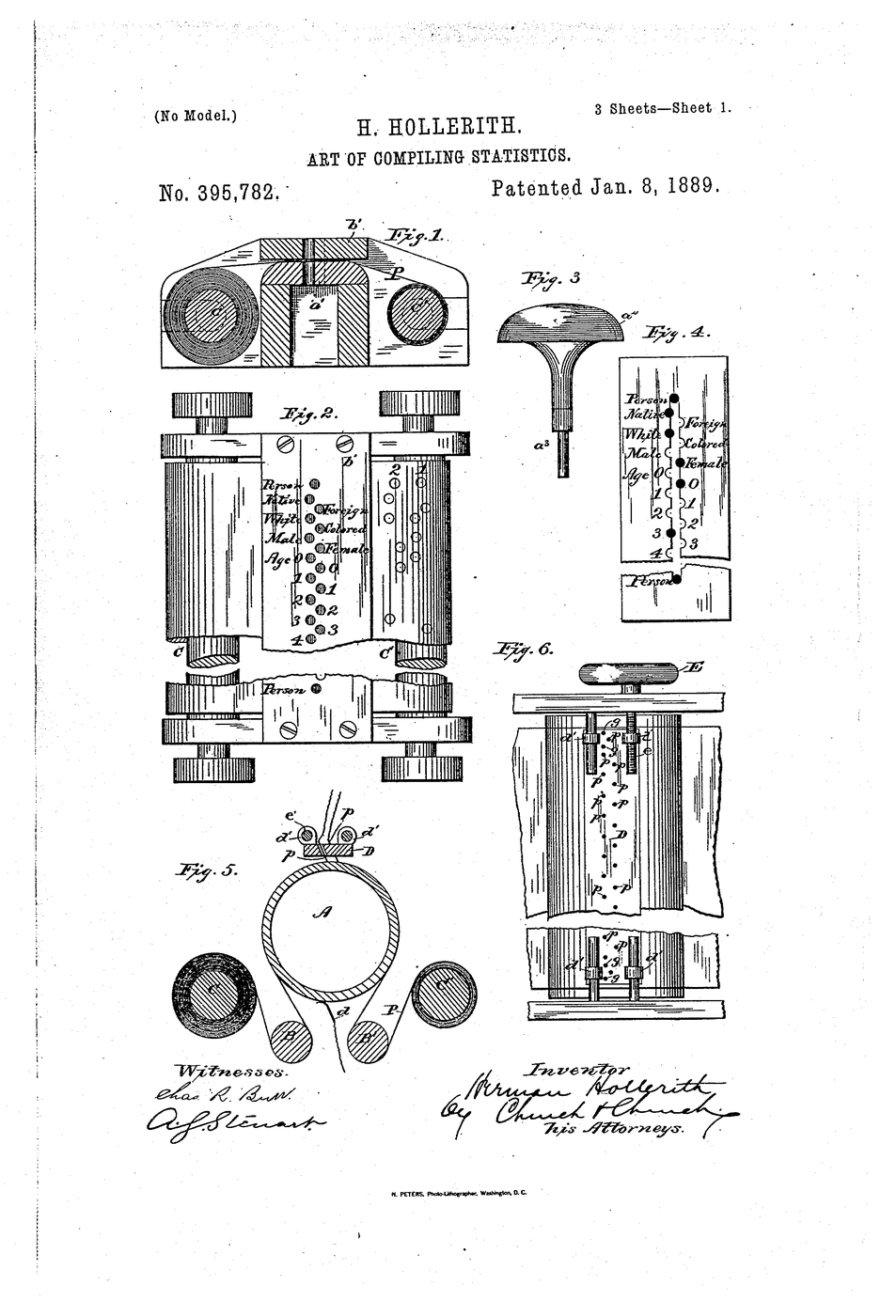
US Patent 395,782, "Art of compiling statistics", filed 23 September 1884 and granted 8 January 1889 to Herman Hollerith. The claim turns on "circuit-controlling index-points bearing a fixed relation to each other".
Зааварчилгаа
Read US 395,782 and note the three stages
Read US 395,782 and note the three stages
Hollerith claims recording, verifying and tabulating as one connected art. The machine is only the third stage; the fixed hole positions are what make it possible.
Write 20 records out longhand
Write 20 records out longhand
Invent 20 people, each with three attributes: trade, age band, birthplace. Write them as sentences on paper.
Hand-count one question and time it
Hand-count one question and time it
Count how many are farmers. Time yourself. Now count farmers over forty — and notice you had to read all 20 again.
Rule a card into fixed index positions
Rule a card into fixed index positions
Mark 12 positions in a fixed grid on a card: 4 for trade, 4 for age band, 4 for birthplace. Position carries the meaning — nothing is written down.
Punch the 20 records
Punch the 20 records
Make one card per person, punching only the positions that apply. Keep the punch clean — a half-punched hole is the classic failure.
Verify with a template overlay
Verify with a template overlay
Cut a labelled template and lay it over each card to confirm the holes mean what you intended. Hollerith makes verification its own claimed stage.
Sort by dropping a knitting needle through
Sort by dropping a knitting needle through
Stack the cards, push a needle through the "farmer" position and lift. Farmers stay behind, everyone else rises. You just counted without reading.
Use two needles at once
Use two needles at once
Push needles through "farmer" AND "over forty" together. What drops satisfies both. This is a logical AND, done with wire.
Build the electrical reader
Build the electrical reader
Fix a strip of foil below the card and mount a springy wire pin above one index position, wired through a battery to an LED.
Энэ алхмын материал:
 Цайрдсан ган утас1 метр
Шаардлагатай багаж:
 Хавтгай хошуут хямсаа
Pass an unpunched card under the pin
Pass an unpunched card under the pin
The card insulates the pin from the foil. No circuit, no light. Card stock is the switch.
Pass a punched card under the pin
Pass a punched card under the pin
The pin drops through the hole and touches the foil. The LED lights. A hole is a closed circuit — this single fact is the whole invention.
Шаардлагатай багаж:
 Тоон мультиметр — автомат хязгаар, жинхэнэ RMS
Wire two pins in series
Wire two pins in series
Put pins on "farmer" and "over forty" in series. The LED lights only when BOTH holes are present — the combined question is answered by the wiring, not by a person.
Rewire the same pins in parallel
Rewire the same pins in parallel
Now it lights for EITHER. Same cards, same pins, different question. Re-asking costs a wire, not another pass through the records.
Run all 20 cards and tally
Run all 20 cards and tally
Feed the stack through, ticking a counter each time it lights. Time it and compare with step 3.
History & Context — the census that built a computer company
History & Context — the census that built a computer company
The patent. US 395,782, "Art of compiling statistics", filed 23 September 1884 and granted 8 January 1889 to Herman Hollerith. Note the granted title: an art, not a machine. Hollerith claimed the whole method — record, verify, tabulate — and that breadth is why the patent mattered commercially.
This patent uses punched paper STRIPS, not cards. The rolled strip is what the 1889 document describes, and it has an obvious defect: a strip must be read in order, so you cannot pull one record out, re-sort the set, or replace a single entry. The independent card — which can be sorted, counted, re-sorted and filed — arrives in Hollerith's later work and is what everyone pictures. Retro-fitting the card onto this patent is a small error that hides the actual design step.
It worked, and the numbers are the argument. The 1890 census was tabulated in a fraction of the time its predecessor took, on a larger population, and produced cross-tabulations that had previously been unaffordable to ask for. Hollerith formed the Tabulating Machine Company; through a 1911 merger and a 1924 renaming it became IBM. The line from a census clerk's bottleneck to the twentieth-century computer industry is unusually direct.
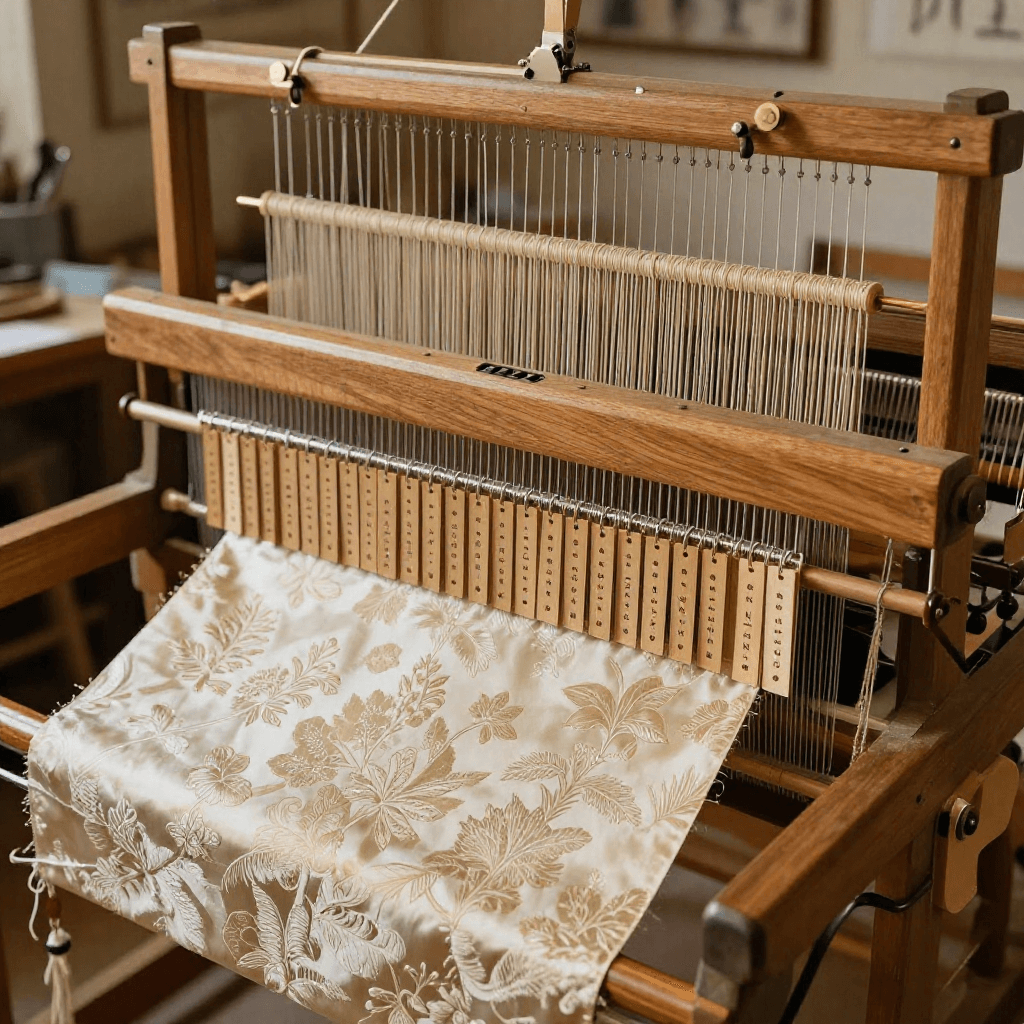
Where the idea came from, and where it went. Punched-hole control was not new — the Jacquard loom had been using punched cards to control weaving since 1804, and Hollerith knew it. His change is what the hole does: in Jacquard's loom a hole permits a mechanical hook to pass, controlling one machine action; in Hollerith's it closes an electrical circuit, and electricity can be branched, combined and counted in ways levers cannot. That is why steps 12 and 13 are the heart of this build. Wiring pins in series asks AND; in parallel asks OR. Hollerith is doing Boolean logic on physical media half a century before anyone builds a computer, and the reason his machine could answer questions no clerk had time for is that the question lives in the wiring, not in the records.
The uncomfortable part, stated plainly. A technology that makes populations efficiently countable and cross-classifiable is powerful in whoever's hands hold it. Hollerith-type punched-card systems were later used by states for purposes far darker than census statistics, including by Nazi Germany. That history belongs beside the invention rather than after it: the machine is genuinely brilliant, and what it does is make it cheap to sort people into categories.
Материал
1- 1 метрТүр орлуулагч
Шаардлагатай багаж
2- Түр орлуулагч
- Түр орлуулагч
Холбоотой загварууд
Эдгээр загварууд мэдлэг хуваалцдаг — арга техник, материал эсвэл зарчим

CC0 Нийтийн домэйн
Энэ загвар CC0 дор гаргагдсан. Та зөвшөөрөл авахгүйгээр хуулах, өөрчлөх, түгээх, ашиглах боломжтой.
Загвараар дамжуулан бүтээгдэхүүн худалдаж авч Бүтээгчийг дэмжээрэй Бүтээгчийн шимтгэл Борлуулагчаар тогтоосон, эсвэл энэ загварын шинэ хувилбар үүсгэж орлогоо хуваахын тулд өөрийн загварт холбоос болгон оруулна уу.