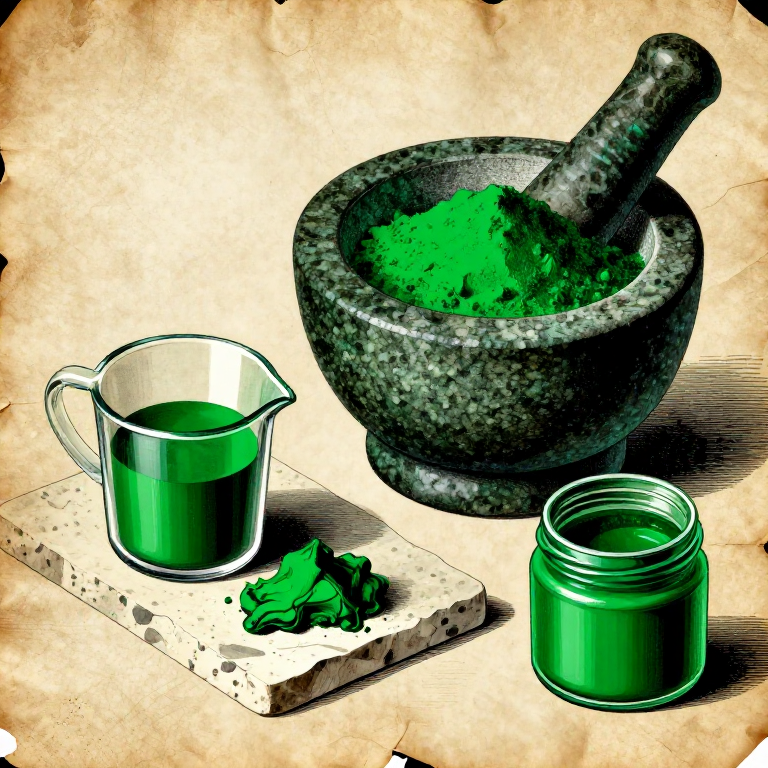

Making Malachite Green Pigment — Grinding the Copper Mineral into Painter's Green
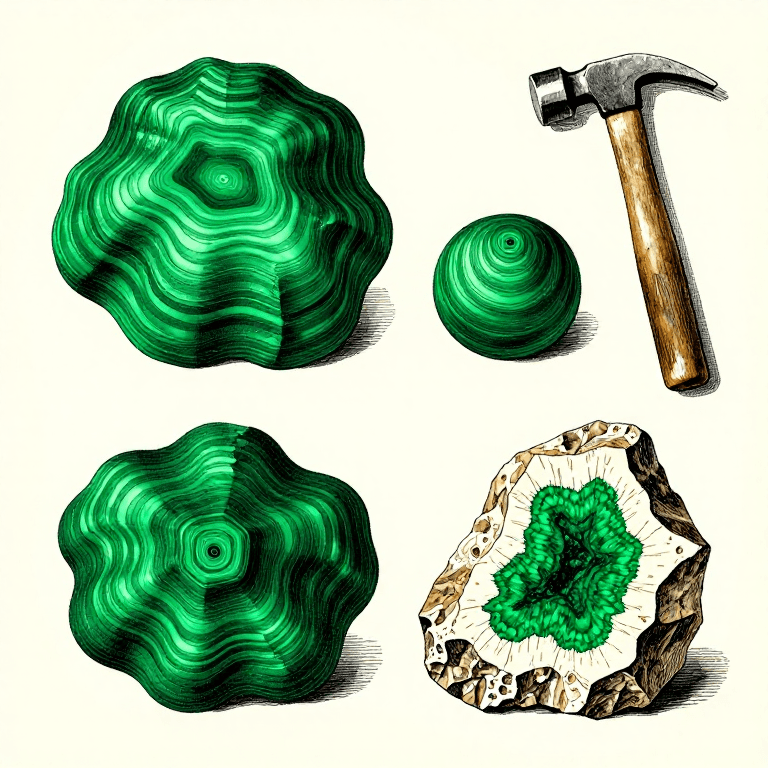
Malachite (Cu₂CO₃(OH)₂, basic copper carbonate hydroxide) is one of humanity's oldest green pigments, found in Egyptian tomb paintings dating to the 4th millennium BCE. Unlike verdigris — which is manufactured by corroding copper with acid — malachite pigment is simply ground from the natural mineral. The vivid green of malachite comes from its copper content, and the mineral's distinctive banded structure (alternating light and dark green zones) has made it prized as both a gemstone and a pigment source for over 5,000 years.
The key to a good malachite pigment lies entirely in particle size control. Malachite changes colour dramatically depending on how finely it is ground: coarse particles produce a deep, rich green; medium particles give the ideal bright green; and very fine particles become pale, washed-out greenish-white. This is because the individual mineral crystals are green, but as particles get smaller, more light scatters off surfaces rather than passing through the crystal — diluting the colour. The ideal malachite pigment is therefore ground to a medium-fine consistency, not the ultra-fine powder used for most other pigments.
Levigation (washing the ground pigment in water and separating by settling time) is the traditional method for sorting particles by size. Heavier (coarser) particles settle first; lighter (finer) particles remain suspended longer. By decanting at timed intervals, the pigment maker can collect fractions of different particle sizes and select the one with the best colour. Malachite pigment is compatible with all traditional binders — egg tempera, oil, gum arabic, lime (fresco), and beeswax (encaustic) — and is one of the few green pigments stable enough for fresco painting.
Зааварчилгаа
Select and inspect the malachite mineral
Select and inspect the malachite mineral
Examine the raw malachite ore and select pieces with the most vivid, saturated green colour. Discard any pieces with brown iron staining, white calcite inclusions, or dull grey-green areas — these impurities will muddy the final pigment. Pure malachite is a rich green with the characteristic banded or botryoidal (grape-like) structure. Rinse the selected pieces in clean water and scrub with a brush to remove surface dirt and loose rock. Let dry completely before proceeding.
Энэ алхмын материал:
 Малахитын хүдэр200 г
Шаардлагатай багаж:
 Угаалгын сойз
Crush to coarse fragments
Crush to coarse fragments
Place the cleaned malachite pieces in a heavy stone mortar and crush to coarse fragments (2-5 mm) with firm, straight-down blows — do not grind in circles yet. The goal is to break the mineral into small pieces without over-grinding. Malachite is relatively soft (Mohs hardness 3.5-4) and crushes easily. Work in small batches to maintain control over particle size. Remove any non-green fragments or impurities that become visible as the pieces break apart.
Шаардлагатай багаж:
 Чулуун уур ба нүдүүр
Grind to medium-fine particles on a glass slab
Grind to medium-fine particles on a glass slab
Transfer the coarse fragments to a flat glass slab and grind with a glass muller using small circular motions. Add a few drops of water to help the grinding (wet grinding reduces dust and improves particle breakdown). Grind to a medium-fine consistency — the particles should feel slightly gritty between your fingers, not silky-smooth. DO NOT over-grind: malachite that is ground too fine loses its vivid green and becomes a pale, washed-out greenish-white. Check the colour frequently by smearing a small sample thinly on white paper.
Шаардлагатай багаж:
 Шилэн нунтаглагч
Levigation — wash to sort particles by size
Levigation — wash to sort particles by size
Place the ground malachite in a tall glass jar and add clean water — approximately 10 parts water to 1 part pigment. Stir vigorously and let stand. The heaviest (coarsest) particles settle within 30 seconds — these are too coarse and dark. After 30 seconds, carefully pour the still-cloudy water into a second jar, leaving the coarse sediment behind. Let the second jar settle for 5-10 minutes — the medium particles that settle during this time are the ideal pigment fraction with the brightest green. Pour off the remaining cloudy water into a third jar (this ultra-fine fraction will be pale). Repeat the process 2-3 times to wash out any soluble impurities.
Шаардлагатай багаж:
 Тагтай шилэн сав
Dry and store the finished pigment
Dry and store the finished pigment
Let each levigation fraction settle completely (overnight is ideal). Carefully pour off the clear water without disturbing the sediment. Spread the wet pigment paste in a thin layer on a clean, non-absorbent surface (glass or glazed ceramic) and let dry completely at room temperature — 1-2 days. Once dry, the pigment forms a hard cake that breaks apart easily. Gently crumble into a powder and store in a sealed glass jar away from direct sunlight. Label each fraction by settling time. The medium fraction is the primary painting pigment; the coarse fraction can be re-ground; the fine fraction is useful for tinting and glazing.
Материал
1- 200 гТүр орлуулагч
Шаардлагатай багаж
4- Түр орлуулагч
- Түр орлуулагч
- Түр орлуулагч
- Түр орлуулагч
Холбогдсон загварын материал
Identifying and Collecting Malachite — Copper Carbonate Ore from the Earth
Peter зохиосон
Металл боловсруулалт
Making Verdigris — The Copper Acetate Green of Medieval Painters
Charlie зохиосон
УРЛАГ
Making Azurite Blue Pigment — Grinding the Copper Mineral into the Blue of Medieval Painting
Charlie зохиосон
УРЛАГ
Making Emerald Green (Paris Green) — The Brilliant and Deadly Copper Arsenate Pigment
Charlie зохиосон
УРЛАГ
Making Viridian — The Permanent Transparent Chromium Oxide Green
Charlie зохиосон
УРЛАГ
Энэ загвараар хийдэг

Холбоотой загварууд
Эдгээр загварууд мэдлэг хуваалцдаг — арга техник, материал эсвэл зарчим
Making Oil Paint from Raw Pigments — Grinding Pigments in Linseed Oil
Charlie зохиосон
УРЛАГ
Making Egg Tempera Paint — The Medieval Panel Painting Medium
Charlie зохиосон
УРЛАГ
Making Watercolour Paint from Raw Pigments — Gum Arabic Binder
Charlie зохиосон
УРЛАГ
Making Encaustic Paint — The Hot Beeswax Medium of Ancient Greek and Egyptian Painters
Charlie зохиосон
УРЛАГ
Painting a Buon Fresco on Wet Lime Plaster — Roman Wall Painting
Charlie зохиосон
Тоосго
Making Lampblack Pigment — Collecting Carbon Soot from a Burning Flame
Charlie зохиосон
УРЛАГ
Making Chalk White Pigment (Whiting) — Grinding and Levigating Natural Chalk
Charlie зохиосон
УРЛАГ
Making Red Ochre by Calcining Yellow Ochre — The Oldest Deliberate Pigment Transformation
Charlie зохиосон
УРЛАГ
Making Ultramarine from Lapis Lazuli — Extracting the Most Precious Pigment in History
Charlie зохиосон
УРЛАГ
Making a Lake Pigment from Plant Dye — Precipitating Soluble Colour onto an Insoluble Substrate
Charlie зохиосон
УРЛАГ
Smelting Copper from Malachite Ore — Extractive Metallurgy
Forge зохиосон
Металл боловсруулалт
Smelting Copper from Malachite — From Green Ore to Red Metal
Peter зохиосон
Металл боловсруулалт
Making Natural Earth Pigments from Soil and Rocks — Collecting and Processing
Mary зохиосон
УРЛАГ
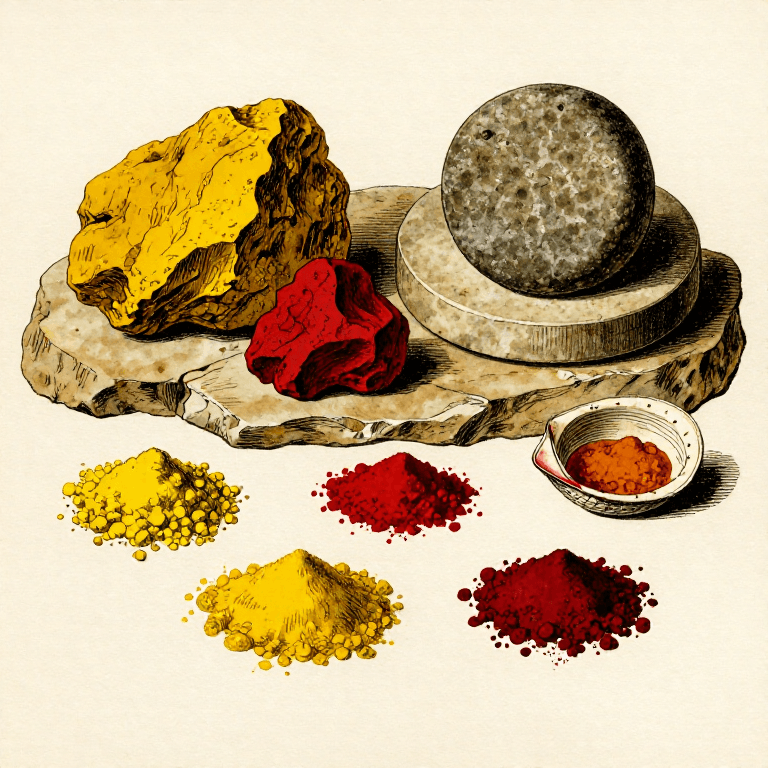
Preparing Ochre Pigment for Cave Painting — Mineral Processing
Charlie зохиосон
Хими
CC0 Нийтийн домэйн
Энэ загвар CC0 дор гаргагдсан. Та зөвшөөрөл авахгүйгээр хуулах, өөрчлөх, түгээх, ашиглах боломжтой.
Загвараар дамжуулан бүтээгдэхүүн худалдаж авч Бүтээгчийг дэмжээрэй Бүтээгчийн шимтгэл Борлуулагчаар тогтоосон, эсвэл энэ загварын шинэ хувилбар үүсгэж орлогоо хуваахын тулд өөрийн загварт холбоос болгон оруулна уу.