
Pottage
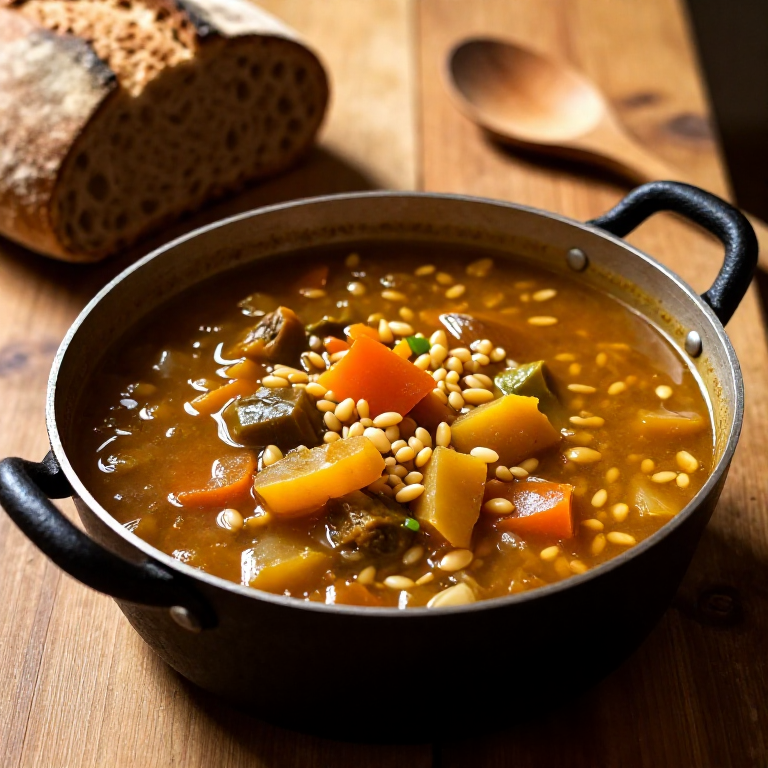
For most people in medieval Europe, dinner was pottage. One pot over the fire, grain or pulses as the body of it, whatever vegetables and herbs the garden held, and meat when there was meat.
It is not a recipe so much as a method, and the method is built around two facts of a pre-industrial kitchen: fuel is expensive and the pot never really stops. One pot means one fire. A pottage topped up daily and reboiled feeds a household continuously with very little wood.
The cooking skill is in sequencing. Everything goes in at the moment that leaves it correctly cooked at the same time — which is the same problem a modern one-pot dish has, solved with a great deal less equipment.
Зааварчилгаа
Soak the pulses overnight
Soak the pulses overnight
Put 200 g of dried peas or beans in cold water overnight. Unsoaked pulses take hours and never soften evenly — this is the step that decides whether the pot works.
Энэ алхмын материал:
 Хатаасан шош200 г
Start with 2 litres of cold water
Start with 2 litres of cold water
Put the drained pulses in a heavy pot with 2 litres of cold water. Cold start, not boiling — pulses dropped into boiling water firm up on the outside before the middle softens.
Шаардлагатай багаж:
 Усан ваннтай давхар тогоо
Bring it up slowly and skim
Bring it up slowly and skim
Bring to a bare simmer over 20 minutes and skim off the grey foam. Skimming is what separates a clean-tasting pot from a muddy one.
Add the grain
Add the grain
Stir in 100 g of barley or oats. Grain is the thickener — it releases starch as it cooks and gives pottage its body. Wheat was for bread; barley and oats went in the pot.
Энэ алхмын материал:
 Бүхэл улаан буудайн гурил100 г
Add the long-cooking roots
Add the long-cooking roots
Chop and add onions, leeks and any hard roots — parsnip, turnip, carrot. These go in early because they take as long as the grain.
Энэ алхмын материал:
 Сонгино2 ширхэг
Keep it below a rolling boil
Keep it below a rolling boil
Hold it at a lazy simmer for an hour, stirring occasionally so the grain does not catch on the bottom. A hard boil breaks the vegetables into mush and scorches the starch.
Add greens only in the last ten minutes
Add greens only in the last ten minutes
Cabbage, kale, chard and any leaf go in near the end. Sequencing is the whole technique — greens added at the start turn grey and give up everything they had.
Season with what a garden actually held
Season with what a garden actually held
Add parsley, thyme, savory, sage — the pot-herbs grown in ordinary gardens. Imported spice belonged to wealthy kitchens and would be wrong in an everyday pottage.
Salt at the end, not the start
Salt at the end, not the start
Salt once the pulses are soft. Salting early can slow the softening, and a pot that reduces while cooking will over-salt itself if seasoned at the beginning.
Judge the consistency by the spoon
Judge the consistency by the spoon
A spoon should stand up briefly and then fall. Thin pottage is broth; a stiff one is a mess of pottage — both are real, and the difference is water and time.
Add meat where it belongs
Add meat where it belongs
If you have bacon or a bone, add it at the start so it flavours the whole pot. A little meat used as seasoning for a large pot of grain and vegetables is how meat actually appeared in most medieval meals.
Serve it with bread, not in a bowl alone
Serve it with bread, not in a bowl alone
Eat it with coarse bread. Pottage and bread together is the ordinary meal — either alone is only half of it.
Keep the pot going — safely
Keep the pot going — safely
Traditionally the pot was topped up and re-boiled daily. If you do this, cool it fast, refrigerate it, and bring it to a full rolling boil for several minutes before eating. A pot left warm all day is a bacterial incubator — the historical practice worked with a fire and constant reheating, not a modern warm kitchen.
History & Context
History & Context
The default meal. Across medieval Europe, pottage was what most people ate most days. The word covers a range — thin and soupy through to thick enough to eat with a spoon standing in it — and its constant is the method rather than the ingredients: one pot, grain or pulses as the base, garden vegetables, herbs, and meat as a flavouring when available.
Fuel is the hidden constraint. Cooking over a fire that must be fed with gathered or bought fuel makes a single long-simmering pot vastly cheaper than several dishes cooked separately. Nearly every peasant cuisine in the world converges on one-pot cooking, and it is an economic result rather than a culinary preference.
Nutritionally it works. Grain plus pulses together supply a more complete set of amino acids than either alone, and the long simmer softens fibre and makes the food easier to digest. It is not a poor imitation of a better meal — it is a genuinely sound way to feed people from cheap ingredients, which is why versions survive everywhere from Scottish broth to Italian minestra.
The perpetual pot, honestly. The romantic version has a pot hanging over the hearth for weeks, added to daily. Something like this did happen — but it worked because the pot was boiled hard every day over an active fire, which kills what grows in it between times. Repeating it in a modern kitchen without refrigeration and a genuine rolling boil is a food-poisoning risk, and this blueprint says so rather than letting the picturesque version stand.
Where the phrase comes from. "A mess of pottage" — a serving of pottage — is now a set phrase for something trivial traded for something valuable, from the biblical story of Esau. That a word for the ordinary daily meal became shorthand for worthlessness says a good deal about who wrote the histories.
Материал
3- 200 гТүр орлуулагч
- Түр орлуулагч
- 2 ширхэгТүр орлуулагч
Шаардлагатай багаж
1- Түр орлуулагч
Энэ загвараар хийдэг

CC0 Нийтийн домэйн
Энэ загвар CC0 дор гаргагдсан. Та зөвшөөрөл авахгүйгээр хуулах, өөрчлөх, түгээх, ашиглах боломжтой.
Загвараар дамжуулан бүтээгдэхүүн худалдаж авч Бүтээгчийг дэмжээрэй Бүтээгчийн шимтгэл Борлуулагчаар тогтоосон, эсвэл энэ загварын шинэ хувилбар үүсгэж орлогоо хуваахын тулд өөрийн загварт холбоос болгон оруулна уу.