УРЛАГ
ГОО САЙХАН БА ЭРҮҮЛ МЭНД
ГАРААР ХИЙСЭН
СОЁЛ БА ТҮҮХ
ҮЗВЭР НААДАМ
БАЙГАЛЬ ОРЧИН
ХООЛ БА УНДАА
УРВУУ ИНЖЕНЕРЧЛЭЛ
ШИНЖЛЭХ УХААН
СПОРТ
ТЕХНОЛОГИ
ӨМСДӨГ ХЭРЭГСЭЛ



Staple and Preparation: What Decides Whether a Fibre Can Be Spun at All
A yarn is short fibres held together by twist, and how well that works depends almost entirely on how long the fibres are and how they are lying when the twist arrives.
**Staple length** is the single most important property of a fibre. It decides whether the yarn can be fine, how strong it will be, how much twist it needs, and which of the two great preparation traditions is appropriate.
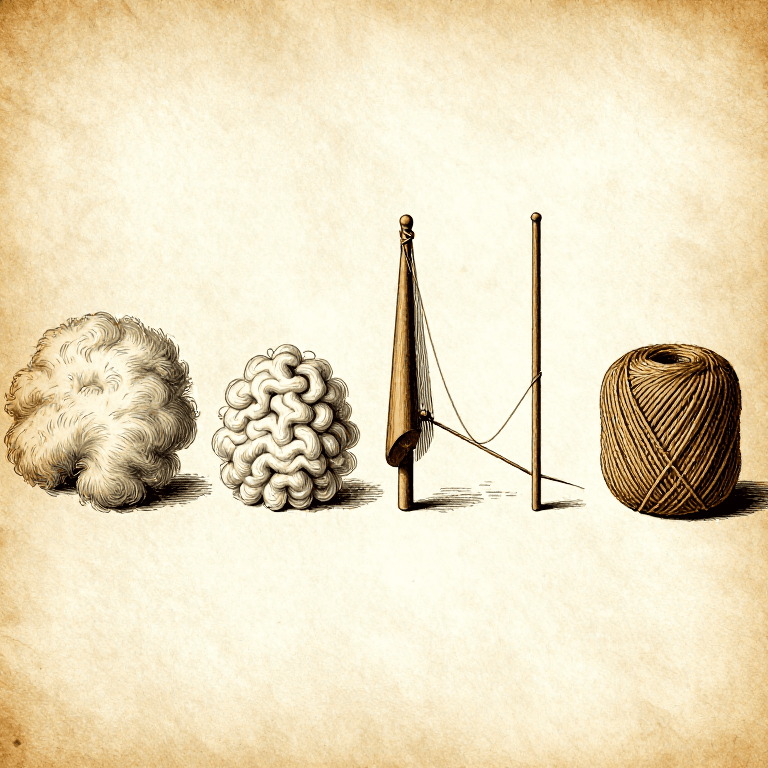
Those two traditions — **woollen**, from carded fibre lying every which way, and **worsted**, from combed fibre lying parallel — produce yarns so different that they are barely the same material, from the same fleece.
Анхан шат
3 hours
Зааварчилгаа
1
1
Staple length, crimp and fineness
Staple length, crimp and fineness
**Staple length** is the length of an individual fibre, measured by pulling a small lock straight and measuring it relaxed.
* under about 25 mm — short, hard to spin, needs a lot of twist: cotton, cashmere
* 25 to 75 mm — the general run of wool, and the easiest to learn on
* over 100 mm — long wool, mohair, flax, and it wants a different technique
**Fibres shorter than the distance between your hands cannot be drafted conventionally**, which is why cotton needed machinery to be spun at scale and wool did not.
**Crimp** is the natural waviness. It is what makes a woollen yarn elastic and warm — the crimp traps air and springs back — and it is why wool felts and linen does not.
**Fineness** is the fibre diameter, in micrometres. Fine wool is around 18 to 22 microns and next-to-skin soft; coarse carpet wool is 35 and up. The rule that matters: a yarn needs **at least about 30 fibres in its cross-section** to hold together, so a fine fibre can make a finer yarn than a coarse one can. That is the whole reason fine wool is worth more.
Test the fleece you have before planning what to make from it.
Энэ алхмын материал:
 Түүхий хонины ноос1 ширхэг
 Хөвөнгийн ровинг1 ширхэг
Шаардлагатай багаж:
 Шугам
Шугам Томруулагч луп
2
2
Washing, and why it comes first
Washing, and why it comes first
A raw fleece carries lanolin, suint (dried sweat), vegetable matter and dirt — commonly 30 to 50% of its weight, which is why a fleece bought by weight is mostly not fibre.
**Skirt it first.** Remove the belly, the britch and anything matted or heavily soiled before washing. It is quicker than washing it and throwing it away afterwards.
**Hot water and detergent, no agitation.** Lanolin melts around 40 C, so the water must be genuinely hot — 60 C or so — and the fleece is lowered in, left, and lifted out. Every rule from the scouring of yarn applies here and more so: **heat plus agitation plus alkali equals felt**, and felted fleece cannot be spun at all.
**Rinse at the same temperature.** A temperature shock felts as surely as stirring does.
**Dry completely before storing.** Damp wool in a bag is ruined within a week.
**Or spin it in the grease.** Unwashed fleece can be spun as it is — the lanolin makes the drafting smoother and the yarn is washed afterwards. It is the traditional method in much of the world, and the only cost is a greasy wheel.
Энэ алхмын материал:
Түүхий хонины ноос2 ширхэгШаардлагатай багаж:
 Нарийн жин
3
3
Carding or combing: the decision that makes the yarn
Carding or combing: the decision that makes the yarn
**Carding** opens the locks and mixes the fibres into a light airy mass with the fibres pointing in all directions. Hand cards, a drum carder, or the fingers.
Carded fibre spun with a long draw gives a **woollen** yarn: lofty, elastic, warm, full of trapped air, fuzzy on the surface, and not very strong. Blankets, jumpers, tweed.
**Combing** pulls the fibres parallel and **throws the short ones away**. What comes off the comb is a top of long parallel fibre; what stays in the comb is noil, which is not waste but is a different, shorter fibre.
Combed fibre spun with a short draw gives a **worsted** yarn: smooth, dense, strong, lustrous, hard-wearing, and cool. Suiting, socks, warp.
**They are not interchangeable and they are not qualities.** A woollen yarn is not a badly made worsted; they are two answers to two purposes. The same fleece makes both.
**Combing costs material.** Half a fleece can end up as noil. That is the price of the strength and the smoothness, and it is why worsted cloth has always cost more.
The intermediate — combed fibre spun woollen, or carded fibre spun worsted — is "semi-worsted" and is what most commercial yarn actually is.
Энэ алхмын материал:
Түүхий хонины ноос2 ширхэгШаардлагатай багаж:
 Гар самнуур
 Ноос самнуурТомруулагч луп
4
4
The bast fibres, which work the other way round
The bast fibres, which work the other way round
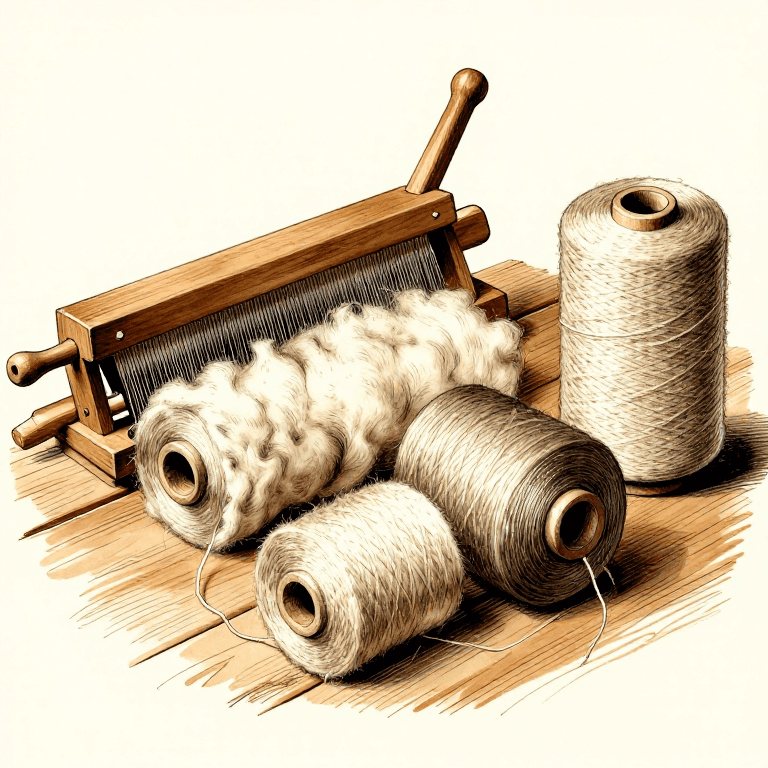
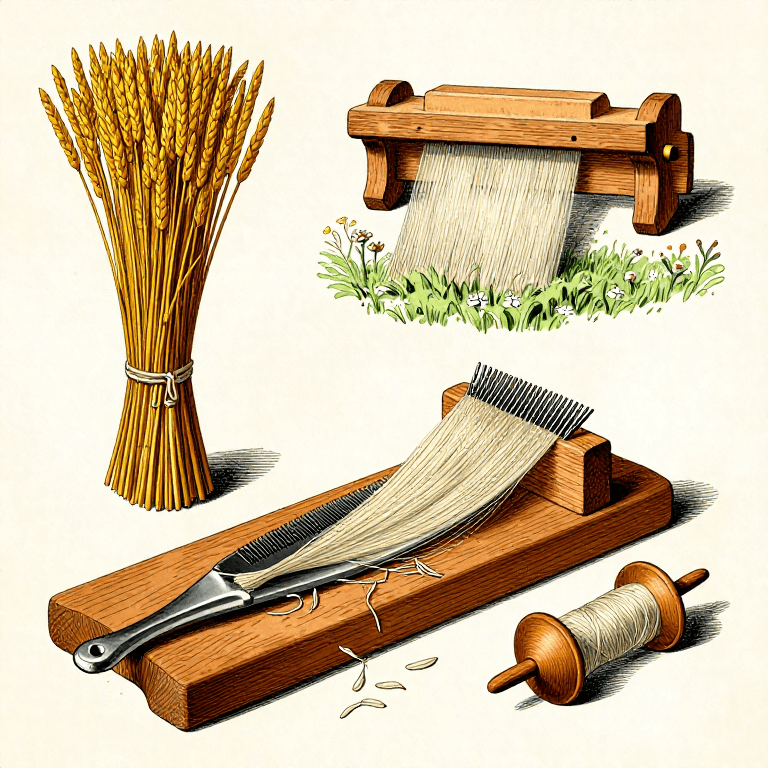
Flax, hemp, ramie, nettle and jute are **bast** fibres — the fibre bundles from inside a plant stem — and almost everything above is different for them.
**They must be retted first.** Controlled rotting, in water or on the ground, lets bacteria break down the pectin gluing the fibre to the woody core. Under-ret and the fibre will not separate; over-ret and the fibre itself is destroyed. There is no way to undo either, and the catalogue's retting blueprints are about exactly this judgement.
**Then broken, scutched and hackled.** Break the woody core, beat it away, then pull the fibre through progressively finer combs. Hackling is combing, and it serves the same purpose: parallel fibres, short ones removed.
**They are very long** — flax line fibre runs to 600 mm and more — so they are spun from a distaff rather than from the hand, with a short draft and often wet-spun, because water makes the pectin that is left sticky and binds the yarn.
**They have almost no crimp and no elasticity.** Linen is strong, cool, lustrous, creases hard and does not spring back. It is stronger wet than dry, which is the opposite of most fibres and the reason linen was the fabric of sails, sacks and shirts.
**They do not felt.** No scales, so nothing interlocks.
Энэ алхмын материал:
 Маалингын утас1 ширхэгТүүхий хонины ноос1 ширхэг
Шаардлагатай багаж:
Томруулагч лупШугамМатериал
3- 6 ширхэгТүр орлуулагч
- 1 ширхэгТүр орлуулагч
- 1 ширхэгТүр орлуулагч
Холбоотой загварууд
Эдгээр загварууд мэдлэг хуваалцдаг — арга техник, материал эсвэл зарчим
CC0 Нийтийн домэйн
Энэ загвар CC0 дор гаргагдсан. Та зөвшөөрөл авахгүйгээр хуулах, өөрчлөх, түгээх, ашиглах боломжтой.
Загвараар дамжуулан бүтээгдэхүүн худалдаж авч Бүтээгчийг дэмжээрэй Бүтээгчийн шимтгэл Борлуулагчаар тогтоосон, эсвэл энэ загварын шинэ хувилбар үүсгэж орлогоо хуваахын тулд өөрийн загварт холбоос болгон оруулна уу.