

Drinking Sumerian Beer Through a Reed Straw — Why Ancient Beer Needed a Filter
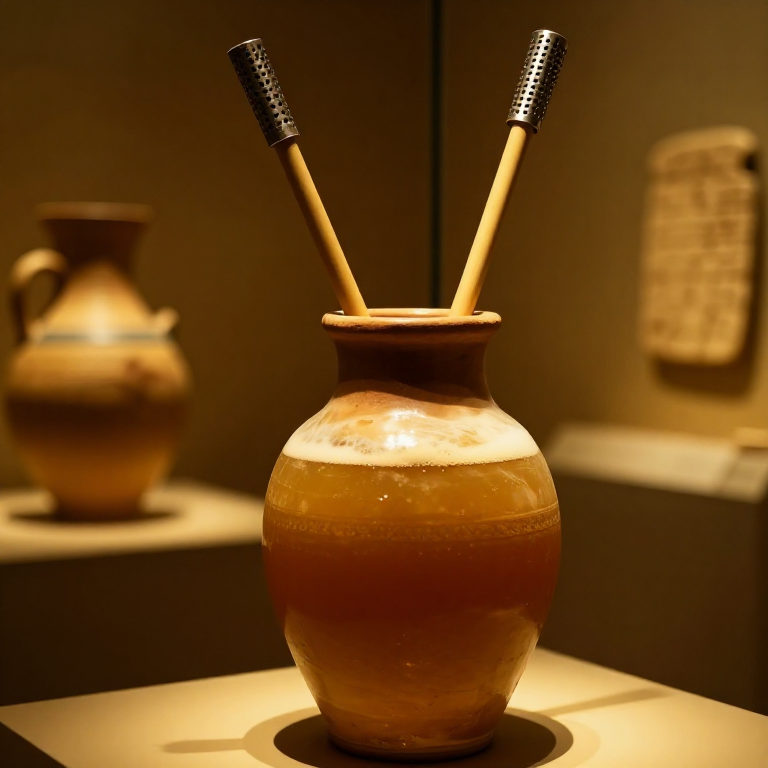
The oldest known depiction of beer drinking is a 4,000-year-old Sumerian seal showing two people sharing a large jar through long reed straws. This was not a quirky preference — it was a necessity. Ancient Mesopotamian beer was nothing like modern filtered, carbonated beer. It was a thick, porridge-like fermented grain mash filled with floating husks, bran particles, dead yeast, and chunks of the bread (bappir) used as the fermentation starter. Drinking it directly from the jar meant getting a mouthful of gritty sediment.
The reed straw solved this elegantly: the bottom end was either perforated with small holes or fitted with a metal strainer tip that filtered the liquid while the drinker sucked. Gold and lapis lazuli drinking straws found in the Royal Cemetery of Ur (c. 2600 BCE) show that beer straws were luxury items for the elite — the Sumerian equivalent of fine wine glasses. Queen Puabi was buried with her personal golden beer straw, alongside other treasures she presumably needed in the afterlife.
The Hymn to Ninkasi — the oldest known beer recipe, written as a prayer to the Sumerian goddess of brewing around 1800 BCE — describes the entire process from malting grain to filtering the finished beer through reed mats. Beer was so central to Mesopotamian civilization that workers were partially paid in beer rations (approximately 2-5 liters per day, depending on rank), and the earliest known written laws (the Code of Hammurabi, c. 1754 BCE) included regulations on beer pricing and quality. The reed straw was the interface between humanity and its oldest social lubricant.
Зааварчилгаа
Select and harvest reeds
Select and harvest reeds
Mesopotamian beer straws were made from the giant reed (Arundo donax) or common reed (Phragmites australis), both of which grew abundantly in the marshlands of southern Iraq between the Tigris and Euphrates rivers. Select mature, dry reed stalks approximately 60-80 cm long and 8-12 mm in diameter — long enough to reach from the drinker's mouth to the bottom of a large clay beer jar set on the floor.
The reed must be naturally hollow with thin, membranous nodes (the internal walls at each joint). These nodes are the key to the straw's filtering function — they can be partially punctured to create a built-in strainer, or fully cleared to create a smooth drinking tube. Cut the reed cleanly above and below a joint using a sharp knife. Avoid cracked, split, or insect-damaged reeds.
Энэ алхмын материал:
 Хатаасан зэгс1 ширхэг
Шаардлагатай багаж:
 Хутга
ХутгаClear the internal nodes
Clear the internal nodes
Push a thin, straight stick or wire through the hollow reed to puncture and clear the internal node membranes. The cleared tube should allow air (and liquid) to flow freely from one end to the other. Test by holding one end to your mouth and blowing — air should exit the other end without resistance. If any node is still partially blocked, push the clearing stick through again from the opposite direction.
For the bottom section that will be submerged in the beer, leave the final node partially intact or drill several small holes through it using a heated awl or thorn. This creates a strainer that allows liquid to pass while blocking the grain husks, bran particles, and yeast clumps that made ancient beer a challenge to drink directly. The holes should be approximately 1-2 mm in diameter — large enough for liquid to flow easily when sucked, small enough to stop solid particles.
Шаардлагатай багаж:
 Шөвөг
ШөвөгSmooth and seal the reed
Smooth and seal the reed
Sand the exterior of the reed smooth, paying special attention to the mouthpiece end — any rough edges or splinters will make it uncomfortable to drink from. The drinking end can be cut at a slight angle (like a modern drinking straw) or left straight. Some Sumerian straws had a flared bell-shaped mouthpiece carved from the reed's natural node, creating a comfortable lip rest.
Seal any cracks or thin spots in the reed wall with beeswax or pine resin — a leaking straw defeats its purpose as a filter. Apply a thin coat of beeswax to the entire exterior for waterproofing. The wax also prevents the reed from absorbing beer and becoming soft during extended drinking sessions. Sumerian banquets could last for hours, with guests sharing from communal beer jars throughout the evening.
Энэ алхмын материал:
 Зөгийн лав1 ширхэг
 Нарсны давирхай1 ширхэг
The luxury version — metal strainer tips
The luxury version — metal strainer tips
Wealthy Sumerians used straws with metal strainer tips — small perforated cups or cones of copper, bronze, silver, or gold fitted to the bottom end of the reed. The Royal Cemetery of Ur yielded several examples: gold tubes with lapis lazuli inlay, silver straws with intricate perforated strainer baskets, and bronze straws with bulbous strainer ends drilled with dozens of tiny holes.
To make a metal strainer tip, hammer a small sheet of copper or bronze into a cone approximately 3 cm long and 1.5 cm in diameter at the open end. Drill or punch 10-15 small holes (1-2 mm) through the metal. Insert the narrow end of the cone into the bottom of the reed straw and secure with wrapped cord and beeswax. The metal strainer is far more effective than a punctured reed node — it filters finer particles and does not deteriorate in the acidic beer.
Энэ алхмын материал:
 Зэсэн хуудас1 ширхэг
Шаардлагатай багаж:
 Алх
АлхWhy ancient beer was undrinkable without a straw
Why ancient beer was undrinkable without a straw
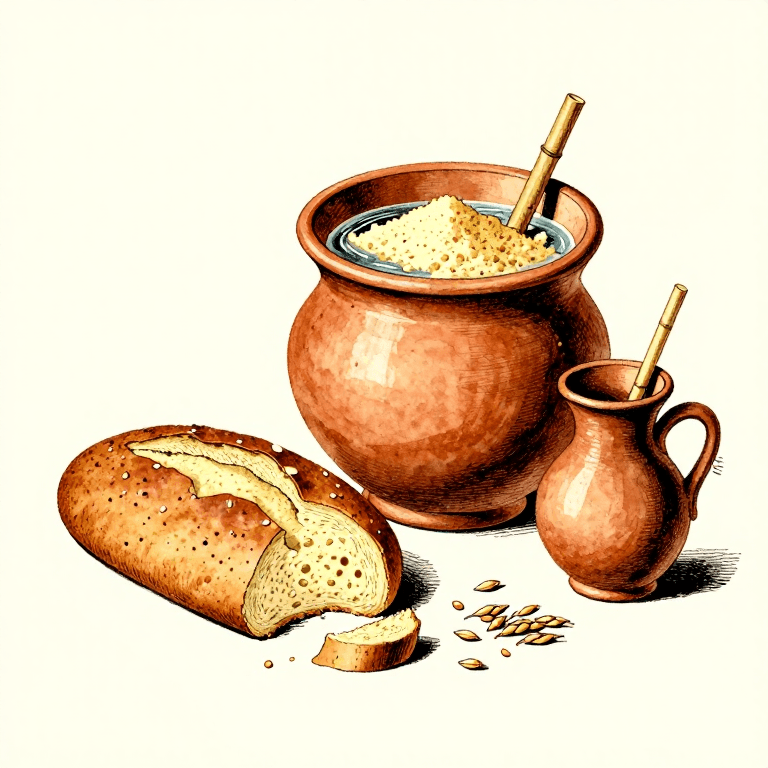
Modern beer is filtered, pasteurised, and carbonated — a clear, uniform liquid that pours cleanly into a glass. Ancient Mesopotamian beer was none of these things. It was made by crumbling bappir (twice-baked barley bread) into a clay jar, adding water, and allowing wild yeast and Lactobacillus bacteria to ferment the sugars over 2-3 days. The result was a cloudy, sour, slightly alcoholic porridge (approximately 3-5% ABV) with a thick layer of floating debris.
Without filtering or straining, drinking this beer meant ingesting spent grain husks (abrasive and bitter), yeast sediment (which causes digestive discomfort in large quantities), insect fragments (the open jars attracted flies), and occasionally chunks of unfermented bread. The straw's filter tip sat below the floating debris layer and above the settled sediment, drawing clear(ish) beer from the middle zone — the same principle used in modern brewing's 'racking' process, where clear beer is drawn from between the top krausen and bottom trub.
The social ritual of shared drinking
The social ritual of shared drinking
The beer straw was not just a filter — it was a social instrument. Sumerian cylinder seals and relief carvings consistently show two or more people drinking from the same large jar through individual straws. This communal drinking was a ritual act: sharing a beer jar signified friendship, trust, and social bonding. The Sumerian proverb 'He who does not know beer, does not know what is good' reflects a culture where beer was inseparable from social life, religion, and daily nourishment.
Beer rations were a form of currency — workers at temples and construction projects received 2-5 liters of beer daily as partial payment. The goddess Ninkasi was honoured with hymns that doubled as brewing instructions, ensuring the recipe would be preserved through oral tradition even if the written tablets were lost. The reed beer straw — simple, effective, and communal — was the tool that made this 5,000-year-old social tradition physically possible.
Материал
4- 1 ширхэгТүр орлуулагч
- 1 ширхэгТүр орлуулагч
- 1 ширхэгТүр орлуулагч
- 1 ширхэгТүр орлуулагч
Холбогдсон загварын материал

Холбоотой загварууд
Эдгээр загварууд мэдлэг хуваалцдаг — арга техник, материал эсвэл зарчим


CC0 Нийтийн домэйн
Энэ загвар CC0 дор гаргагдсан. Та зөвшөөрөл авахгүйгээр хуулах, өөрчлөх, түгээх, ашиглах боломжтой.
Загвараар дамжуулан бүтээгдэхүүн худалдаж авч Бүтээгчийг дэмжээрэй Бүтээгчийн шимтгэл Борлуулагчаар тогтоосон, эсвэл энэ загварын шинэ хувилбар үүсгэж орлогоо хуваахын тулд өөрийн загварт холбоос болгон оруулна уу.