

The Nest Box
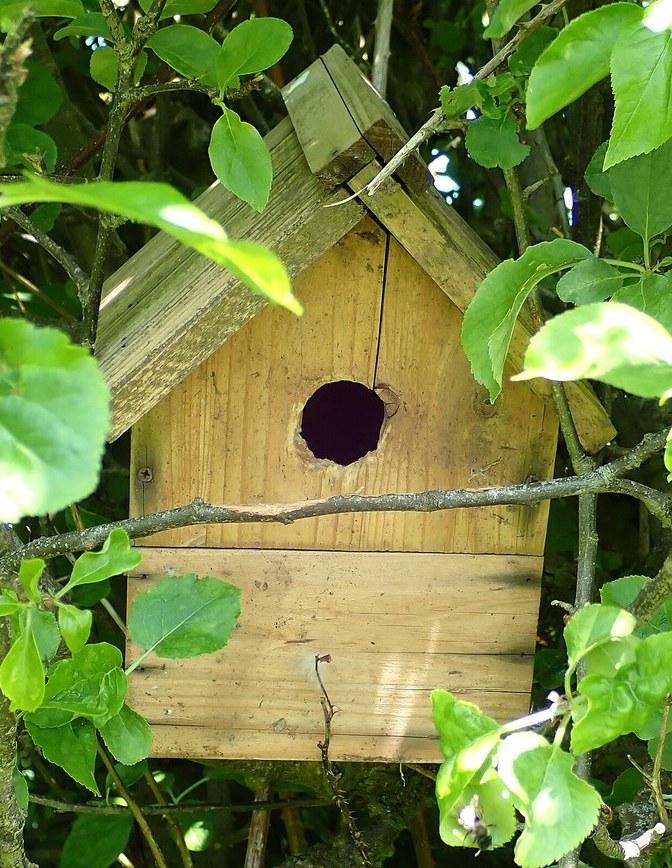
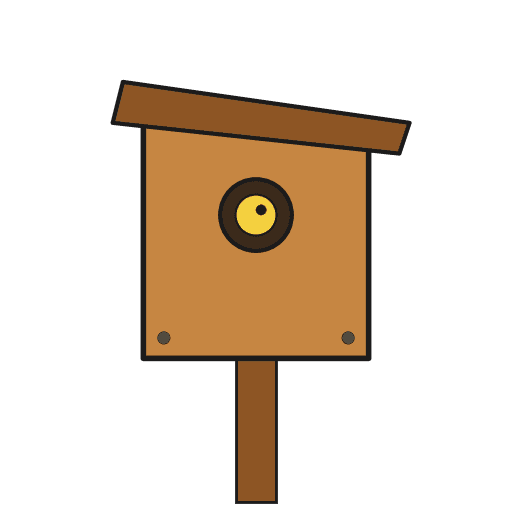
A nest box is a plank box with a hole in it, and almost every detail that looks arbitrary is doing a job.
The hole is the clearest case. The diameter selects the species. A 25 mm hole admits blue tit, coal tit and marsh tit and excludes almost everything larger. 28 mm adds great tit and tree sparrow. 32 mm opens it to house sparrow and nuthatch as well. You are not building a box that birds might use — you are building a filter, and the filter setting is a number you choose with a drill bit.
The rest follows the same logic. No perch: the occupants do not need one and it gives a predator somewhere to stand. The hole set high in the front panel so a reaching paw cannot get down to the cup. A sloping, overhanging roof so rain runs off rather than in. Drainage holes in the floor and small ventilation gaps at the top, because a sealed box is a box that cooks or drowns a brood. Unpainted, untreated inside. And a screwed, openable panel, because a box that cannot be cleaned out is a box that fills with old nests and parasites.
The systematic nest box is credited to Baron Hans von Berlepsch, who from the 1880s promoted boxes modelled on natural woodpecker holes on his estate in Germany, and published on it widely.
Build one, choose your hole, and find out who moves in.
Зааварчилгаа
Cut the six panels from one board
Cut the six panels from one board
Use rough-sawn softwood at least 15 mm thick — 18-20 mm is better. Cut front, back, two sides, floor and roof.
Make the sides taper so the roof slopes forward, and cut the back panel long top and bottom for fixing.
Thin timber is the commonest mistake. The wall thickness is the insulation; a 10 mm box swings from cold to lethal inside on a sunny afternoon.
Энэ алхмын материал:
 Нарсан модон материал1 ширхэг
Шаардлагатай багаж:
 Гар хөрөө
 Соронзон хэмжих туузан шугам
Choose the hole diameter — this is the design decision
Choose the hole diameter — this is the design decision
Drill the entrance hole in the front panel, high up, at least 125 mm above the floor.
Pick the diameter deliberately: 25 mm for blue, coal and marsh tit; 28 mm to add great tit and tree sparrow; 32 mm to admit house sparrow and nuthatch too.
Fit no perch.
Every millimetre widens the guest list downwards in competitiveness — a 32 mm hole in a garden with house sparrows will rarely hold tits.
Шаардлагатай багаж:
 Нүх хөрөөдөгч багц
 Утасгүй өрөм
 Дижитал штангенциркуль 6 инч
Drill drainage and ventilation
Drill drainage and ventilation
Drill four 6 mm holes in the floor, one near each corner. Leave a small gap or drill two 6 mm holes near the top of each side panel.
Test the floor by pouring a cup of water in — it must run straight through.
Rain gets in whatever you do; the box's job is to let it out again. Ventilation matters for the same reason a sealed car does: a small closed box in sun overheats fast.
Assemble with screws and an openable panel
Assemble with screws and an openable panel
Screw the box together — do not rely on glue outdoors. Set the floor recessed a few millimetres up from the bottom edges so end grain is not sitting in water.
Fix the roof with a hinge at the back and a hook, or make one side panel removable with two screws.
Leave the inside bare. No paint, no preservative, no varnish; treat the outside only, and let it dry fully before it goes up.
Энэ алхмын материал:
 #8 × 1" модны шураг24 ширхэг
 Хаалганы нугас1 ширхэг
Шаардлагатай багаж:
Утасгүй өрөмSite it, and record why
Site it, and record why
Fix the box 2-4 m up, tilted very slightly forward so rain runs off the front, with a clear flight path in.
Face it between north and east in the northern hemisphere, away from strong afternoon sun and the wettest prevailing wind.
Write down the height, aspect and date in your notebook.
Aspect is not superstition — a south-facing box in full sun can reach temperatures a brood cannot survive.
Шаардлагатай багаж:
 Ямар ч цаг агаарт тэсвэртэй хээрийн тэмдэглэлийн дэвтэр
Run it as an experiment, not an ornament
Run it as an experiment, not an ornament
Put up two or more boxes differing in one variable only — hole size, or aspect, or height — and leave everything else the same.
Record occupancy over a season from a distance, with binoculars, using the scan-sampling discipline.
Do not open an occupied box. Clean out old material only in autumn or winter, once the season is over.
One box tells you nothing. Two boxes differing in one variable is an experiment.
Шаардлагатай багаж:
 Хос дуран
History & Context
History & Context
People have offered birds cavities for a very long time, but usually to eat them. Earthenware nesting flasks were hung on Dutch and German houses from the medieval period, and North American peoples hung gourds for purple martins; in several traditions the eggs or squabs were the point. The nest box as conservation and as study tool is a nineteenth-century idea, and its systematic form is generally credited to Baron Hans von Berlepsch, who from the 1880s made boxes on his German estate that deliberately copied the internal proportions of natural woodpecker holes, and published and promoted the design widely.
The reason nest boxes matter ecologically is that natural cavities are scarce. Cavity-nesting birds mostly cannot excavate their own holes — they depend on woodpeckers, rot and old age. Managed woodland removes dead and dying timber on exactly the schedule that removes cavities, so the limiting resource for a whole guild of birds is not food but real estate. A box is a cheap way to lift that limit, and the effect is often immediate and obvious.
The scientific consequence was enormous and mostly unintended. A nest box is a standardised, accessible, repeatable unit — so a hillside of numbered boxes became a laboratory. Long-running box studies of great tits and pied flycatchers, some now running for over seventy years, are among the most important datasets in ecology: they are where much of what we know about clutch size, timing of breeding, and the mismatch between hatching dates and caterpillar peaks under a warming climate actually comes from. A plank box with a hole in it turned out to be a scientific instrument, for the same reason the Secchi disk did — it is standardised, and it has been used the same way for decades.
Honest limits. Boxes help only cavity nesters — most garden birds build open nests and will never use one. A badly sited box is worse than none: too sunny, too exposed, too low, or with a perch that helps predators. Concentrating boxes can concentrate predators too, and can raise parasite loads if boxes are never cleaned. There are legal protections in many countries on disturbing nesting birds, and checking an active box is restricted or licensed in several jurisdictions — look it up before you open anything. And a box is not a substitute for the habitat: a bird that finds a nest site but no caterpillars nearby has been given a house in a desert.
Материал
3- 1 ширхэгТүр орлуулагч
- 24 ширхэгТүр орлуулагч
- 1 ширхэгТүр орлуулагч
Шаардлагатай багаж
8- Түр орлуулагч
- 1 vendor sell this, none ship to you yetТүр орлуулагч
- Түр орлуулагч
- 1 vendor sell this, none ship to you yetТүр орлуулагч
- Түр орлуулагч
- 1 vendor sell this, none ship to you yetТүр орлуулагч
- Түр орлуулагч
Холбогдсон загварын материал

Энэ загвараар хийдэг
Холбоотой загварууд
Эдгээр загварууд мэдлэг хуваалцдаг — арга техник, материал эсвэл зарчим
CC0 Нийтийн домэйн
Энэ загвар CC0 дор гаргагдсан. Та зөвшөөрөл авахгүйгээр хуулах, өөрчлөх, түгээх, ашиглах боломжтой.
Загвараар дамжуулан бүтээгдэхүүн худалдаж авч Бүтээгчийг дэмжээрэй Бүтээгчийн шимтгэл Борлуулагчаар тогтоосон, эсвэл энэ загварын шинэ хувилбар үүсгэж орлогоо хуваахын тулд өөрийн загварт холбоос болгон оруулна уу.