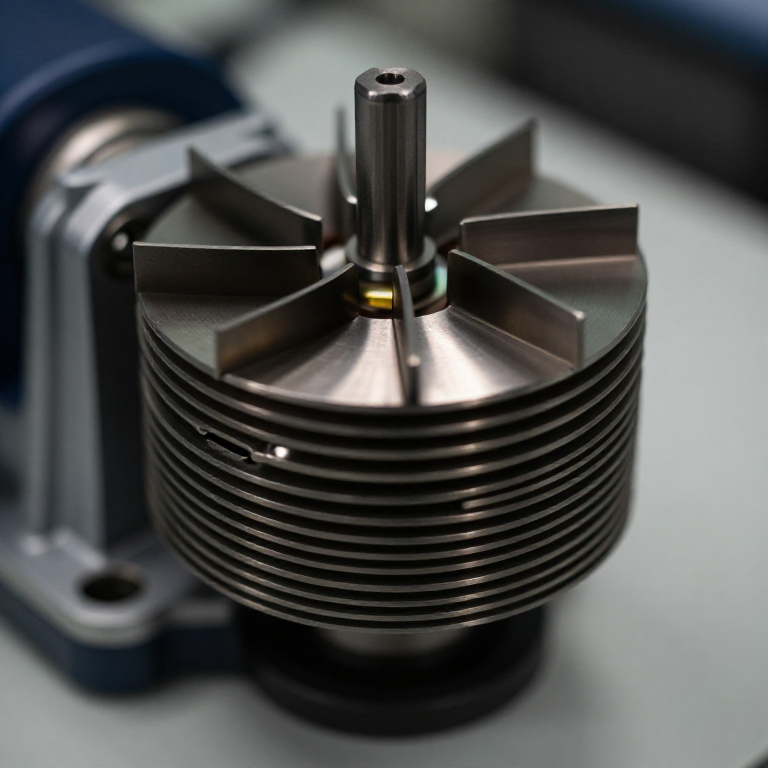


Turbomolecular Pump
Зааварчилгаа
Cut angled blades into rotor and stator discs
Cut angled blades into rotor and stator discs
Blade angle is what gives a struck molecule a preferred direction.
- Cut several discs from thin aluminium sheet to fit inside a cylindrical housing.
- On the rotor discs, cut radial slots and twist each blade to a consistent angle — steeper near the inlet, shallower toward the outlet.
- On the stator discs, cut blades angled in the OPPOSITE sense.
- Stack them alternately: rotor, stator, rotor, stator.
- Check every rotor blade clears every stator blade.
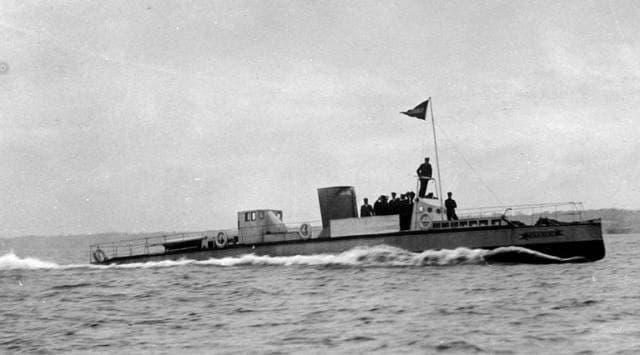
Opposite angles are what make it a pump rather than a fan. A moving rotor blade knocks molecules downward and slightly sideways; the following stator redirects them so the next rotor stage can do the same again. Each stage compresses only slightly, so many stages are needed — which is exactly the arrangement of a Parsons steam turbine, running backwards and pumping instead of being driven.
Blade angle changes along the stack for a reason: the inlet stages are optimised for capturing molecules at very low pressure, the outlet stages for compressing them against the backing pressure.Энэ алхмын материал:
 Aluminium Plate (10mm)1 ширхэг
 Aluminum Flat Bar (1x1/4 inch, 36-inch)1 ширхэг
Шаардлагатай багаж:
 Coping Saw
 File Set
 Cordless Drill/Driver (20V)
 Drill Bit Set
 Digital Caliper 6-Inch
 Combination Square
Balance the rotor, which is a safety requirement
Balance the rotor, which is a safety requirement
At these speeds an unbalanced rotor is a serious hazard, not an annoyance.
- Assemble the rotor stack on its shaft and mount it on knife edges or low-friction bearings.
- Let it settle and mark the heavy side.
- Remove material from the heavy side, a little at a time, until it shows no preference.
- Repeat in two planes along the shaft.
- Enclose the whole rotor in a substantial housing before any high-speed running.
Real turbomolecular pumps spin at 20,000 to 90,000 rpm. The rotor is machined from a single aluminium billet — never assembled from separate blades — precisely because a blade liberating itself at that speed destroys the pump and anything nearby. This build will run far slower and must still be enclosed; treat the housing as a containment shield rather than a cover.
Balance in two planes. A rotor balanced only at one point can still be dynamically unbalanced along its length, and a long stack is exactly the geometry where that matters.Энэ алхмын материал:
 Aluminum Round Bar1 ширхэг
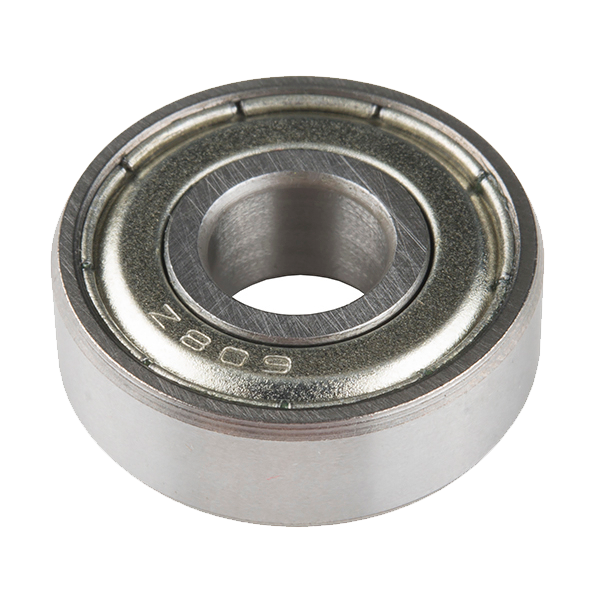 Ball Bearing - Non-Flanged (8mm Bore, 22mm OD)2 ширхэг
 Baltic Birch Plywood (3/4 inch, 24x30)1 хуудас
Шаардлагатай багаж:
 Digital Kitchen ScaleFile SetDigital Caliper 6-InchCordless Drill/Driver (20V)
 Allen/Hex Key Set
Establish why it needs a backing pump too
Establish why it needs a backing pump too
Same staged architecture as the diffusion pump, for a related but distinct reason.
- Connect the rotary vane pump to the turbo pump's outlet.
- Pump down to rough vacuum BEFORE spinning the rotor up.
- Now try running the turbo at atmospheric pressure and note the load on the drive.
- Record the pressure at inlet and outlet during normal running.
Шаардлагатай багаж:
 Digital Multimeter (Lab Grade)
 StopwatchDigital Caliper 6-Inch
Compare cleanliness against the diffusion pump
Compare cleanliness against the diffusion pump
The reason this pump displaced the other, demonstrated directly.
- Run the diffusion pump on a system with a clean glass slide at the inlet for an hour.
- Repeat with the turbo pump and a fresh slide.
- Compare the two slides under a bright light.
- Also compare how quickly each reaches working vacuum from cold.
Энэ алхмын материал:
 Acrylic Sheet1 хуудас
Шаардлагатай багаж:
StopwatchDigital Caliper 6-InchDigital Multimeter (Lab Grade)Hitting molecules with metal, and history
Hitting molecules with metal, and history
Willi Becker at Pfeiffer produced the practical turbomolecular pump in 1958, developing an idea Gaede had explored decades earlier as the molecular drag pump. Gaede's version worked but had impossibly tight clearances; Becker's bladed design achieved the same effect with clearances a workshop could actually hold, and that is what made it manufacturable.
The condition for it to work is worth stating. The blade tips must move at a speed comparable to the thermal speed of the gas molecules — hundreds of metres per second. That is why the rotational speeds are so extreme, and why the pump only works in molecular flow where molecules travel in straight lines between collisions with the blades rather than with each other.
How this batch has progressed: Guericke moved gas with a piston; Sprengel with falling mercury; the rotary vane pump with oil-sealed vanes; the diffusion pump with a vapour jet; the getter by chemically binding gas in place; and the turbomolecular pump by physically striking individual molecules with solid blades. Six mechanisms, each defeating the previous one's specific limit, and the last one arriving at the most direct method possible — hit the molecule and knock it where you want it to go.
Its honest limits: expensive; delicate, since a dropped spanner into the inlet destroys it instantly; still needs a backing pump; and it handles light gases like hydrogen and helium poorly, because those molecules move too fast relative to the blades to be reliably knocked along. For hydrogen-rich systems an ion pump or a getter is often added — which brings this batch full circle, since the getter is the one device here that pumps by chemistry rather than by motion.
Материал
6- 1 ширхэгТүр орлуулагч
- 1 ширхэгТүр орлуулагч
- 1 ширхэгТүр орлуулагч
- 2 ширхэг$1.28
- 1 хуудасТүр орлуулагч
- 1 хуудасТүр орлуулагч
Шаардлагатай багаж
10- Түр орлуулагч
- Түр орлуулагч
- Түр орлуулагч
- Түр орлуулагч
- Түр орлуулагч
- Түр орлуулагч
- Түр орлуулагч
- Түр орлуулагч
- Түр орлуулагч
- Түр орлуулагч
Холбоотой загварууд
Эдгээр загварууд мэдлэг хуваалцдаг — арга техник, материал эсвэл зарчим

CC0 Нийтийн домэйн
Энэ загвар CC0 дор гаргагдсан. Та зөвшөөрөл авахгүйгээр хуулах, өөрчлөх, түгээх, ашиглах боломжтой.
Загвараар дамжуулан бүтээгдэхүүн худалдаж авч Бүтээгчийг дэмжээрэй Бүтээгчийн шимтгэл Борлуулагчаар тогтоосон, эсвэл энэ загварын шинэ хувилбар үүсгэж орлогоо хуваахын тулд өөрийн загварт холбоос болгон оруулна уу.