
Understanding Titanium Extraction from Ilmenite — The Impossible Metal to Smelt
Titanium (Ti, element 22) is the ninth most abundant element in the Earth's crust, yet it was one of the last common metals to be produced in pure form. The reason is extraordinary: titanium cannot be reduced by carbon. Unlike virtually every other metal extracted since the Bronze Age, heating titanium oxide with charcoal produces titanium carbide (TiC) rather than titanium metal — the carbon bonds to the titanium before the oxygen leaves. This single chemical fact meant that titanium was effectively inaccessible until the 20th century, despite being identified in 1791.
Reverend William Gregor, an amateur mineralogist in Cornwall, discovered titanium in 1791 when he analyzed black sand (ilmenite, FeTiO₃) from a stream near Manaccan. He recognized it contained an unknown element but could not isolate it. Martin Heinrich Klaproth independently identified the element in rutile (TiO₂) in 1795 and named it titanium after the Titans of Greek mythology. Pure metallic titanium was not produced until 1910 by Matthew Hunter using sodium reduction of TiCl₄, and commercial production began only in 1946 with the Kroll process (magnesium reduction of TiCl₄).
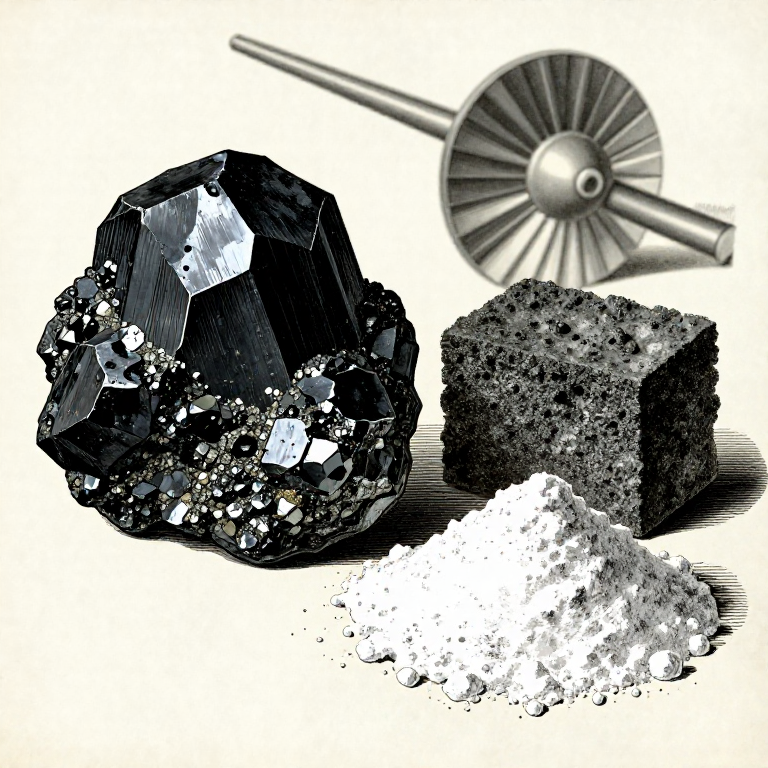
Ilmenite (FeTiO₃) is the world's primary titanium ore, containing 31.6% titanium (52.7% TiO₂) by mass. This blueprint explains why carbon reduction fails for titanium and describes the Kroll process that finally solved the problem — a process that remains essentially unchanged today and makes titanium one of the most expensive structural metals.
NOTE: Unlike most elements in this series, titanium cannot be extracted by traditional smelting. This blueprint is primarily educational — it explains the chemistry of why carbon reduction fails and how the Kroll process works. Attempting titanium reduction requires industrial equipment (sealed reactors, inert atmosphere, molten magnesium or sodium) that is not available at small scale.
Аюултай агуулга
Энэ Blueprint аюултай үйл ажиллагаа агуулж байна. Алхам алхмаар зааварчилгааг үзэхийн тулд нэвтэрч, бүртгэлийн тохиргооноос аюултай контентыг идэвхжүүлнэ үү.
НэвтрэхЭнэ загвараар хийдэг

CC0 Нийтийн домэйн
Энэ загвар CC0 дор гаргагдсан. Та зөвшөөрөл авахгүйгээр хуулах, өөрчлөх, түгээх, ашиглах боломжтой.
Загвараар дамжуулан бүтээгдэхүүн худалдаж авч Бүтээгчийг дэмжээрэй Бүтээгчийн шимтгэл Борлуулагчаар тогтоосон, эсвэл энэ загварын шинэ хувилбар үүсгэж орлогоо хуваахын тулд өөрийн загварт холбоос болгон оруулна уу.