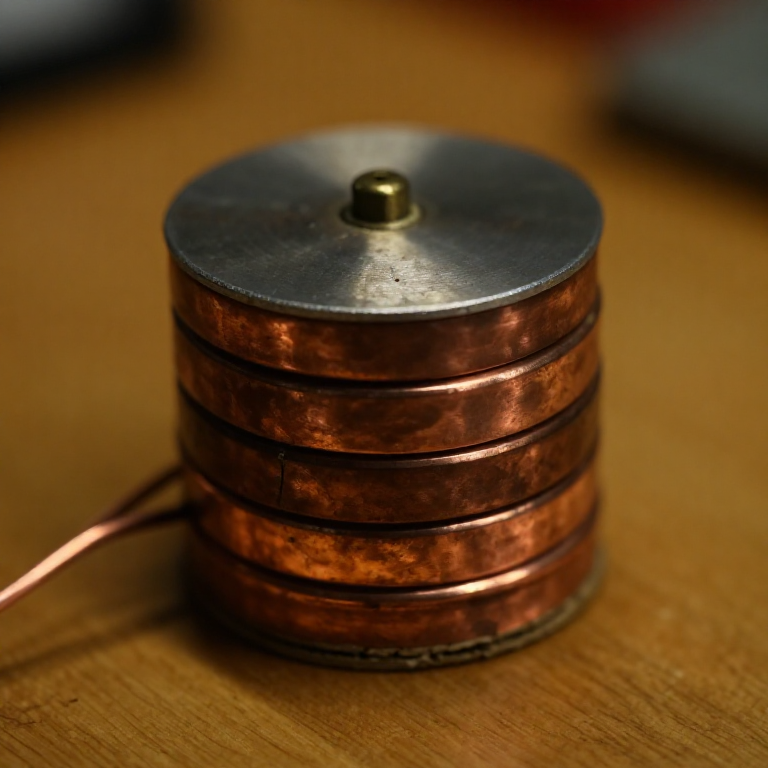


Building a Voltaic Pile — The First Battery and the Birth of Steady Electricity
Until 1800, electricity was a party trick: a spark you could store briefly in a jar and discharge in an instant. Then Alessandro Volta stacked discs of two metals and wet cardboard into a pile and produced something entirely new — a steady, continuous electric current that flowed for as long as you wanted. It was the first battery, and it opened the electrical age.
The principle is beautifully simple. Put two different metals, like zinc and copper, in a salty or acidic liquid and a voltage appears between them. One such pair is feeble, but stack many in a column — zinc, wet disc, copper, zinc, wet disc, copper — and their voltages add up into a useful current. The zinc slowly dissolves, pushing electrons out through a wire to the copper, while the brine carries the charge inside the pile.
With a voltaic pile, scientists could finally do chemistry and physics with electricity on tap. Within a few years it had been used to split water into hydrogen and oxygen, isolate new elements, and reveal the link between electricity and magnetism — the discoveries that led on to the telegraph, electroplating, the dynamo, and everything electrical that followed.
Зааварчилгаа
Understand the principle
Understand the principle
Cut the metal discs
Cut the metal discs
Энэ алхмын материал:
 Цайрын хуудас1 хуудас
 Зэсэн хуудас1 хуудас
Шаардлагатай багаж:
 Тугалган цаас огтлох хайч
Cut and soak the separators
Cut and soak the separators
Энэ алхмын материал:
 Атираат картон хайрцаг1 хуудас
 Ширээний давс30 г
 Ус1 литр
Build the first cell
Build the first cell
Stack the pile
Stack the pile
Keep the order consistent
Keep the order consistent
Attach the leads
Attach the leads
Энэ алхмын материал:
 Зэс утас1 метр
Test for current
Test for current
Шаардлагатай багаж:
 Луужин (компас)
Follow the chemistry
Follow the chemistry
Keep it running
Keep it running
Tune voltage and current
Tune voltage and current
Appreciate what it unlocked
Appreciate what it unlocked
Материал
6- 1 хуудасТүр орлуулагч
- 1 хуудасТүр орлуулагч
- 1 хуудасТүр орлуулагч
- 30 гТүр орлуулагч
- 1 литрТүр орлуулагч
- 1 метрТүр орлуулагч
Шаардлагатай багаж
2- Түр орлуулагч
- Түр орлуулагч
Холбогдсон загварын материал

Холбоотой загварууд
Эдгээр загварууд мэдлэг хуваалцдаг — арга техник, материал эсвэл зарчим
CC0 Нийтийн домэйн
Энэ загвар CC0 дор гаргагдсан. Та зөвшөөрөл авахгүйгээр хуулах, өөрчлөх, түгээх, ашиглах боломжтой.
Загвараар дамжуулан бүтээгдэхүүн худалдаж авч Бүтээгчийг дэмжээрэй Бүтээгчийн шимтгэл Борлуулагчаар тогтоосон, эсвэл энэ загварын шинэ хувилбар үүсгэж орлогоо хуваахын тулд өөрийн загварт холбоос болгон оруулна уу.