

Zeppelin Navigable Balloon
A gas balloon goes where the wind goes. Adding an engine helps only a little, because a non-rigid envelope changes shape under the thrust and under its own aerodynamic loads — push it and it bends, and a bending airship cannot be steered.
Zeppelin's answer was to put the shape in a frame and the gas in bags inside it. The hull is a rigid lattice that holds its form whatever the gas does; separate cells inside carry the lift. Now the envelope is a structure rather than a bubble, so engines can be mounted in several places, control surfaces have something to push against, and the craft is genuinely navigable.
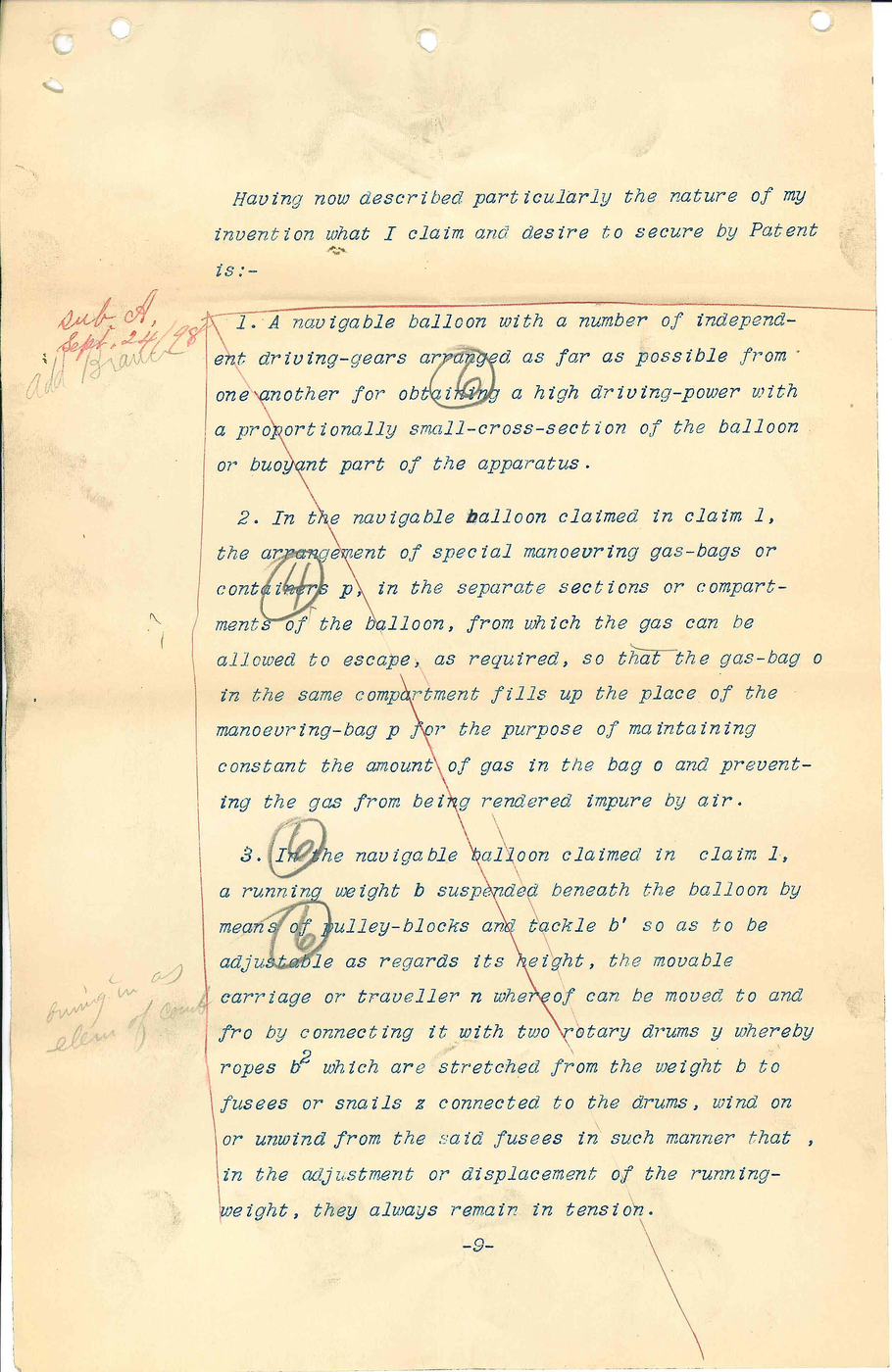
The patent is titled "Navigable Balloon", which understates it considerably. US Patent 621,195, granted to Ferdinand Graf Zeppelin on 14 March 1899. This blueprint builds a helium model — never hydrogen — and measures the lift you actually get.
Зааварчилгаа
Helium only — never hydrogen
Helium only — never hydrogen
Hydrogen gives about 8 % more lift and is violently flammable across an enormous range of mixtures with air. Use helium. The lift difference is not worth any part of the risk.
Read US 621,195 and note the separate cells
Read US 621,195 and note the separate cells
Zeppelin claims a rigid framework containing a number of separate gas cells and motors mounted apart from each other. Subdivision and rigidity are the two claims that matter.
Fly a simple gas bag and try to push it
Fly a simple gas bag and try to push it
Fit a small fan to a plain balloon. It deforms, the nose folds, and it goes sideways. That deformation is exactly what the frame prevents.
Calculate the lift before you build anything
Calculate the lift before you build anything
Air is about 1.225 kg/m³, helium about 0.169. Net lift is roughly 1.05 kg per cubic metre. Lift scales with VOLUME, which is why airships are enormous and why size is not vanity.
Work out why bigger is disproportionately better
Work out why bigger is disproportionately better
Volume grows as the cube of length, structure and skin roughly as the square. Doubling the length gives eight times the lift for about four times the structure — the square-cube law working in your favour for once.
Build transverse rings and longitudinal girders
Build transverse rings and longitudinal girders
Make a series of light hoops joined by lengthwise members. Rings hold the cross-section, girders carry bending — the same logic as a ship's frames and stringers.
Энэ алхмын материал:
 Хулсан шон8 ширхэг
Triangulate every bay with cross-bracing
Triangulate every bay with cross-bracing
Wire-brace each bay diagonally. An unbraced rectangular bay is a parallelogram waiting to happen, and the whole hull racks.
Энэ алхмын материал:
 Ган утас10 метр
Fit several separate gas cells, not one
Fit several separate gas cells, not one
Install a series of independent bags along the hull. One puncture then loses one cell's lift, not all of it — subdivision is a damage-tolerance decision.
Cover the frame with a taut outer skin
Cover the frame with a taut outer skin
Stretch fabric over the structure. This carries no lift at all — it is purely aerodynamic fairing and weather protection.
Энэ алхмын материал:
 Брезент даавуу2 метр
Trim the model to neutral buoyancy
Trim the model to neutral buoyancy
Add ballast until it neither rises nor sinks. An airship is flown at neutral buoyancy and steered in pitch — it does not simply float upward.
Шаардлагатай багаж:
 Шугам
ШугамBalance it fore and aft
Balance it fore and aft
Shift ballast until it hangs level. An out-of-trim airship flies nose-up or nose-down and wastes thrust fighting its own attitude.
Mount motors at separate points on the hull
Mount motors at separate points on the hull
Fit two or more thrust units apart from one another, as the patent specifies. Differential thrust turns the ship and gives redundancy if one fails.
Add fins and movable control surfaces at the tail
Add fins and movable control surfaces at the tail
Fit fixed fins for directional stability and hinged rudders and elevators behind them. They only work because the rigid hull gives them a firm mounting.
Discover the real operating problem
Discover the real operating problem
Burn off or release a little ballast and watch it climb. Consuming fuel makes an airship LIGHTER and it rises — managing buoyancy in flight is the airship pilot's constant task.
Compendium — putting the shape in a frame
Compendium — putting the shape in a frame
The patent. US 621,195, "Navigable Balloon", granted 14 March 1899 to Ferdinand Graf von Zeppelin, following his German patent of 1895. The distinguishing claims are a rigid framework carrying a number of separate gas cells, and motors arranged separately from one another. LZ 1 first flew on 2 July 1900 over Lake Constance. Zeppelin was sixty-two and had spent most of his own fortune; the German public eventually funded the programme by subscription after the LZ 4 was destroyed in a storm in 1908.
Why rigidity is the whole invention. A non-rigid airship — a blimp — holds its shape by internal gas pressure, so it deforms under thrust and aerodynamic load, which limits its size and its speed. A rigid hull maintains its form independently of gas pressure, so the gas cells can be at almost atmospheric pressure, engines can be hung at several points, and control surfaces have a stiff structure to react against. That is the difference between a powered balloon and a navigable airship, and it is what the patent's title fails to convey.
Lift, and the square-cube law. Buoyant lift is the weight of displaced air minus the weight of the lifting gas: about 1.05 kg per cubic metre for helium, about 1.14 for hydrogen. Lift therefore scales with volume, as length cubed, while the frame and skin scale closer to length squared. Making an airship bigger improves its payload fraction — which is why the Hindenburg was 245 metres long and why airships are the one vehicle class where scale is an unambiguous advantage.
Hydrogen, and an honest accounting. German airships used hydrogen because the United States controlled essentially the world's helium supply and, under the 1927 Helium Control Act, would not export it. Hydrogen is flammable over a very wide range of mixtures with air and needs almost no energy to ignite. The Hindenburg burned at Lakehurst on 6 May 1937, killing 35 of 97 aboard; the exact ignition source is still debated. It is worth being precise, though, that hydrogen was not the only problem — the R101, the Akron and the Macon were all lost to weather and structural failure, and the Akron and Macon were helium-filled. Rigid airships were ended by a combination of fragility in bad weather, enormous ground-handling demands, and aeroplanes becoming fast and reliable — not by a single fire.
Материал
3- 8 ширхэгТүр орлуулагч
- 10 метрТүр орлуулагч
- 2 метрТүр орлуулагч
Холбоотой загварууд
Эдгээр загварууд мэдлэг хуваалцдаг — арга техник, материал эсвэл зарчим

CC0 Нийтийн домэйн
Энэ загвар CC0 дор гаргагдсан. Та зөвшөөрөл авахгүйгээр хуулах, өөрчлөх, түгээх, ашиглах боломжтой.
Загвараар дамжуулан бүтээгдэхүүн худалдаж авч Бүтээгчийг дэмжээрэй Бүтээгчийн шимтгэл Борлуулагчаар тогтоосон, эсвэл энэ загварын шинэ хувилбар үүсгэж орлогоо хуваахын тулд өөрийн загварт холбоос болгон оруулна уу.