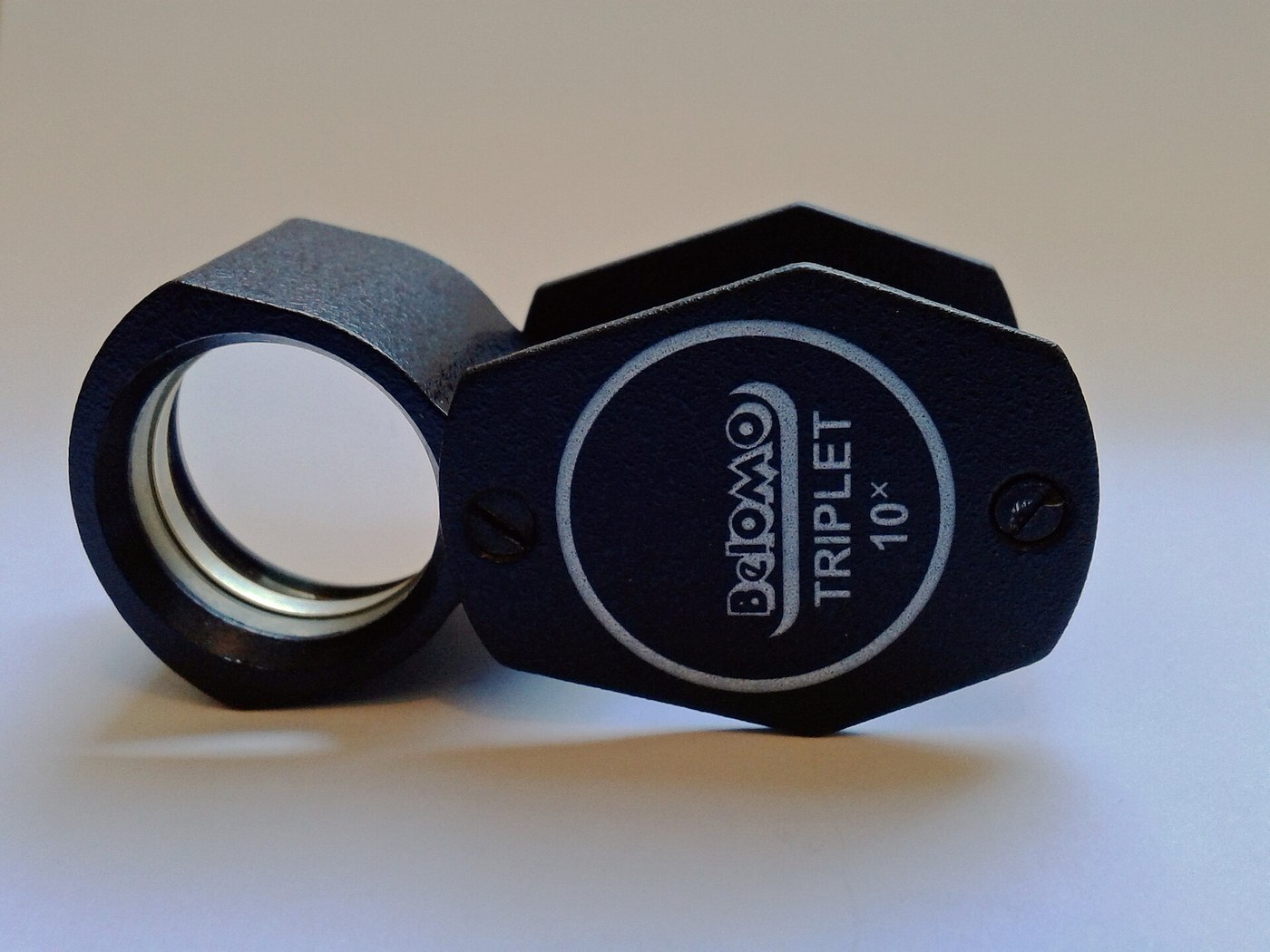


Achromatic Lens
Instrucciones
See the fault
See the fault
Find chromatic aberration before trying to cure it.
- Use a single convex lens to focus a bright white source onto a card.
- Move the card slowly through the focus.
- Watch the fringe colour flip from bluish on one side to reddish on the other.
Materiales para este paso:
 Lente convexa1 pieza
Separate bending from spreading
Separate bending from spreading
Two different properties, and the distinction is the key to everything.
- Pass a narrow beam through a prism and note the spread of colours.
- Note also how far the beam as a whole is deviated.
- Deviation is bending; dispersion is spreading.
Materiales para este paso:
 Transportador de ángulos1 pieza
Cancel colour, keep focus
Cancel colour, keep focus
The doublet takes advantage of that mismatch.
- A crown element: converging, low dispersion.
- A flint element: diverging, high dispersion.
- Choose powers so the dispersions cancel while a net converging power remains.
Compare a doublet against a singlet
Compare a doublet against a singlet
Put the two side by side on the same target.
- Focus a high-contrast edge with a simple lens; note the coloured fringe.
- Repeat with an achromatic doublet — a cheap binocular or camera objective will do.
- Look specifically at the edges of the field, not the centre.
History and context
History and context
Isaac Newton concluded from his prism work that dispersion was proportional to refraction for all materials, making an achromatic refractor impossible. That conclusion drove him to the reflecting telescope, and it held the field for half a century — a case of a great experimenter generalising from too few glasses.
Chester Moor Hall, an Essex barrister, worked out around 1733 that crown and flint could be combined to cancel colour, and had the two elements made by different opticians so neither would understand the whole. The secret leaked anyway, reportedly because both subcontracted the work to the same man.
John Dollond patented the achromatic doublet in 1758. When his son Peter sued rival opticians, the courts accepted that Hall had made achromats first — and still upheld the patent, on the reasoning that the public benefit belongs to whoever brings an invention out into the world rather than whoever keeps it in a drawer. It is one of the clearest early statements of what a patent is actually for, and it is worth knowing that the first inventor lost.
What it made possible: refracting telescopes became competitive with reflectors again, and — more consequentially — the compound microscope became genuinely useful. Nineteenth-century biology and the germ theory rest on microscope objectives that do not smear every specimen with colour.
Materiales
2- 1 piezaMarcador de posición
- 1 piezaMarcador de posición
CC0 Dominio público
Este Blueprint se publica bajo CC0. Eres libre de copiar, modificar, distribuir y usar este trabajo para cualquier propósito, sin pedir permiso.
Apoya al Maker comprando productos a través de su Blueprint, donde gana una Comisión del Maker establecida por los vendedores, o crea una nueva iteración de este Blueprint e inclúyela como conexión en tu propio Blueprint para compartir ingresos.