ARTE
BELLEZA Y BIENESTAR
ARTESANÍA
CULTURA E HISTORIA
ENTRETENIMIENTO
MEDIO AMBIENTE
COMIDA Y BEBIDAS
INGENIERÍA INVERSA
CIENCIAS
DEPORTES
TECNOLOGÍA
TECNOLOGÍA VESTIBLE
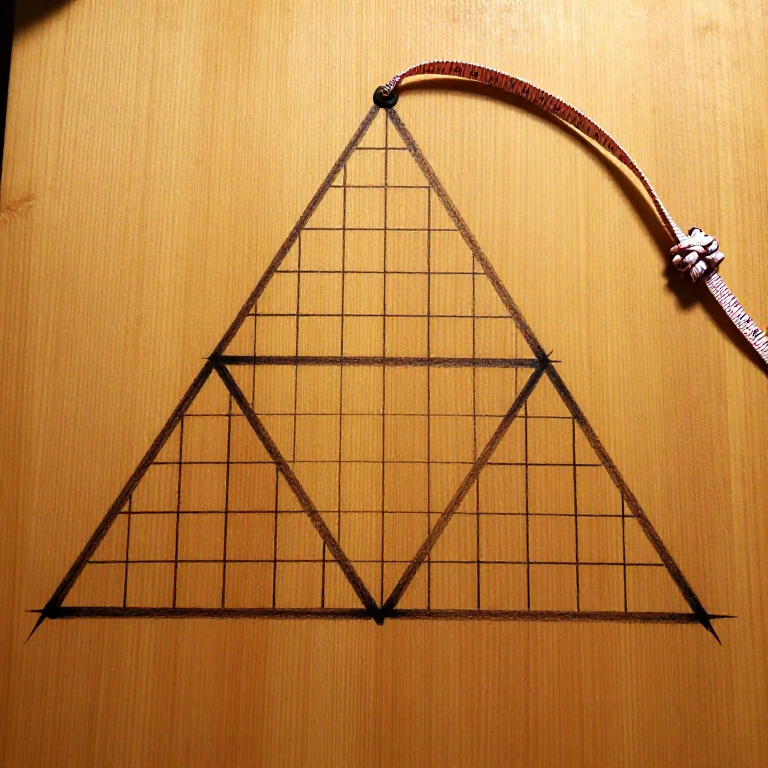


Proving the Pythagorean Theorem by Cutting Squares — a² + b² = c²
The most famous rule in geometry says that in any right-angled triangle, the square built on the longest side equals the two squares on the shorter sides added together: a² + b² = c². The school of Pythagoras proved it around 530 BC. This blueprint proves it the maker's way — with a knotted cord, three cut squares, and a dissection you can hold in your hands. Seeing the pieces of the two small squares fit exactly into the big one is a proof that needs no algebra, and it doubles as the ancient builder's test for a true square corner.
Principiante
2
Instrucciones
1
1
State the theorem
State the theorem
In a right-angled triangle, name the two short sides a and b and the longest side (the hypotenuse) c. The theorem says the square on c has exactly the same area as the squares on a and b together: a² + b² = c². You will prove this by area, not algebra.
2
2
Make a right angle with a cord
Make a right angle with a cord
Knot a loop of cord into twelve equal spaces. Peg it out as a triangle with sides of 3, 4 and 5 spaces; the corner between the 3 and 4 sides is a perfect right angle. This 3-4-5 trick is how builders have squared corners for thousands of years.
Herramientas necesarias:
 Bramante de algodón para cocina
3
3
Lay out a right triangle
Lay out a right triangle
Using that right angle, mark a right triangle with legs 3 and 4 units on a board. Its hypotenuse comes out to exactly 5 units — a whole-number right triangle to make the areas easy to count.
Materiales para este paso:
 Tabla de madera dura1 pieza
Herramientas necesarias:
 Cordel de marcar
4
4
Cut the three squares
Cut the three squares
Cut a square on each side of the triangle: 3×3, 4×4 and 5×5. Rule each into unit squares — 9, 16 and 25 of them. These three squares are the whole proof, made physical.
Herramientas necesarias:
 Serrucho
 Cuchillo
5
5
Count the areas
Count the areas
Count: the small squares hold 9 and 16 unit squares, together 25 — exactly the number in the big square on the hypotenuse. 9 + 16 = 25 is a² + b² = c² in plain counting.
6
6
Prove it by dissection
Prove it by dissection
Now cut the two smaller squares into pieces and lay them inside the largest square. They tile it exactly — no gaps, no overlaps. Because the pieces fit for reasons of shape, not luck, this works for every right triangle, not only 3-4-5.
Herramientas necesarias:
Cuchillo7
7
Test other triangles
Test other triangles
Repeat with other right triangles: the square on the hypotenuse always equals the sum of the other two. Change the corner so it is no longer a right angle, and the fit fails — which is exactly why the same rule can TEST whether a corner is truly square.
8
8
See why it matters
See why it matters
This single relationship underlies distance, surveying, navigation and building ever since. Any time you find a straight-line distance from two measurements at right angles, you are using Pythagoras — a 2,500-year-old proof you just held in your hands.
Materiales
2- 1 piezaMarcador de posición
- Marcador de posición
Blueprints relacionados
Estos blueprints comparten conocimiento — técnicas, materiales o principios
CC0 Dominio público
Este Blueprint se publica bajo CC0. Eres libre de copiar, modificar, distribuir y usar este trabajo para cualquier propósito, sin pedir permiso.
Apoya al Maker comprando productos a través de su Blueprint, donde gana una Comisión del Maker establecida por los vendedores, o crea una nueva iteración de este Blueprint e inclúyela como conexión en tu propio Blueprint para compartir ingresos.