


Cotton Candy Machine
Spun sugar was a delicacy for centuries, made by flicking molten caramel off a fork to throw fine threads across an oiled rod. It was slow, it needed a trained confectioner, and a serving cost accordingly.
Morrison and Wharton replaced the confectioner's wrist with a spinning bowl. Melted sugar sits in a heated head that rotates fast; centrifugal force drives it through tiny holes in the rim, and each thread cools and solidifies within centimetres of leaving. Because sugar cools from liquid to glass without crystallising, the threads stay as threads.
The patent is titled plainly "Candy-Machine" — US Patent 618,428, granted to William J. Morrison and John C. Wharton of Nashville on 31 January 1899. Morrison was a dentist, which is a detail nobody has ever been able to leave out of the story.
Instrucciones
A spinning head full of molten sugar is two hazards at once
A spinning head full of molten sugar is two hazards at once
Sugar at 170 °C sticks to skin, and the head runs at thousands of rpm. Fit a full-height collecting bowl before powering up, and never reach toward a spinning head.
Read US 618,428 and note the mechanism
Read US 618,428 and note the mechanism
Morrison and Wharton claim a rotating vessel converting melted sugar into "silk-like filaments" by centrifugal force. The phrase is theirs, and it is a good description.
Spin sugar by hand first
Spin sugar by hand first
Melt sugar, let it cool slightly, and flick threads off a fork across two oiled rods. This is the confectioner's method, and it shows you what the machine has to reproduce.
Materiales para este paso:
 Azúcar blanco500 g
Understand why sugar can form threads at all
Understand why sugar can form threads at all
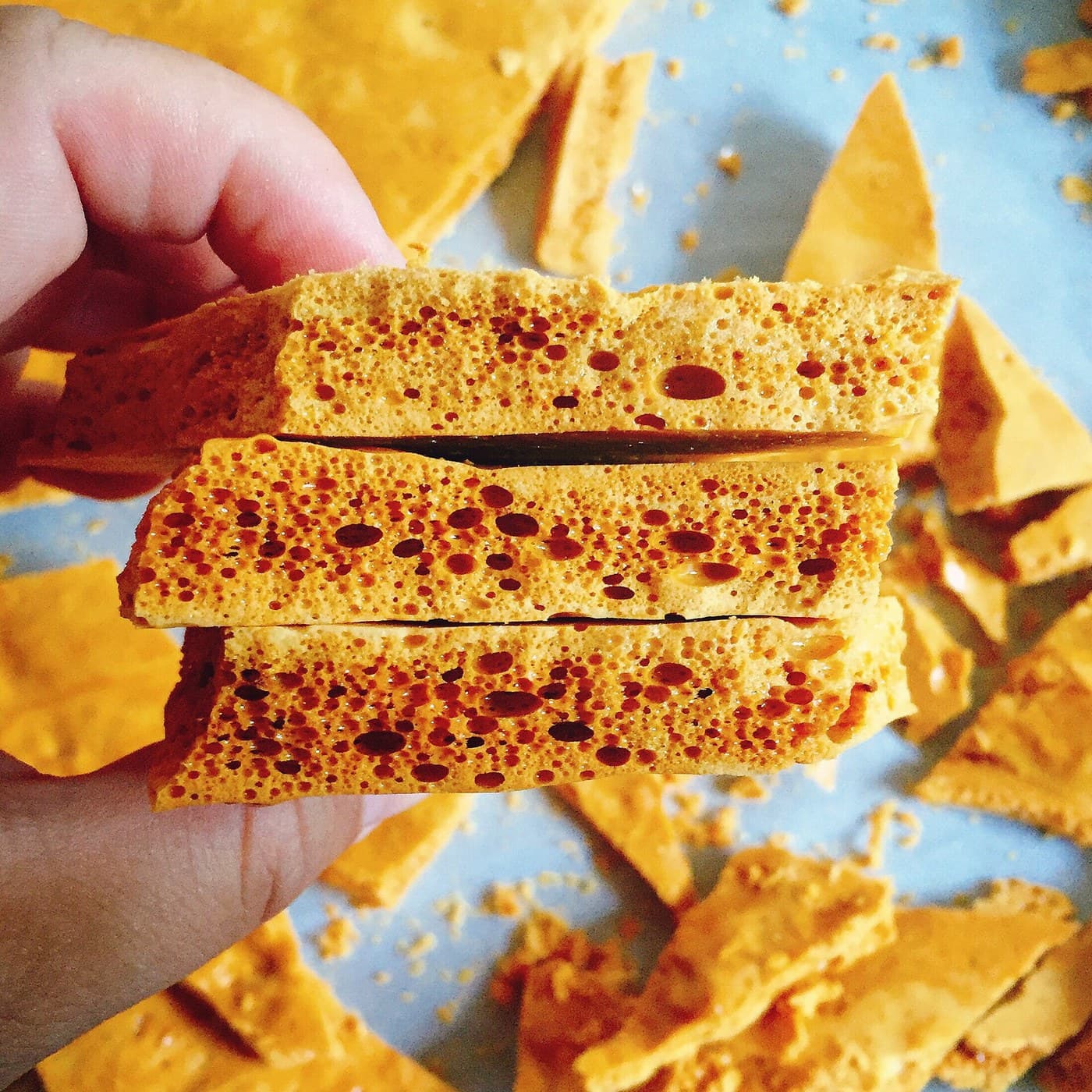
Molten sucrose cools into an amorphous GLASS rather than crystallising. A material that crystallised on cooling would snap instead of drawing — this is the same property that makes glass fibre possible.
Build a shallow metal spinning head
Build a shallow metal spinning head
Make a small drum on a vertical shaft. Shallow, so sugar spreads to the rim quickly rather than pooling in the middle.
Materiales para este paso:
 Chapa de acero inoxidable1 hoja
Herramientas necesarias:
 Lima para metal
Drill a ring of very fine holes around the rim
Drill a ring of very fine holes around the rim
Make the holes as small as you can drill, evenly spaced. Hole diameter sets thread diameter, and thread diameter is what makes the product feel like floss instead of wire.
Herramientas necesarias:
 Taladro inalámbrico
Wrap a heating element around the head
Wrap a heating element around the head
Coil nichrome around the outside of the drum on insulators. The sugar must be molten AT THE RIM, or it solidifies in the holes and blocks them.
Materiales para este paso:
 Hilo de nicrom2 metros
 Aislante cerámico4 piezas
Hold the temperature in a narrow window
Hold the temperature in a narrow window
Aim for roughly 170 °C. Too cool and it will not flow; too hot and the sugar caramelises brown and then burns bitter.
Herramientas necesarias:
 Termómetro de ambiente
Drive the head fast and balance it carefully
Drive the head fast and balance it carefully
Spin at several thousand rpm. Balance the head before fitting the element — an unbalanced drum at this speed is genuinely dangerous.
Surround it with a large collecting bowl
Surround it with a large collecting bowl
Build a wide bowl well clear of the head. Threads must have room to cool in flight before they touch anything, or they land sticky and clump.
Charge the head with sugar and start it
Charge the head with sugar and start it
Add a spoonful of sugar to the spinning heated head. Threads should appear within seconds and drift outward as a web.
Diagnose wet, clumping output
Diagnose wet, clumping output
Sticky clumps mean the threads have not cooled before landing — the bowl is too small or the head too hot. Increase the flight distance first.
Diagnose no output at all
Diagnose no output at all
Nothing coming out means blocked holes — sugar solidified in them. Bring the rim up to temperature BEFORE the sugar goes in, not after.
Leave a finished serving out overnight
Leave a finished serving out overnight
It collapses into a sticky lump. Sugar glass is strongly hygroscopic, and the enormous surface area of the threads makes the collapse fast — which is why it is sold to be eaten immediately.
Compendium — sugar drawn like glass fibre
Compendium — sugar drawn like glass fibre
The patent. US 618,428, "Candy-Machine", granted 31 January 1899 to William J. Morrison and John C. Wharton of Nashville, Tennessee. Morrison was a dentist — and also a lawyer, an author and president of the Tennessee State Dental Association — and Wharton was a confectioner. They introduced the product as "Fairy Floss" at the 1904 St Louis World's Fair, selling around 68,000 boxes at 25 cents each, roughly half the price of admission to the fair itself.
Why sugar can be spun and most things cannot. Molten sucrose cooled quickly does not crystallise; it passes through a glass transition into an amorphous solid. A material that crystallised on cooling would form ordered grains and fracture rather than draw into a filament. This is precisely the property exploited in glass fibre and in melt-spun polymers, and it is why the patent's phrase "silk-like filaments" is more accurate than it sounds — the process is closer to fibre spinning than to confectionery.
Centrifugal extrusion, and why it must be hot at the rim. Rotating the melt drives it outward with a force proportional to ω²r, forcing it through fine perforations. Each emerging thread has an enormous surface-area-to-volume ratio, so it loses heat and solidifies within a few centimetres — which is what allows the product to be collected as a dry web rather than a syrup spray. The failure modes follow directly: a rim below the melting point blocks its own holes, and a collecting bowl too small catches threads before they have solidified.
The hygroscopy is not a flaw in the process. Amorphous sugar readily absorbs atmospheric moisture, and floss has perhaps a thousand times the exposed area of the same mass as a lump. It therefore takes up water, softens and collapses within hours in humid air. No amount of improvement to the machine changes this; it is a property of the material and its geometry, and it is the reason cotton candy is a fairground product made in front of the customer rather than a packaged one.
Materiales
4- 500 gMarcador de posición
- Marcador de posición
- 2 metrosMarcador de posición
- 4 piezasMarcador de posición
Herramientas requeridas
3- Marcador de posición
- 1 vendor sell this, none ship to you yetMarcador de posición
- Marcador de posición
Este plano hace

Blueprints relacionados
Estos blueprints comparten conocimiento — técnicas, materiales o principios

CC0 Dominio público
Este Blueprint se publica bajo CC0. Eres libre de copiar, modificar, distribuir y usar este trabajo para cualquier propósito, sin pedir permiso.
Apoya al Maker comprando productos a través de su Blueprint, donde gana una Comisión del Maker establecida por los vendedores, o crea una nueva iteración de este Blueprint e inclúyela como conexión en tu propio Blueprint para compartir ingresos.