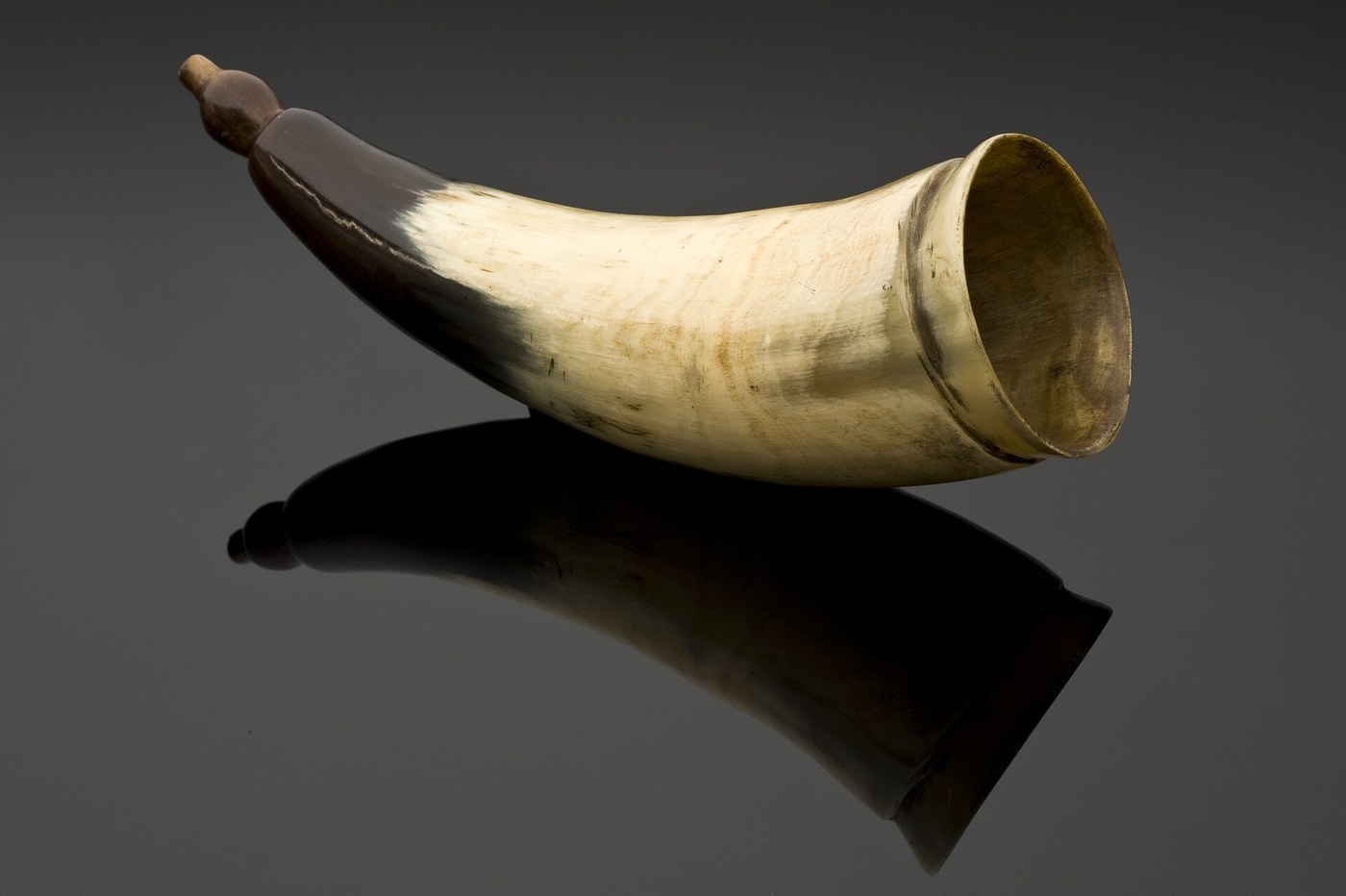


The Ear Trumpet
A stethoscope confines sound that would otherwise spread out. An ear trumpet has the opposite problem — the sound has already spread out across a room, and almost none of it is going to arrive at an ear canal a centimetre across.
The trumpet does two things, and only one of them is obvious.
It collects. A mouth 20 cm across has roughly four hundred times the area of the ear canal, so it intercepts far more of the passing wave and funnels it inward. That alone is worth a great deal.
It matches. This is the part that is easy to miss and does most of the work. Sound in open air is a large, gentle motion; sound that can drive an eardrum is a small, forceful one. Push the first straight into a narrow tube and most of it simply reflects back out — the same mismatch that stops heart sounds escaping a chest. A gradually tapering horn converts one into the other progressively, so the energy transfers instead of bouncing.
That is why the shape is a smooth flare and not a funnel with a sharp step. The taper is an impedance transformer, and an abrupt change ruins it.
Nothing here is electrical and nothing amplifies. The device only stops throwing sound away — and for a century that was the whole of hearing assistance.
Instrucciones
Measure what cupping a hand is worth
Measure what cupping a hand is worth
Have a partner speak steadily from across a room at a level you can just follow. Listen normally, then cup a hand behind your ear.
Then have them step back until it is just as hard as before.
Record the extra distance.
Expect a real gain from nothing but a hand. You have increased your collecting area and put a reflector behind the ear, and both add signal without any energy being supplied.
Herramientas necesarias:
 Cinta métrica
Scale the mouth and see the gain follow area
Scale the mouth and see the gain follow area
Roll cones of card with mouths of about 5, 10 and 20 cm, all with the same small end, and compare each at a fixed distance from a steady sound.
Expect the gain to track the area of the mouth, not its diameter — doubling the width roughly quadruples the collected sound.
Note the practical ceiling this implies: usefully more gain means a rapidly larger object, which is exactly why nineteenth-century trumpets grew grotesque and why some were built into furniture and walking sticks rather than carried.
Materiales para este paso:
 Cartulina1 pieza
Compare an abrupt step with a smooth flare
Compare an abrupt step with a smooth flare
Make two devices with the same mouth and the same tube: one a cone that tapers gradually, one a wide cylinder ending in a sudden step down to the tube.
Listen to the same source through each.
Expect the gradual taper to be clearly better, despite collecting identical area.
At the abrupt step the sound meets a sudden change in what the medium will accept, and a large fraction reflects straight back. The taper changes conditions slowly enough that the wave stays with it.
This is the same reason a rifle-crack of a pipe end sounds different from a flared horn, and why loudspeaker horns are curves rather than boxes.
Materiales para este paso:
Cartulina1 piezaFind what it does to different pitches
Find what it does to different pitches
Play a low tone and a high tone at the same level and compare each through your trumpet.
Expect the trumpet to favour middle and higher frequencies and to do relatively little for very low ones.
A horn works well only for wavelengths that fit its dimensions; very long waves diffract around a small mouth as though it were not there.
That happens to suit the job — most age-related hearing loss is worst at high frequencies, and much of speech intelligibility lives in consonants there. The instrument's bias accidentally matched the deficit, which is luck rather than design.
Find the limitation no horn can escape
Find the limitation no horn can escape
Use your trumpet in a quiet room, then in a room with background noise or several conversations.
Expect it to help greatly in the first case and much less in the second.
It collects everything arriving from where it points — voice and noise alike — so it improves signal and noise together.
Now aim it deliberately at one speaker and note the modest directional benefit.
This is the central unsolved problem of hearing assistance, and it is why modern aids spend their effort on directional microphones and noise processing rather than on loudness. Making everything louder does not help someone pick a voice out of a crowd.
History & Context
History & Context
For most of history this was the entire technology. Purpose-made trumpets appear in the seventeenth century and were the only real option until electrical amplification. They were made in horn, brass, silver and gutta-percha; some were collapsible, and a trade in concealed versions grew up — built into hats, fans, chair arms and beards — because the stigma of visible deafness was, then as now, a design constraint as real as the acoustics.
Beethoven owned several. They survive, made for him by the maker Mälzel, along with the account of him sawing the legs off a piano to feel it through the floor. Bone conduction as a route around a failing middle ear is a real mechanism, and one that hearing-aid manufacturers still use.
The physics is a horn, and horns are everywhere. The same flare works in reverse in a gramophone, a megaphone, a trumpet's bell, a foghorn and a modern compression driver. In every case the taper is doing impedance matching between a small vibrating thing and a large body of air — and the only difference is which end you speak into.
Electronics changed the ceiling, not the problem. Carbon microphones, then valves, then transistors, then the digital aids of today made loudness cheap and small. But loudness was never the hard part: a damaged ear distorts as well as attenuates, and cannot be repaired by volume. Modern aids compress dynamic range, split the signal into bands and steer directionally — all attempts at the step-5 problem, and none of them fully solved.
Honest limits. Gain of a useful size requires an object of embarrassing size. It helps only where hearing loss is a matter of level, not clarity. It cannot separate a voice from a room. And it must be aimed, which makes group conversation — the situation people most want back — the one it serves worst.
Herramientas requeridas
1- 1 vendor sell this, none ship to you yetMarcador de posición
Materiales de Blueprints conectados


Este plano hace

CC0 Dominio público
Este Blueprint se publica bajo CC0. Eres libre de copiar, modificar, distribuir y usar este trabajo para cualquier propósito, sin pedir permiso.
Apoya al Maker comprando productos a través de su Blueprint, donde gana una Comisión del Maker establecida por los vendedores, o crea una nueva iteración de este Blueprint e inclúyela como conexión en tu propio Blueprint para compartir ingresos.