ARTE
BELLEZA Y BIENESTAR
ARTESANÍA
CULTURA E HISTORIA
ENTRETENIMIENTO
MEDIO AMBIENTE
COMIDA Y BEBIDAS
INGENIERÍA INVERSA
CIENCIAS
DEPORTES
TECNOLOGÍA
TECNOLOGÍA VESTIBLE
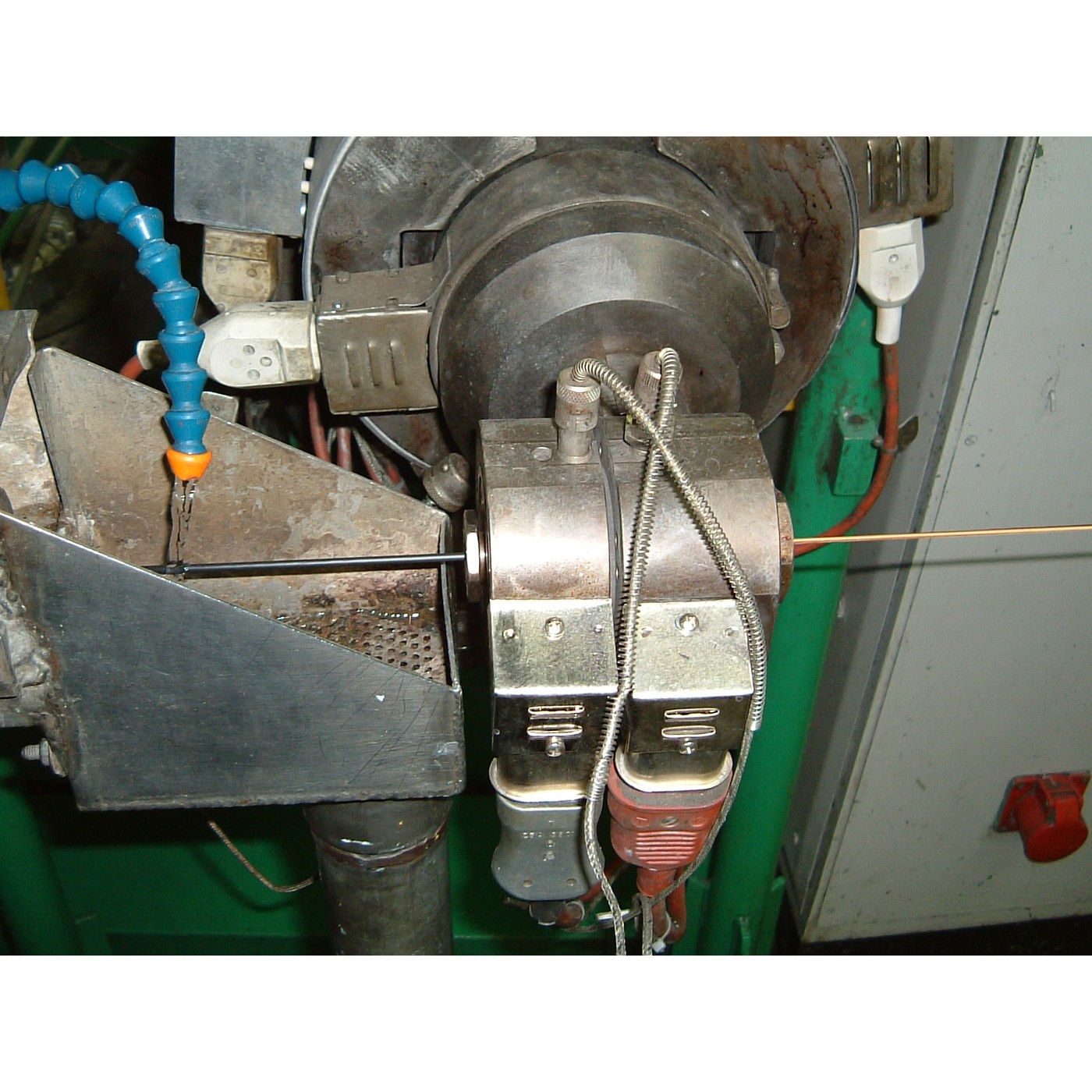


Extruding a Profile, and Blowing Film
Moulding makes one part at a time and needs a tool for each. Extrusion does the opposite: one die makes a continuous length of constant section, for as long as you feed it, and the tool cost is spread over kilometres rather than parts.
Pipe, window frame, cable insulation, filament, garden hose, weatherstrip, the sheet that rung 2's vacuum forming starts from, and — after a further stretch — the thinnest packaging film in the world all come off an extruder.
The catch is that **the die does not decide the shape**. Polymer recoils as it leaves — die swell — and the haul-off stretches it back down. Getting a section right is a matter of cutting the die wrong in exactly the way that cancels both.
Intermedio
About 3 hours
Instrucciones
1
1
Watch die swell happen on a machine you already have
Watch die swell happen on a machine you already have
A 3D printer nozzle is an extrusion die, and it swells like one. This is the cleanest demonstration available on a bench.
Heat the hot end to printing temperature with the nozzle clear of the bed, and extrude slowly into air. Catch the strand, let it cool, and measure it with the micrometer.
It is **larger than the nozzle**. A 0.4 mm nozzle typically gives a free strand of 0.45 to 0.55 mm, depending on polymer and temperature. Do it for PLA, PETG and ABS and tabulate the swell ratio for each.
Then change the conditions and watch the ratio move:
- **Extrude faster.** Swell increases, because the chains are stretched harder in the die and recoil more.
- **Extrude hotter.** Swell decreases, because the chains have time to relax before they freeze.
Now cancel it. Extrude into air and, with tweezers, pull the strand away faster than it emerges. Measure again: the strand is thinner than the nozzle. That is **draw-down**, and in a real line it is the haul-off doing exactly this at a controlled rate.
Those two effects, in opposition, are the whole of profile extrusion control. Step 4 puts numbers on the combination.
Materiales para este paso:
 Filamento de PLA1 pieza
 Filamento PETG1 pieza
 Filamento ABS1 pieza
Herramientas necesarias:
 Impresora 3D
 Micrómetro
 Calibre digital de 6 pulgadas
 Termómetro infrarrojo
 Cronómetro
 Pinzas de punta fina
 Gafas de seguridad transparentes
 Cuaderno de laboratorio (con copia)
2
2
Pull a profile, and find the land
Pull a profile, and find the land
Now make a shaped section rather than a round one. You need a small die: a plate with a slot or a cross cut through it, mounted where the strand leaves.
The cheapest working version is a **die plate for a printer nozzle**: a thin brass or aluminium plate, drilled and filed with a 2 mm slot, held a millimetre below the nozzle in a clamp so the extrudate is forced through it. Crude, hot and fiddly, and it demonstrates the two things that matter.
**The land.** The parallel section of the die, after the taper. A short land gives more swell and a rougher surface; a longer land lets the chains relax inside the die and gives a steadier, more accurate section. Make two plates, one with a 1 mm land and one with 4 mm, and compare the extrudate.
**Uneven flow.** Extrude through a slot that is wider at one end. The melt comes out faster where the die is more open, so the profile bends towards the slow side as it leaves. Every asymmetric profile does this, and a real die is cut with deliberately uneven land lengths to balance the flow — which is why an extrusion die is hand-tuned on the machine and not finished at the CAD stage.
Cool the extrudate as a real line does: run it through a shallow tray of water a few centimetres from the die. Note that cooling too fast freezes the outside while the inside is still shrinking, and the section bows.
Molten polymer at 200–260 °C, a hot brass plate and water in close proximity. Face shield, gloves, a stable clamp, and never chase a falling hot strand with your hands.
Materiales para este paso:
Filamento de PLA1 pieza Chapa de aluminio1 pieza
Herramientas necesarias:
Impresora 3D Limas (lima de mano)
 Juego de limas
 Taladro de columna
 Tornillo de bancoCalibre digital de 6 pulgadasMicrómetroTermómetro infrarrojo
 Pantalla facialGafas de seguridad transparentes
 Guantes de trabajo de cuero
 Campana extractora (con conducto)Cuaderno de laboratorio (con copia)
3
3
Blow a film, and feel the difference orientation makes
Blow a film, and feel the difference orientation makes
Blown film is extrusion with the stretch turned up: melt leaves an annular die as a thin tube, air inflates it to several times its diameter while a nip pulls it upward many times faster than it left. It freezes mid-air, stretched both ways at once.
You cannot blow film on a bench, but you can produce the *property* it has and prove it matters, which is the part worth knowing.
Take a carrier bag or a piece of packaging film. Cut two strips, one along the roll direction and one across it — the roll direction is usually obvious from the fold lines or from any print.
Tear both by hand. One tears cleanly and easily in a straight line; the other resists and wanders. Then pull both to destruction with the spring scale and record the force.
That difference is **orientation**: the chains are lined up more in one direction than the other, so the film is strong along them and splits between them. A bag that tears beautifully down its length and not across it is a bag whose blow-up ratio and draw-down were not balanced.
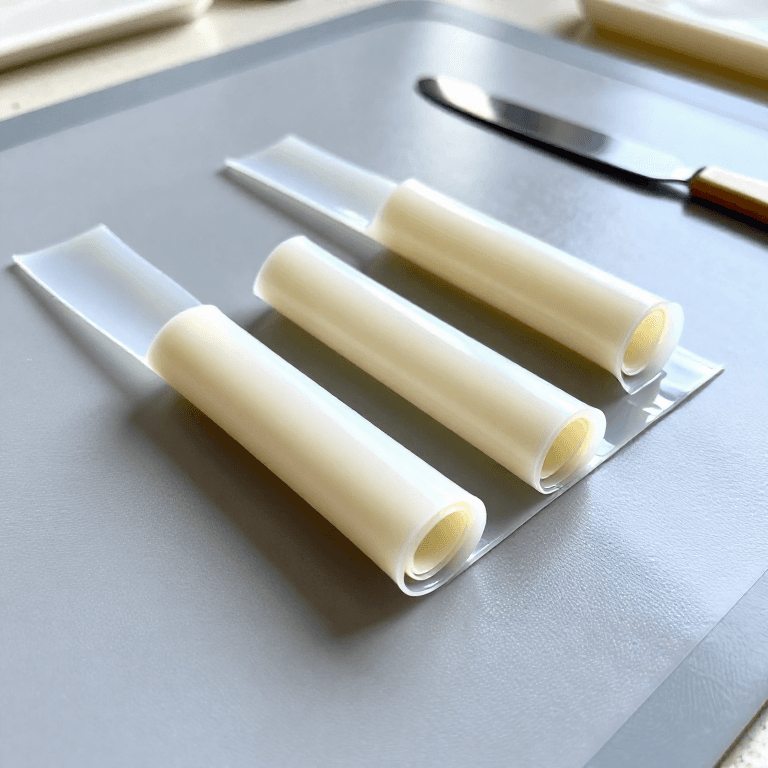
Now do the same test on a piece of **cast** film — cling film, or a sheet cut from the vacuum-forming rung's stock. It behaves much more evenly in both directions, and it is also weaker. That is the trade: orientation buys strength in the direction you orient, and takes it from the other one.
Hold that result. The next rung takes it much further and makes a bottle out of it.
Materiales para este paso:
 Película de polietileno2 piezas
Herramientas necesarias:
 Dinamómetro (balanza de resorte)Calibre digital de 6 pulgadasMicrómetro
 Regla
Regla Cúter de precisión
 Microscopio digital
 Papel milimetradoGafas de seguridad transparentesCuaderno de laboratorio (con copia)
 Lámina de polipropileno (A4)
4
4
Swell, draw-down and the film gauge
Swell, draw-down and the film gauge
Cargando el cuaderno de Jupyter…
Herramientas necesarias:
Papel milimetrado5
5
History and context
History and context
**Attribution, stated honestly.** No single patent is claimed for this rung. Screw extrusion of plastics grew out of the rubber industry across the nineteenth century and was thoroughly established by the 1930s, and the catalogue already holds the lead pipe extrusion rung as its metal-working ancestor. Dozens of filings cover particular dies, screws and die-swell compensations; none of them is *the* extrusion patent, and asserting one would be inventing a tidiness that history does not have.
**What it does for economics.** Extrusion is the cheapest way to convert polymer into useful geometry, because the tool runs continuously and its cost is spread over length rather than over parts. That is why the cheapest plastic objects in the world — film, bag, pipe, profile — are extruded, and why a small moulded part can cost more than a metre of extruded section that weighs ten times as much.
**Orientation is the idea to carry forward.** Everything downstream of the die in a film or fibre line is there to stretch the polymer while it freezes, because stretching lines the chains up and lined-up chains are far stronger. The next rung is that same principle, done deliberately in two directions, to make a bottle that holds five bar.
**Honest limits.** Extrusion makes constant sections and nothing else — any variation along the length has to be added afterwards. Tolerances are much looser than moulding, and they wander with line speed, melt temperature and cooling. Die swell is not calculable to useful accuracy for a real compound, so dies are cut, run, measured and recut; the bench work in step 2 is a small honest version of exactly that loop. And the process is unforgiving of wet feedstock: hygroscopic polymers must be dried or the water flashes to steam in the die and the extrudate comes out foamed and streaked.
Materiales
5- 1 piezaMarcador de posición
- 1 piezaMarcador de posición
- 1 piezaMarcador de posición
- 1 piezaMarcador de posición
- 2 piezasMarcador de posición
Herramientas requeridas
21- Marcador de posición
- Marcador de posición
- Marcador de posición
- Marcador de posición
- Marcador de posición
- Marcador de posición
- Marcador de posición
- Cuaderno de laboratorio (con copia)10% de comisiónMarcador de posición
- Marcador de posición
- Marcador de posición
- Marcador de posición
- Marcador de posición
- Marcador de posición
- Marcador de posición
- Marcador de posición
- Marcador de posición
- Marcador de posición
- Marcador de posición
- Marcador de posición
- Marcador de posición
- Marcador de posición
Blueprints relacionados
Estos blueprints comparten conocimiento — técnicas, materiales o principios


CC0 Dominio público
Este Blueprint se publica bajo CC0. Eres libre de copiar, modificar, distribuir y usar este trabajo para cualquier propósito, sin pedir permiso.
Apoya al Maker comprando productos a través de su Blueprint, donde gana una Comisión del Maker establecida por los vendedores, o crea una nueva iteración de este Blueprint e inclúyela como conexión en tu propio Blueprint para compartir ingresos.