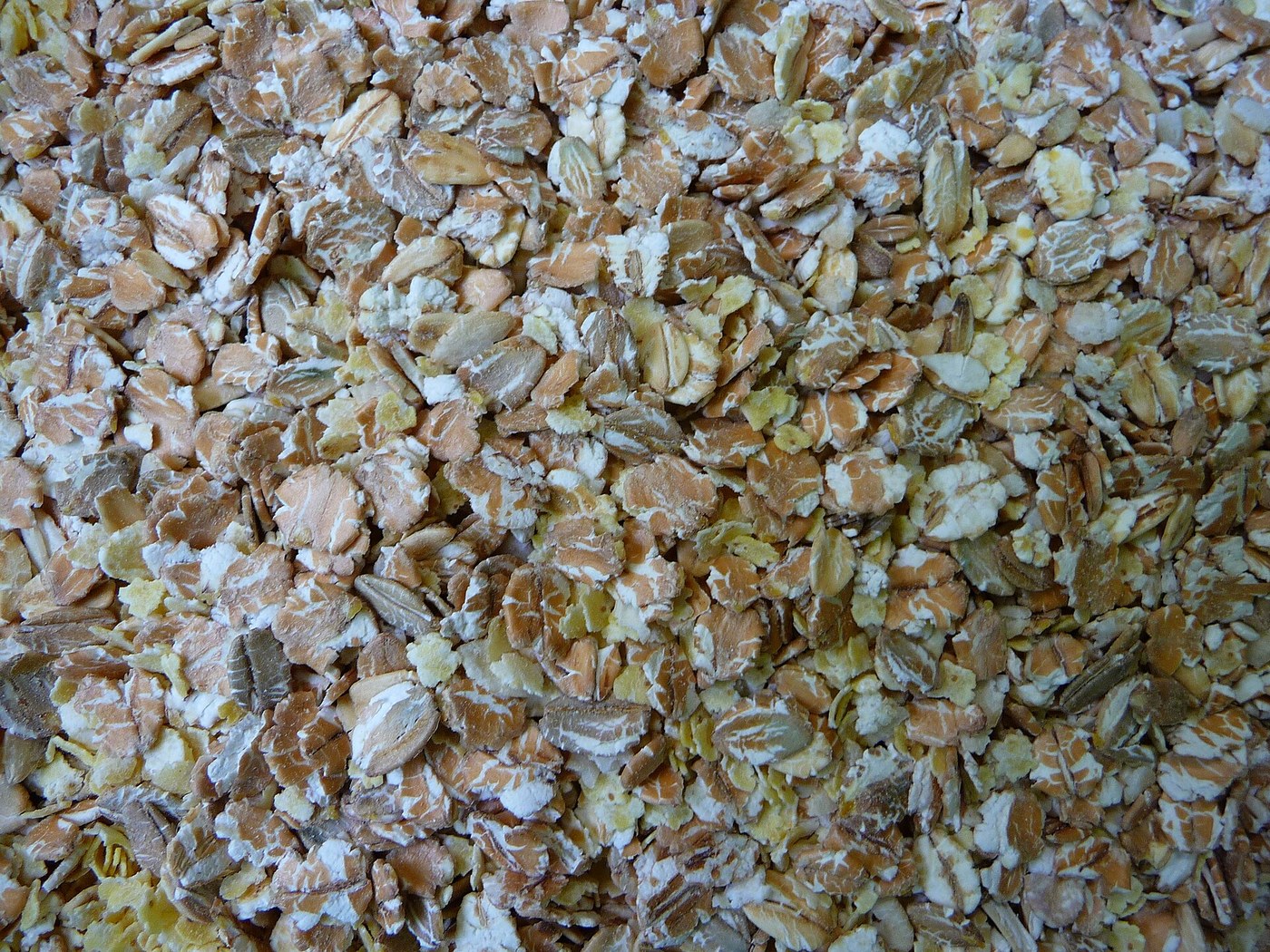


Flaked Cereal
Try to roll a boiled wheat berry flat and you get paste. The starch is gelatinised and sticky, the grain smears rather than spreads, and what comes off the roller is dough. Every attempt to make a thin, crisp, shelf-stable breakfast grain in the nineteenth century failed on exactly this.
The fix is an enzyme, and it happens before the cooking. Soaking the whole grain for hours lets a starch-digesting ferment in the hull convert some of the starch to dextrin. The grain turns cohesive instead of sticky — and cohesive grain can be rolled extremely thin between cold rollers, with no heating and no smearing.
US Patent 558,393, "Flaked cereals and process of preparing same", filed 31 May 1895 and granted 14 April 1896 to John Harvey Kellogg of Battle Creek, Michigan. The patent names the agent explicitly: "cerealin, a starch-digesting organic ferment contained in the hull". That single sentence is the invention.
Instrucciones
Read US 558,393 and find the word cerealin
Read US 558,393 and find the word cerealin
Kellogg attributes the whole effect to "a preliminary digestion by aid of cerealin", which "converts a part of the starch into dextrin, and thus causes the grain to become somewhat glutinous."
Split the wheat into two labelled batches
Split the wheat into two labelled batches
Weigh out 2 × 200 g whole wheat berries. Label one SOAKED and one CONTROL. The control never gets soaked — it is what proves the patent.
Materiales para este paso:
 Granos de trigo400 g
Soak the first batch 8-12 hours
Soak the first batch 8-12 hours
Cover the SOAKED batch with cold water and hold it at 4-16 °C (the patent's 40-60 °F) for 8 to 12 hours. A refrigerator works.
Herramientas necesarias:
 Termómetro de cocina
Note the second temperature window
Note the second temperature window
Kellogg gives an alternative warm soak at 43-60 °C (110-140 °F). He specifies two separate windows and not the range between them — follow one or the other, not the middle.
Drain and rinse the soaked grain
Drain and rinse the soaked grain
Pour off the soaking water and rinse once. The grain should look plump and feel slightly slippery.
Boil both batches one hour
Boil both batches one hour
Simmer each batch in fresh water for about an hour, separately. The patent says "boiled in water for about an hour, and if steamed a longer time will be required."
Test a grain between finger and thumb
Test a grain between finger and thumb
A cooked berry should crush with no hard core. Undercooked grain will not flake, it will shatter.
Drain and cool both batches
Drain and cool both batches
Drain thoroughly and spread out to cool to room temperature. The patent rolls the grain cold, not hot.
Surface-dry for 30 minutes
Surface-dry for 30 minutes
Leave the grain spread on a tray until the surfaces are no longer wet but the berries are still soft. Wet surfaces glue the flakes to the roller.
Roll the CONTROL batch first
Roll the CONTROL batch first
Press unsoaked berries thin with a rolling pin on a cold surface. Expect smearing, tearing and paste. Record what you see before doing the other batch.
Herramientas necesarias:
 Rodillo de amasar
Roll the SOAKED batch the same way
Roll the SOAKED batch the same way
Same pin, same pressure, same surface. The soaked berries flatten into separate coherent flakes instead of smearing together.
Compare the two side by side
Compare the two side by side
Lay a sample of each on white paper. This difference — paste versus flake, from one overnight soak — is the entire patent.
Bake the flakes at 150 °C
Bake the flakes at 150 °C
Spread flakes in a single layer on a baking sheet and bake at 150 °C for 20-30 minutes, turning once, "until dry and crisp".
Herramientas necesarias:
 Bandeja de horno
Check for crispness, not colour
Check for crispness, not colour
A finished flake snaps cleanly when cold. Pale flakes that bend are still carrying moisture — return them to the oven rather than browning them further.
Cool completely and store airtight
Cool completely and store airtight
Flakes crisp fully as they cool. Store in a sealed jar — they reabsorb humidity within hours in open air, which is why the process ends in a dry oven.
History & Context — one patent, two brothers, one name on it
History & Context — one patent, two brothers, one name on it
The patent. US 558,393, "Flaked cereals and process of preparing same", filed 31 May 1895 and granted 14 April 1896, in the name of John Harvey Kellogg alone. He was the physician superintending the Battle Creek Sanitarium; the flakes were developed as food for patients on a vegetarian, low-stimulant regimen, and were sold as "Granose".
Will Keith Kellogg is not on the patent, and by most accounts should have been. The discovery is usually dated to 1894 and involved both brothers: a batch of cooked wheat was left standing, and rather than throw it out they ran it through the rollers the next day, expecting dough and getting flakes. Will — John Harvey's younger brother, employed as the sanitarium's bookkeeper and general manager — did at least as much of the work and received no credit on the filing. It is worth saying plainly that there is genuine disagreement in the sources about who did what, and this blueprint does not try to settle it; what is documented is the single name on the patent.
The brothers then split over sugar. John Harvey wanted the product to stay a health food, made for patients and sold by mail. Will wanted to add sugar to make it palatable and sell it nationally. He was right about the market and wrong about his brother's tolerance for it; the two fought for years, ending in litigation over the use of the family name in the early 1920s. Will won the rights and renamed his firm the Kellogg Company in 1922. The patent that started it had expired long before the fight finished.
What cerealin actually is. The 1896 term describes a real effect in period language. Whole grain carries starch-degrading enzymes — amylases — concentrated in the bran and aleurone layer just under the hull. Soaking hydrates the grain and gives those enzymes hours at a workable temperature to break some starch into shorter dextrins. Dextrins are cohesive rather than sticky, which is precisely the property a thin flake needs: enough internal binding to hold together under the roller, not so much surface tack that it welds to the steel. This is why Kellogg's process can use cold rollers at high pressure, and why the control batch in step 10 fails. His two temperature windows make sense in the same frame — a cold soak works slowly over 12 hours, a warm soak works fast, and the region between them is where the grain sours before the enzymes finish.
Honest limits of the home version. A rolling pin cannot reach the pressure of the paired steel rollers the patent assumes, so home flakes come out noticeably thicker than commercial ones and the yield is uneven. That is a tooling gap, not a process error — the soak/cook/roll/bake sequence and its result are the patent's, and the difference between the two batches in step 12 shows up clearly regardless. Corn flakes, the descendant everyone actually eats, came later and use corn grits rather than whole wheat berries; the patent already anticipates "barley or oats prepared by the removing of a portion of the outer husks, corn, and other grains."
Materiales
1- 400 gMarcador de posición
Herramientas requeridas
3- Marcador de posición
- Marcador de posición
- Marcador de posición
Este plano hace
Blueprints relacionados
Estos blueprints comparten conocimiento — técnicas, materiales o principios

CC0 Dominio público
Este Blueprint se publica bajo CC0. Eres libre de copiar, modificar, distribuir y usar este trabajo para cualquier propósito, sin pedir permiso.
Apoya al Maker comprando productos a través de su Blueprint, donde gana una Comisión del Maker establecida por los vendedores, o crea una nueva iteración de este Blueprint e inclúyela como conexión en tu propio Blueprint para compartir ingresos.