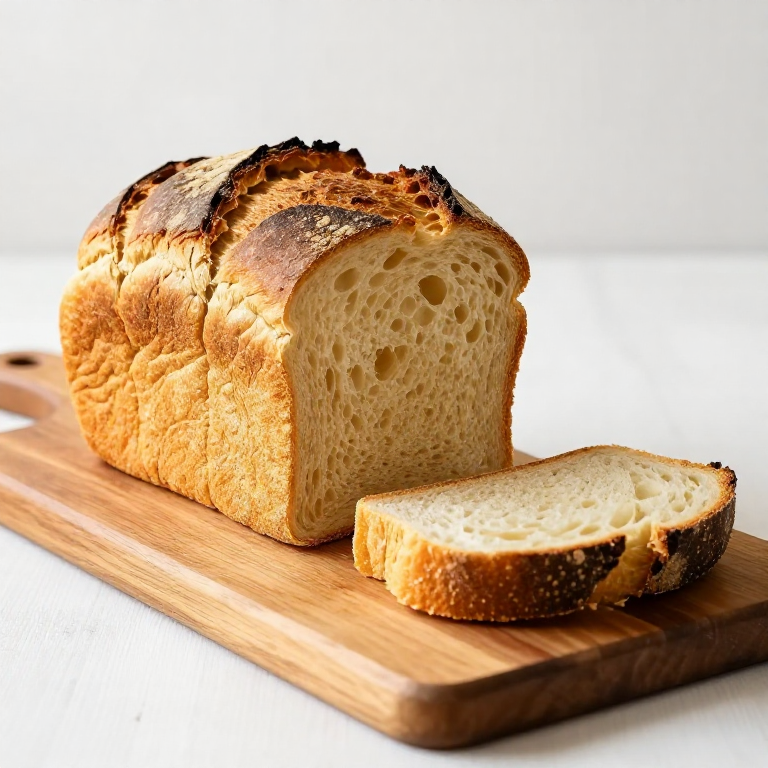


Gluten-Free Bread
Bread works because of a net. Wheat proteins, hydrated and worked, link into gluten — a cohesive, elastic, extensible network that catches the carbon dioxide yeast produces and holds it while the loaf rises and sets. Remove the wheat and you do not have a slightly worse dough. You have no net at all, and gas simply escapes.
That is why gluten-free baking is not substitution. A gluten-free mix behaves as a batter, not a dough: it will not hold a shape, cannot be kneaded, and if baked as-is produces something dense and crumbling.
The fix is to build a different net out of hydrocolloids — long-chain molecules that absorb large amounts of water and form a gel. Xanthan gum binds and thickens, and it is what most commercial blends rely on; on its own it lacks the stretch that lets a loaf rise tall. Psyllium husk forms a sticky, genuinely elastic gel and is what turns a pourable batter into something you can shape and handle, at roughly 2 % of total recipe weight.
The other change is water. Starches and fibres absorb far more of it than wheat flour does, so a gluten-free formula runs much wetter — and a baker who "corrects" that by adding flour reproduces exactly the dryness they were trying to avoid.
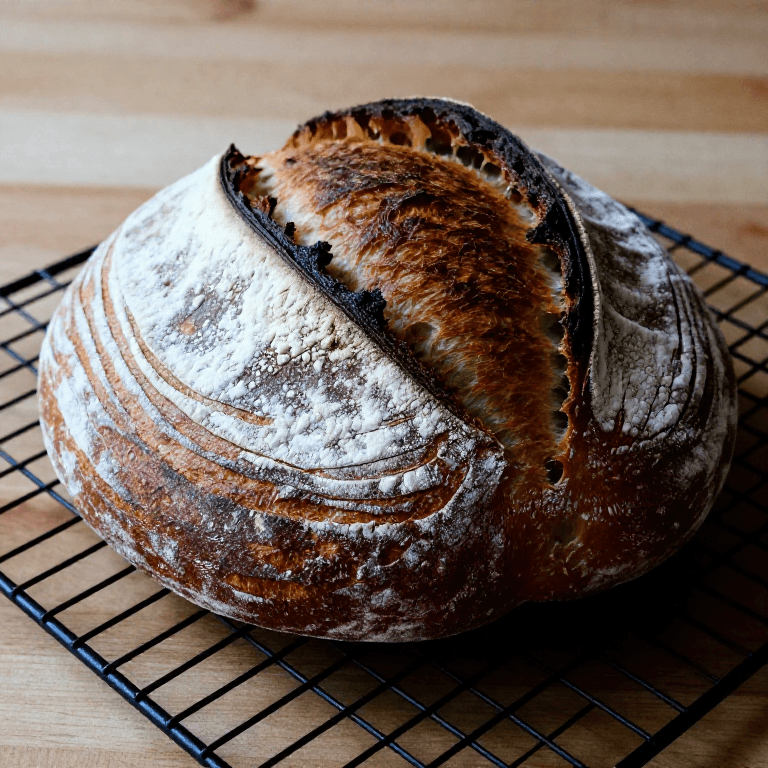
Bake four loaves that differ in one thing each, and the rules stop being arbitrary.
Instrucciones
Bake the control that fails
Bake the control that fails
Make a small loaf from gluten-free flour, yeast, salt, water and nothing else. Mix, prove and bake.
Record risen height and cut it open.
Expect it to be dense, flat and crumbling, and to fall apart when sliced.
Bake the failure deliberately and keep a photograph. Everything after this is measured against it, and it is the only way to see what the hydrocolloid is actually contributing.
Materiales para este paso:
 Kit de mezcla de harinas sin gluten1 kit
 Levadura de panadería7 g
Herramientas necesarias:
 Báscula digital de cocina
 Bandeja de horno de aluminio
Hydrate the psyllium separately, first
Hydrate the psyllium separately, first
Whisk psyllium husk into the recipe's water and leave it ten minutes until it forms a thick gel, before it meets the flour.
Watch it thicken.
Adding dry psyllium to dry flour gives lumps that never hydrate — the outside of each lump gels and seals the inside off. Pre-hydrating is the single change that most reliably rescues a gluten-free loaf.
Materiales para este paso:
 Harina de todo uso500 g
Herramientas necesarias:
 Bol grande de vidrio
Mix wet, and resist the urge to correct it
Mix wet, and resist the urge to correct it
Combine gel, flour, yeast and salt. The mixture should be markedly wetter and stickier than a wheat dough — closer to a thick paste than a ball.
Weigh the total water and record it as a percentage of flour weight.
Do not add flour to make it feel familiar. That percentage is typically far higher than for wheat, and getting it wrong dry is the commonest single cause of a brick.
Prove once, shape wet, and do not knead
Prove once, shape wet, and do not knead
Prove in the tin, not on a board. Smooth the top with a wet spatula rather than shaping by hand.
Prove once, to about 75 % of the tin, and bake without knocking back.
Expect no windowpane, no spring-back, no second rise.
Kneading develops gluten and there is none to develop; all it does here is break the hydrocolloid gel you spent step 2 building.
Bake hotter and longer, and measure the inside
Bake hotter and longer, and measure the inside
Bake at a high temperature and probe the centre. Take it out at an internal temperature around 96-99 °C, well above where a wheat loaf is called done.
Cool completely before cutting — several hours.
Cutting warm is a real failure mode here. The starch gel is still setting, and a loaf cut hot will look gummy in a way it would not have been an hour later.
Herramientas necesarias:
 Termómetro de lectura instantánea
 Termómetro de horno
Run the comparison properly
Run the comparison properly
Bake four small loaves varying one thing each: no hydrocolloid, xanthan only, psyllium only, and both. Keep flour, water, yeast, tin, prove time and oven identical.
Measure risen height, cut a slice and photograph the crumb, and try to fold a slice without it breaking.
Expect psyllium to give the best rise and handling, xanthan to bind but rise less, and both together to beat either.
Compendium — the food science and the safety that is not optional
Compendium — the food science and the safety that is not optional
What gluten actually is. Two wheat protein groups — glutenins, which give strength and elasticity, and gliadins, which give extensibility and flow — link into a network when hydrated and worked. That network is simultaneously strong enough to hold gas and stretchy enough to let the loaf expand, and no single replacement does both. This is why gluten-free formulas use two or three hydrocolloids together: one for binding, one for stretch, sometimes one for moisture retention.
The hydrocolloids, and what each does. Xanthan gum is a bacterial polysaccharide, an excellent thickener and binder, cheap and stable — but it gives structure without much elasticity, which caps how tall a loaf will get. Psyllium husk forms a sticky elastic gel that genuinely mimics extensibility, transforms handling, and is used at around 2 % of recipe weight. HPMC (hydroxypropyl methylcellulose) is the commercial workhorse and has the unusual property of gelling on heating, so it firms up as the loaf bakes rather than before. They are not interchangeable, and swapping one for another gram-for-gram is a common way to ruin a working recipe.
Why hydration is so much higher. Rice, tapioca and potato starches, and any added fibre, absorb far more water than wheat flour, and they go on absorbing it during the bake. A gluten-free formula therefore looks alarmingly wet at the mixing stage and is correct. It also stales faster, because there is no protein network holding water and starch retrogradation proceeds quickly — which is why gluten-free bread is usually better toasted the next day and is often frozen sliced.
🔴 The safety point, and it is the most important paragraph here. For a person with coeliac disease, gluten is not a preference or an intolerance — it triggers an autoimmune reaction that damages the small intestine, and the threshold is measured in milligrams. Cross-contamination is the real hazard in a home kitchen: shared toasters, wooden boards and rolling pins, flour dust in the air after wheat baking, a scoop used in two bins, or a shared oven with uncovered wheat products above. If you are baking for someone coeliac, use dedicated equipment, wipe surfaces down, bake when no wheat flour has been aired recently, and check that every ingredient — including yeast, baking powder and any oats — is certified gluten-free. A loaf made from correct ingredients on a contaminated board is not gluten-free. Wheat allergy is a different condition again and can be severe and rapid. Nothing in this blueprint is medical guidance; if you are cooking for a diagnosed person, follow their clinician's advice over any recipe.
Materiales
3- Marcador de posición
- Marcador de posición
- 500 gMarcador de posición
Herramientas requeridas
5- Marcador de posición
- Marcador de posición
- Marcador de posición
- Marcador de posición
- Marcador de posición
Materiales de Blueprints conectados
Este plano hace
Blueprints relacionados
Estos blueprints comparten conocimiento — técnicas, materiales o principios
CC0 Dominio público
Este Blueprint se publica bajo CC0. Eres libre de copiar, modificar, distribuir y usar este trabajo para cualquier propósito, sin pedir permiso.
Apoya al Maker comprando productos a través de su Blueprint, donde gana una Comisión del Maker establecida por los vendedores, o crea una nueva iteración de este Blueprint e inclúyela como conexión en tu propio Blueprint para compartir ingresos.