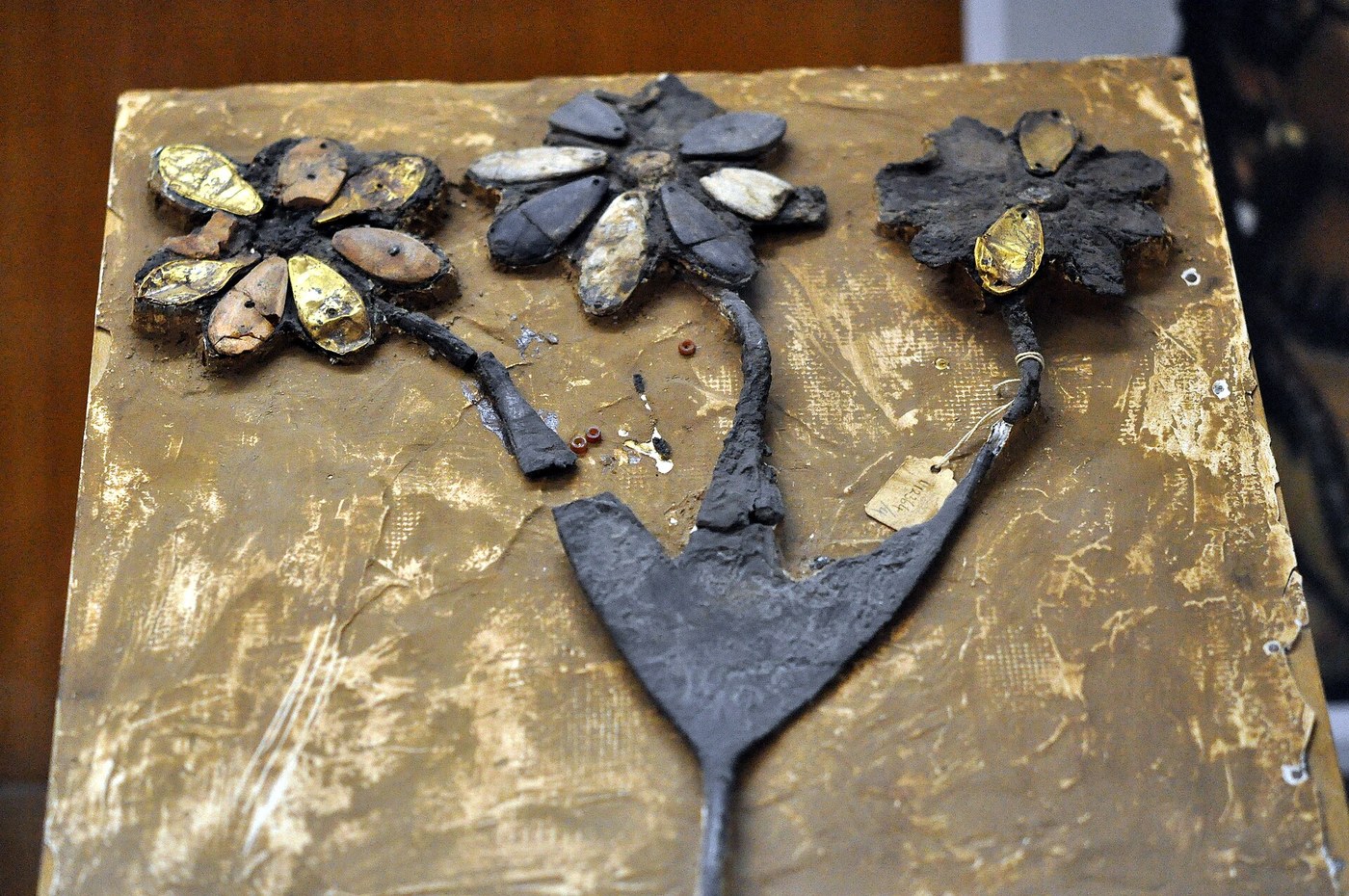


Gold Leaf Diadem of Ur
In 1922 Leonard Woolley began digging at Ur, and in one grave — PG 800 — he found a woman buried under a mass of gold. The headdress on Queen Puabi's remains was built from gold sheet cut into willow and poplar leaves, strung on wreaths with lapis lazuli and carnelian beads, topped with a gold comb carrying seven flowers with lapis centres. The whole assembly weighs over six pounds.
This blueprint builds one wreath band of gold-sheet leaves on a beaded string — the core unit the headdress is made from. The technique is genuinely simple: gold is the most malleable metal there is, and thin sheet can be cut with shears and shaped over a thumb. What makes it beautiful is repetition and the contrast of warm gold against deep blue lapis and red carnelian.
Read the last step before you start. The famous "diadem" is not quite the object the museum label used to suggest, and the story of how it got that name is a lesson in how reconstruction can quietly become fact.
Instrucciones
Cut a paper leaf template
Cut a paper leaf template
Cut a template 45 mm long and 22 mm wide, pointed at both ends — a willow leaf. Poplar leaves are broader and more rounded. Both shapes are present in the Ur material.
Anneal the gold sheet
Anneal the gold sheet
Heat the gold sheet on the firebrick to a dull red, then quench. Gold does not oxidise, so it comes out of the flame clean — no pickling needed, unlike silver.
Materiales para este paso:
 Lámina de oro de 24 quilates de 0,13 mm1 hoja
Herramientas necesarias:
 Soplete de propano
 Ladrillos refractarios
Scribe and cut 12 leaves
Scribe and cut 12 leaves
Scribe round the template and cut 12 leaves with the jeweller's saw. Cut just outside the line — 0.005" sheet tears if you force it.
Herramientas necesarias:
 Sierra de joyero
 Punta de trazar de diamante
File the edges smooth
File the edges smooth
File every edge with a fine needle file. Thin gold sheet leaves a burr that will catch in hair and in the beading thread.
Herramientas necesarias:
 Juego de limas de aguja
Raise a central rib on each leaf
Raise a central rib on each leaf
Lay each leaf face down on a soft pad and run the burnisher down the centre line to raise a shallow midrib. The rib stiffens the leaf and reads as a real leaf vein.
Herramientas necesarias:
 Bruñidor de ágata
Dish each leaf slightly
Dish each leaf slightly
Curve each leaf gently over your thumb into a shallow dish. Flat leaves hang dead; dished leaves catch light from several angles as the wearer moves.
Punch a suspension hole
Punch a suspension hole
Punch a 1.5 mm hole 3 mm from the base of each leaf. Support the leaf on hardwood so the sheet does not stretch and pucker around the hole.
Herramientas necesarias:
Juego de limas de agujaMake the gold wire loops
Make the gold wire loops
Cut 12 lengths of 22 gauge gold or gilded wire at 25 mm. Thread one through each leaf and close it into a loop with the pliers.
Materiales para este paso:
 Hilo de oro de 0,64 mm0.3 metro
Herramientas necesarias:
 Juego de alicates de joyería
Drill and string the lapis beads
Drill and string the lapis beads
String lapis lazuli and carnelian beads alternately onto strong linen thread to a 550 mm length. Blue and red against gold is the Ur palette — lapis traded from Afghanistan, carnelian from the Indus.
Materiales para este paso:
 Piedra de lapislázuli20 piezas
 Cuentas de cornalina20 piezas
 Hilo de lino encerado1 metro
Hang the leaves along the string
Hang the leaves along the string
Slide a leaf loop onto the strung beads every 4 beads, so the 12 leaves sit evenly along the band. Check spacing before closing any loop tight.
Herramientas necesarias:
Juego de alicates de joyeríaClose the band and check the hang
Close the band and check the hang
Knot the ends into a circle sized to the head. Hold it up: every leaf should hang free and turn. A leaf that binds is a loop closed too tight.
History & Context
History & Context
What was actually found. The Royal Cemetery at Ur was excavated between 1922 and 1934 by Leonard Woolley, in a joint expedition of the Penn Museum and the British Museum. In grave PG 800 lay a woman identified from a cylinder seal as Puabi. Her headdress comprises around 20 gold leaves, two strings of lapis and carnelian, and a large gold comb topped with seven gold flowers with lapis centres, held on four wreaths carrying willow and poplar leaves in gold sheet. It weighs over six pounds and is now in the Penn Museum.
The "diadem" is a modern object. This is the part worth being careful about. A separate group of thousands of tiny lapis beads with gold animal and plant pendants was found on a table near her head. In preparing for the British Museum's 1928 exhibition, these were assembled and presented as a single "diadem" — and the name stuck. Later study concluded that Woolley's arrangement was a group of closely related objects that were never intended to be understood as one diadem. The famous piece is, in part, a 1928 reconstruction. It is a clean example of how an excavator's plausible guess becomes, through a museum label and a photograph, an accepted ancient fact.
Why gold sheet and not cast gold. Gold is the most malleable metal known — it can be beaten to a few thousandths of a millimetre without tearing. Sheet goldwork gives maximum visual mass for minimum metal, which matters when your gold arrives by long-distance trade. Ur's smiths were not being frugal by accident; they were making a small quantity of imported metal look like an overwhelming amount.
The stones are a trade map. Lapis lazuli in Mesopotamia came overwhelmingly from Badakhshan in modern Afghanistan — roughly 2,500 km away. Carnelian, and particularly the etched carnelian beads found at Ur, points toward the Indus Valley. A single strung band therefore records a trade network spanning most of southern Asia in the mid-third millennium BC. The jewellery is evidence before it is ornament.
What the burial does not tell us. Puabi's grave included the remains of dozens of attendants. Whether they were killed, took poison willingly, or died some other way has been argued over for a century, and forensic work on the skulls has shifted the picture more than once. It is genuinely unresolved. A blueprint about the goldwork is not the place to settle it — but it is worth knowing that the most spectacular jewellery in the ancient Near East comes out of a grave whose central question is still open.
Materiales
5- Marcador de posición
- 0.3 metroMarcador de posición
- 20 piezasMarcador de posición
- 20 piezasMarcador de posición
- 1 metroMarcador de posición
Herramientas requeridas
7- Marcador de posición
- Marcador de posición
- Marcador de posición
- Marcador de posición
- Marcador de posición
- Marcador de posición
- Marcador de posición
Este plano hace
CC0 Dominio público
Este Blueprint se publica bajo CC0. Eres libre de copiar, modificar, distribuir y usar este trabajo para cualquier propósito, sin pedir permiso.
Apoya al Maker comprando productos a través de su Blueprint, donde gana una Comisión del Maker establecida por los vendedores, o crea una nueva iteración de este Blueprint e inclúyela como conexión en tu propio Blueprint para compartir ingresos.