
Greek Red-Figure Pottery — Creating Red-Figure Pottery by Slip Reservation
Instrucciones
Sketch the Design on the Vessel
Sketch the Design on the Vessel
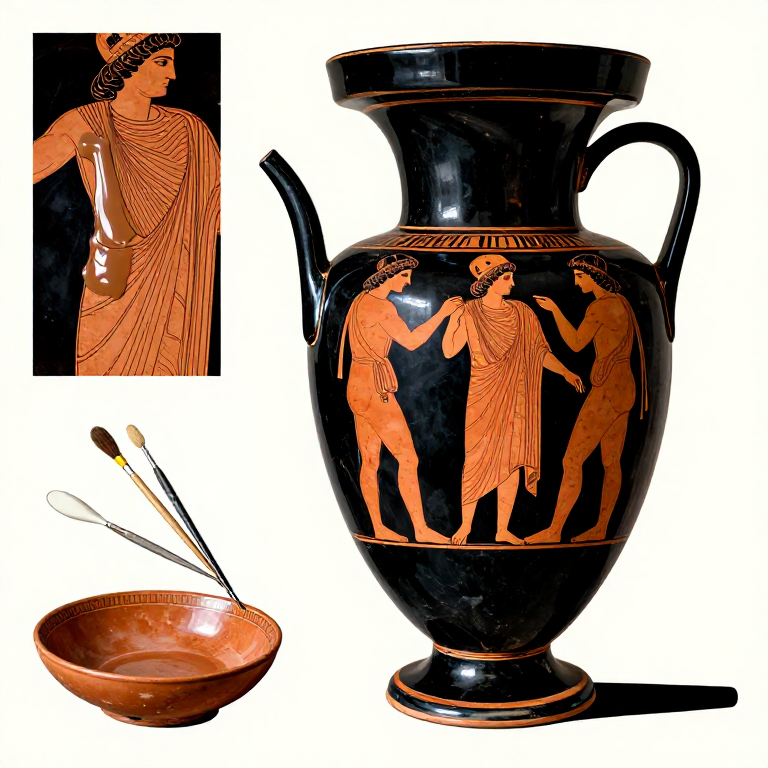
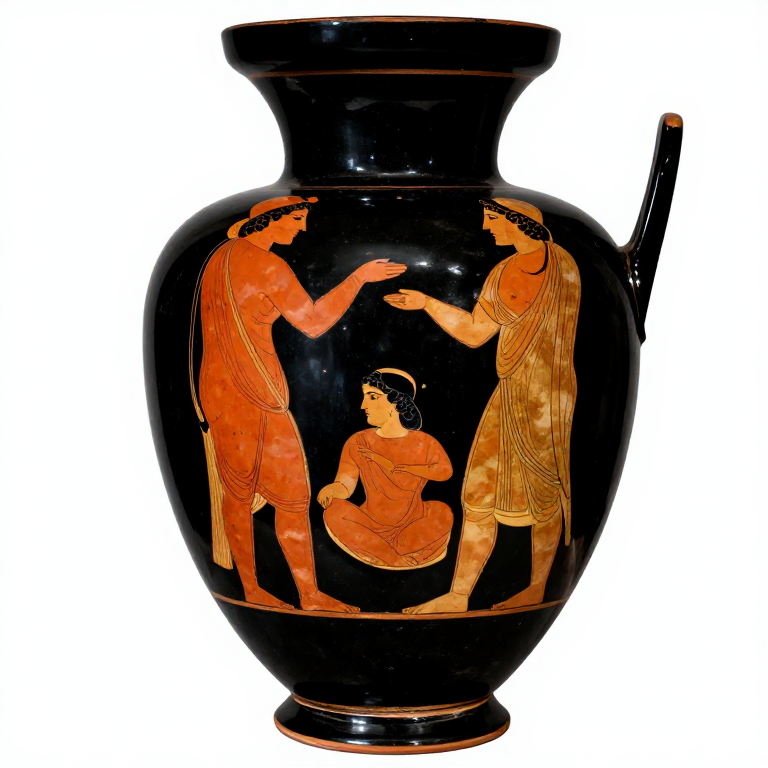
Lightly sketch the figural composition on the leather-hard vessel surface using a blunt pointed tool that leaves faint guidelines without cutting into the clay. Some Greek vase painters used preliminary charcoal sketches that burned away during firing. Plan the composition carefully — in red-figure, the figures are the reserved (unpainted) areas, so you must accurately outline where the figures end and the black background begins. This requires thinking in negative space, which is more challenging than painting positive silhouettes. The red-figure technique was invented in Athens around 530 BCE, traditionally attributed to the Andokides Painter. It rapidly became the dominant technique because it allowed painters to use a brush for internal details rather than an incising tool.
Materiales para este paso:
 Vasija de barro rojo en estado de cuero1 vessel pieza
 Arcilla silvestre200-400 ml ml
Herramientas necesarias:
 Juego de pinceles
 Brochas planas anchas
 Horno cerámico
 Brújula
Paint Internal Details with Dilute Slip
Paint Internal Details with Dilute Slip
Using a fine brush loaded with dilute (thinned) iron-rich slip, paint the internal details of the figures — anatomy, drapery folds, facial features, and decorative patterns. Different dilutions produce different fired colors: full-strength slip fires to glossy black; diluted slip fires to a golden-brown or honey color, creating subtle tonal variation. This tonal range is a major advantage of red-figure over black-figure, where internal details could only be incised lines. Relief lines (raised lines of thick slip applied through a fine nozzle, like modern cake decorating) were used to create the primary contour outlines of figures, providing crisp definition between figure and background.
Fill the Background with Black Slip
Fill the Background with Black Slip
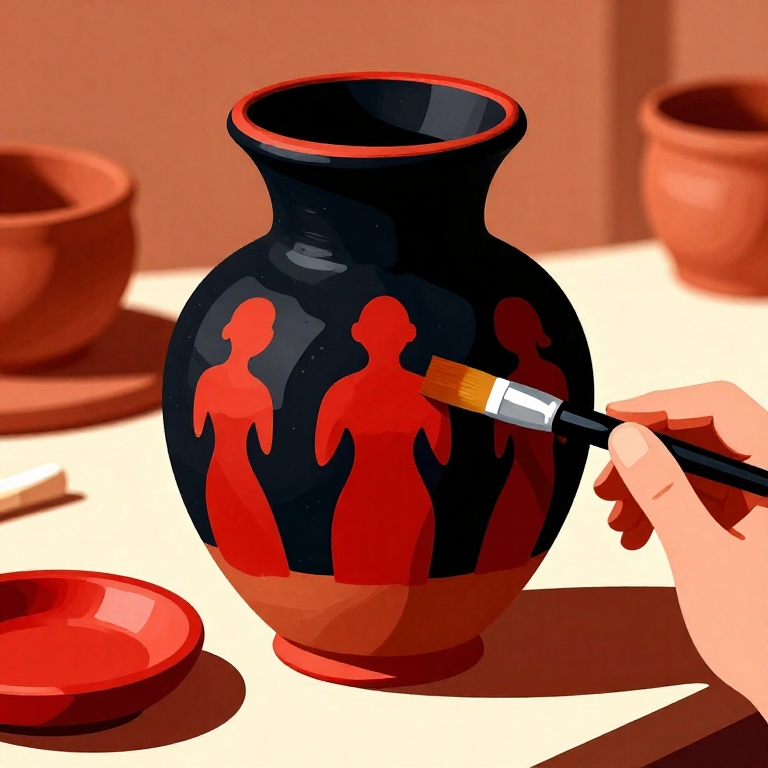
Using a broad brush, carefully fill in the entire background area with full-strength iron-rich slip, working around the reserved figure outlines. This is the most technically demanding step — any slip that accidentally covers a figure area will fire black and ruin the design. Work methodically, first outlining the figure contours with a medium brush, then filling larger background areas with a broad brush. The background slip must be applied evenly with no visible brush strokes or thin patches. Multiple thin coats may be needed to build up sufficient thickness for a deep, uniform black after firing. The inside of the vessel was typically coated entirely with slip (firing black) to waterproof the interior for holding wine or oil.
Fire Using the Three-Phase Cycle
Fire Using the Three-Phase Cycle
Fire the decorated vessel using the same three-phase oxidation-reduction-re-oxidation cycle as black-figure ware. The chemistry is identical: during reduction, all iron turns black; during re-oxidation, the porous body and reserved figure areas return to red while the sintered slip background remains permanently black. The firing temperature peaks at approximately 950 degrees Celsius during the reduction phase. Careful kiln management is critical — the transition from reduction to re-oxidation must be gradual to allow the body clay to re-oxidize evenly. If the kiln is opened too quickly, the figures may fire with grey patches where re-oxidation was incomplete. Well-fired red-figure ware shows a clean, warm orange-red figure color against a deep, lustrous black background.
Assess the Fired Result
Assess the Fired Result
After slow cooling, examine the vessel. The reserved red-figure areas should be warm orange-red with painted details visible in darker tones. The black background should be uniformly glossy. Dilute slip details on the figures should appear as golden-brown to dark brown lines, creating subtle modeling of forms. The relief contour lines should stand slightly proud of the surface and be deep glossy black. Red-figure production centered in Athens (the Kerameikos potters' quarter) from about 530 to 320 BCE, with master painters like Euphronios, the Berlin Painter, and the Kleophrades Painter achieving extraordinary naturalism. The technique spread to Greek colonies in southern Italy, where distinctive local styles developed at workshops in Lucania, Apulia, Campania, and Paestum.
Materiales
4- 200-400 ml mlMarcador de posición
- Dilute slip (watered down, for detail lines)50-100 ml ml
- 1 vessel piezaMarcador de posición
- 200-400 ml piezaMarcador de posición
Herramientas requeridas
6- Marcador de posición
- Marcador de posición
- Marcador de posición
- Marcador de posición
- Marcador de posición
- Marcador de posición
Este plano hace

CC0 Dominio público
Este Blueprint se publica bajo CC0. Eres libre de copiar, modificar, distribuir y usar este trabajo para cualquier propósito, sin pedir permiso.
Apoya al Maker comprando productos a través de su Blueprint, donde gana una Comisión del Maker establecida por los vendedores, o crea una nueva iteración de este Blueprint e inclúyela como conexión en tu propio Blueprint para compartir ingresos.