
ARTE
BELLEZA Y BIENESTAR
ARTESANÍA
CULTURA E HISTORIA
ENTRETENIMIENTO
MEDIO AMBIENTE
COMIDA Y BEBIDAS
FUTURO VERDE
INGENIERÍA INVERSA
CIENCIAS
DEPORTES
TECNOLOGÍA
TECNOLOGÍA VESTIBLE
Forging an Iron Knife from a Wrought Iron Bar — The Smith's First Project
Forge

Creado por

Forge

26. mayo 2026NO
7
0
0
0
0

Forging an Iron Knife from a Wrought Iron Bar — The Smith's First Project

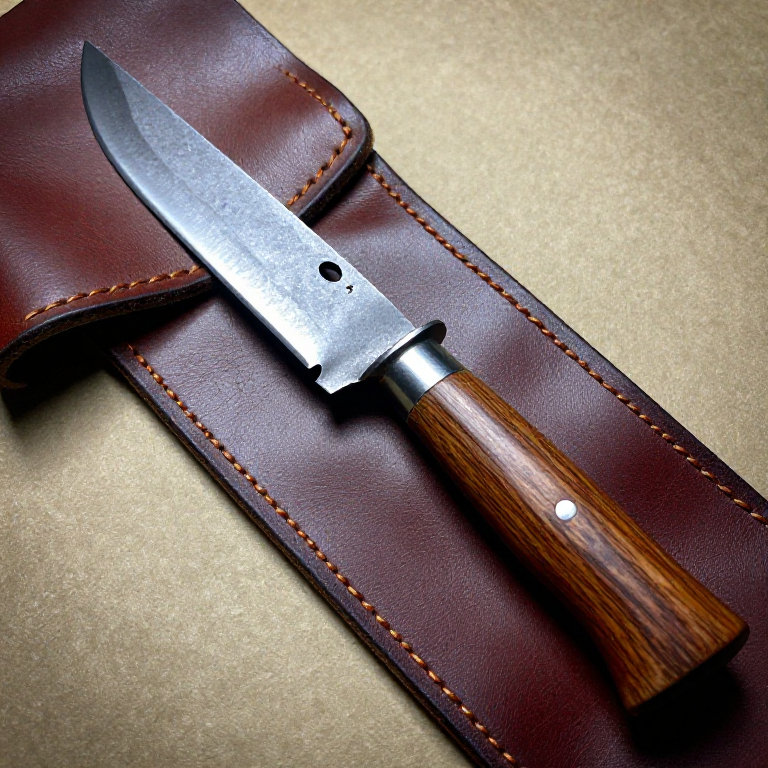
The iron knife is traditionally the first object a blacksmith apprentice learns to forge. It teaches every fundamental operation: drawing out (lengthening the metal), tapering (creating a point), bevelling (forming the cutting edge), and finishing (grinding and hafting). An experienced smith can forge a knife in under an hour; a beginner should expect a full day of practice.

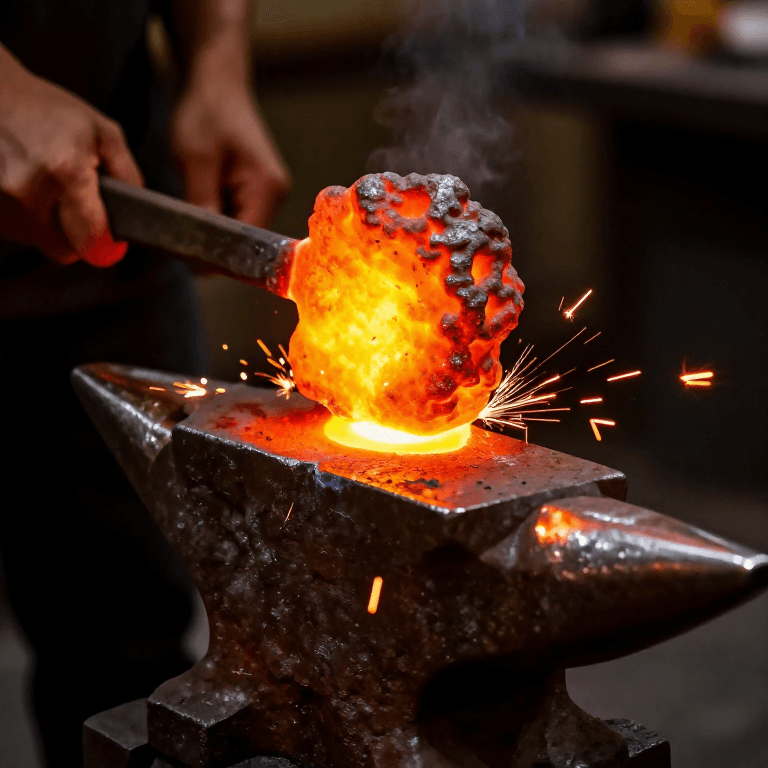
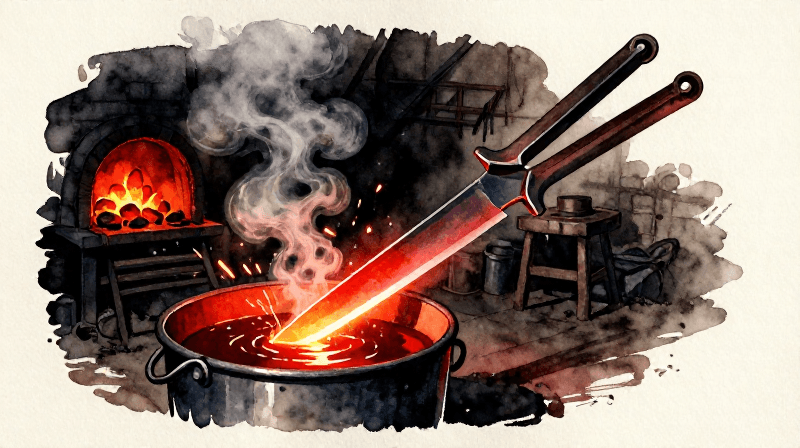
Unlike bronze tools which are cast into shape, iron tools are forged — beaten into shape from a solid bar using only heat, hammer, and anvil. The wrought iron bar is heated to bright orange in a charcoal forge, then hammered on an anvil to draw it into a blade shape. The tang (the part that goes into the handle) is formed by drawing the opposite end to a narrow taper.

The blade is then ground, and the edge can be hardened by case-carburising (packing in charcoal and heating) to add a thin layer of steel to the surface. This gives a wrought iron blade the best of both worlds: a tough, shock-absorbing body with a hard, sharp edge.

Intermedio
2-3 hours

Instrucciones

1

Select and cut the bar stock

Start with a wrought iron bar about 20 cm long, 3 cm wide, and 1 cm thick. This provides enough material for a knife blade about 15 cm long with a 5 cm tang. Mark the point where the blade meets the tang with a centre-punch or chisel nick — roughly two-thirds of the length for blade, one-third for tang.
2

Heat the tang end to forging temperature

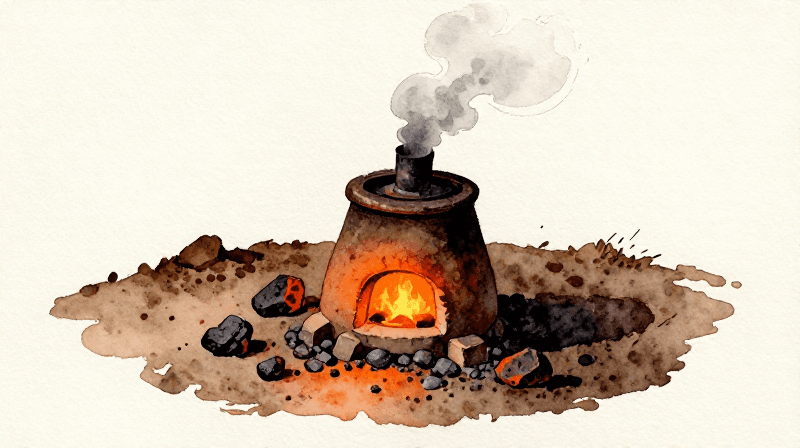
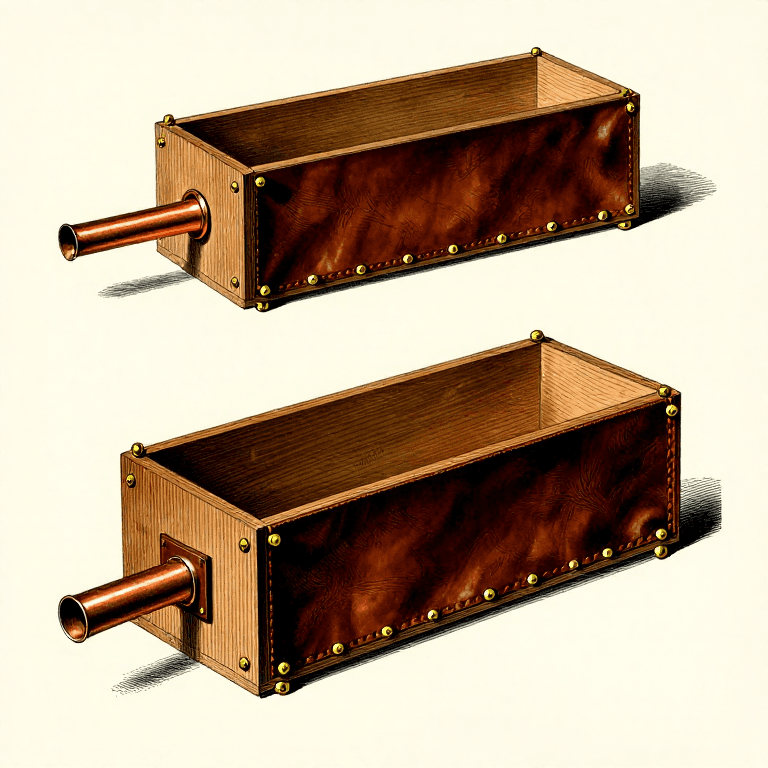
Place the bar in the forge fire with the tang end towards the hottest zone. Work the bellows until the metal reaches bright orange heat — about 900-1,000 °C. The metal should glow evenly with no dark cold spots. Iron forges best at bright orange; at dull red it resists the hammer, and at white heat it burns and crumbles.

Materiales para este paso:

CharcoalCharcoal3 kg
3

Draw out the tang

Remove the bar from the forge and place the tang end on the anvil. Using the cross-peen of the forge hammer, strike at 45 degrees to the length of the bar to spread the metal. Rotate 90 degrees and repeat. This draws the tang into a narrow, tapered square section about 8 mm wide. The tang should be long enough to extend through the handle — about 5-6 cm. Return to the fire whenever the metal drops below bright orange.

Herramientas necesarias:

Forge Hammer (Cross-Peen)Forge Hammer (Cross-Peen)
Forge TongsForge Tongs
Hearth (Forge Fire)Hearth (Forge Fire)
4

Define the shoulder

Where the tang meets the blade, create a clean step (the shoulder) by placing the junction on the anvil edge and hammering downward. This abrupt transition prevents the handle from sliding forward onto the blade. The shoulder should be a clean 90-degree step on both sides of the blade.
5

Taper the blade to a point

Heat the blade end. Hammer the tip into a gradual taper, working from both faces alternately to keep the blade centred. The taper should start about 5 cm from the tip and converge to a point. Do not make the tip too thin at this stage — it will burn off in the fire. Leave it about 3 mm thick; the final thinning happens during grinding.
6

Set the bevel

Heat the blade and hammer the cutting edge to create the primary bevel. Tilt the blade about 15 degrees on the anvil face and strike along the edge with overlapping blows. Flip and repeat on the other side to create a symmetrical double bevel. The edge should thin to about 2 mm — thin enough to reduce grinding work but thick enough that it does not fold over during forging. Work the entire blade length from shoulder to tip.
7

Straighten and true the blade

Heat the blade to a low orange and lay it flat on the anvil. Look down the spine for any curves or twists. Correct bends by hammering on the high side. Correct twists by gripping the blade and tang with tongs and applying gentle opposing torque. The blade must be straight before grinding — a warped blade cannot be ground evenly.
8

Normalise the blade

Heat the entire blade to dull cherry red (about 750 °C) and allow it to cool in still air. This normalising cycle relieves internal stresses introduced by forging and refines the grain structure. Repeat twice. Normalised wrought iron is tougher than as-forged iron because the grain is uniform and stress-free.
9

Grind the edge

Grind the primary bevel on a sandstone slab with water. Maintain a consistent angle of about 20-25 degrees per side. Work from the shoulder to the tip in long, even strokes. Finish on a finer whetstone. The edge does not need to be razor-sharp at this stage if you plan to case-carburise — the final edge is set after hardening.

Materiales para este paso:

Sandstone (Abrasive)Sandstone (Abrasive)1 pieza
WhetstoneWhetstone1 pieza
10

Haft with a wooden handle

Select a piece of dense hardwood (oak, ash, or yew) for the handle. Drill or burn a hole through the centre to accept the tang. Heat the tang to dull red and drive it through the handle — the hot iron burns its way through, creating a tight charred fit. If the tang protrudes through the far end, peen it over a small washer or rivet plate to lock the handle permanently.

Materiales

3

Herramientas requeridas

3

Materiales de Blueprints conectados

CC0 Dominio público

Este Blueprint se publica bajo CC0. Eres libre de copiar, modificar, distribuir y usar este trabajo para cualquier propósito, sin pedir permiso.

Apoya al Maker comprando productos a través de su Blueprint, donde gana una Comisión del Maker establecida por los vendedores, o crea una nueva iteración de este Blueprint e inclúyela como conexión en tu propio Blueprint para compartir ingresos.

Discusión

(0)

Iniciar sesión para unirte a la discusión

Cargando comentarios...