

Monotype Casting
The Linotype casts a whole line as one solid slug. Correct a single letter and you recast the entire line. Tolbert Lanston's machine took the opposite approach: cast every character as a separate piece of type, then assemble them into justified lines.
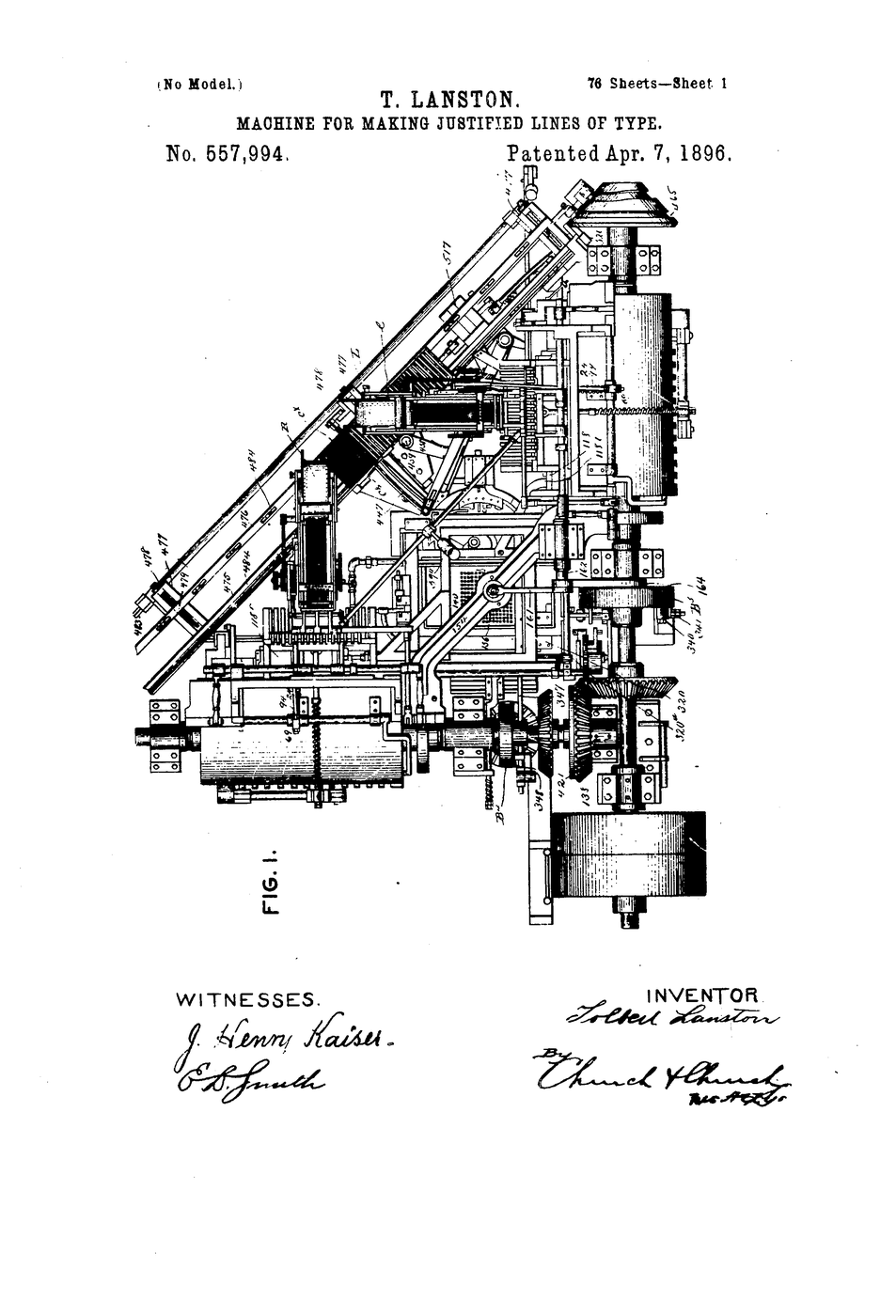
US 557,994, “Machine for making justified lines of type”, granted 7 April 1896. Its classification, B41B7/04, is precise: mechanical composition in which the type is cast or moulded from matrices. The patent runs to 76 sheets of drawings.
Separate types mean a compositor can pull one wrong letter with tweezers. It also means the hard problem moves to justification — deciding, before casting begins, exactly how much extra width each space in a line must carry. This blueprint builds the mould-and-matrix geometry and solves the justification arithmetic by hand, without melting any metal.
Instrucciones
Understand the difference from Linotype
Understand the difference from Linotype
Linotype casts a line as one slug. Monotype casts single characters. Write down one advantage and one disadvantage of each before building.
Safety substitution — no molten type metal
Safety substitution — no molten type metal
Real type metal is a lead–antimony–tin alloy. Lead is a cumulative poison and casting it is not a classroom activity. This blueprint casts plaster of Paris instead. The mould geometry, the matrix, and the justification arithmetic are identical; only the material changes.
Cut a matrix
Cut a matrix
Carve a single letter, in reverse, into the rubber sheet about 3 mm deep. This is your matrix — the female form the type is cast against.
Materiales para este paso:
 Plancha de caucho natural1 pieza
Herramientas necesarias:
 Cúter de precisión
Build an adjustable mould
Build an adjustable mould
Make a small open box from card, one wall movable. The matrix forms the base. The movable wall is the point — Monotype's mould changes width for every character.
Materiales para este paso:
 Láminas de cartón corrugado1 hoja
 Cola de carpintero3 ml
Herramientas necesarias:
Cúter de precisión Regla
ReglaSet the mould to one character width
Set the mould to one character width
Set the movable wall to 8 mm. Record the setting.
Herramientas necesarias:
ReglaCast the first type
Cast the first type
Mix plaster to a pourable cream and fill the mould. Level the top.
Materiales para este paso:
 Escayola50 g
Herramientas necesarias:
 Báscula digital de cocina
Let it set and release
Let it set and release
Wait 15 minutes, then flex the rubber matrix away. You have a single piece of type with a raised reversed letter.
Herramientas necesarias:
 Cronómetro
Cast three more at different widths
Cast three more at different widths
Reset the movable wall to 6 mm, 10 mm and 12 mm and cast three more. Real type is proportional — an 'i' is not as wide as an 'm'.
Materiales para este paso:
Escayola150 gHerramientas necesarias:
ReglaDress the castings
Dress the castings
Sand each casting flat on its back and sides so all four stand at identical height.
Herramientas necesarias:
 Hoja de papel de lija
Measure the set widths
Measure the set widths
Measure each type body. Record the four widths. These are your character set widths.
Herramientas necesarias:
ReglaDo the justification arithmetic
Do the justification arithmetic
Choose a line length of 120 mm. Add up your character widths for a short sentence. Subtract from 120. Divide the remainder by the number of spaces. That quotient is what every space must be widened by — and Monotype had to know it before it cast the first character of the line.
Herramientas necesarias:
ReglaCast spaces to your computed width
Cast spaces to your computed width
Set the mould to the width you calculated and cast the spaces.
Materiales para este paso:
Escayola50 gHerramientas necesarias:
ReglaCompose and measure the line
Compose and measure the line
Assemble types and spaces in a card channel. Measure the finished line. It should reach 120 mm within a millimetre.
Materiales para este paso:
Láminas de cartón corrugado1 hojaHerramientas necesarias:
ReglaCorrect one character
Correct one character
Pull a single type out and replace it. Note that this took seconds. On a Linotype it means recasting the whole line — the entire argument for Monotype in one action.
Ink and pull a proof
Ink and pull a proof
Roll ink over the assembled line and press paper onto it.
Materiales para este paso:
 Tinta para xilografía2 ml
 Papel1 hoja
Herramientas necesarias:
 Rodillo entintador de goma
History & Context
History & Context
US 557,994, “Machine for making justified lines of type”, Tolbert Lanston, granted 7 April 1896. Patent protection ran 17 years from grant and expired in 1913.
Lanston, of Washington D.C., applied in 1885 for a typesetting system that produced its printing surface by cold-stamping rather than casting, and demonstrated a prototype in 1887. The hot-metal machine of this 1896 patent is the mature form. Sources disagree over whether to date the Monotype to 1885, 1887 or 1896 because they are describing three different things — the application, the prototype, and the casting machine.
A note on the record. Google Patents shows the filing date for US 557,994 as identical to the grant date. That is a cataloguing artefact, as with Hawes's envelope machine in this same batch; cite the grant date only.
How the real machine split the job in two. Monotype used two separate units — a keyboard that punched a paper ribbon, and a caster that read it. The operator typed; the ribbon was carried to the caster; the caster read the ribbon backwards, which is why the justification had to be computed and recorded at the end of each line as it was keyed. This is a genuine ancestor of stored-program control: an operator producing a physical instruction tape consumed later by a separate machine, in the same family as Jacquard's cards and Hollerith's punched strips.
Monotype outlived Linotype in fine bookwork precisely because of single types — corrections were cheap and the typographic quality was higher. Both were finished by phototypesetting and then by digital composition.
Materiales
6- 1 piezaMarcador de posición
- Marcador de posición
- Marcador de posición
- 250 gMarcador de posición
- Marcador de posición
- 1 hojaMarcador de posición
Materiales de Blueprints conectados


Blueprints relacionados
Estos blueprints comparten conocimiento — técnicas, materiales o principios


CC0 Dominio público
Este Blueprint se publica bajo CC0. Eres libre de copiar, modificar, distribuir y usar este trabajo para cualquier propósito, sin pedir permiso.
Apoya al Maker comprando productos a través de su Blueprint, donde gana una Comisión del Maker establecida por los vendedores, o crea una nueva iteración de este Blueprint e inclúyela como conexión en tu propio Blueprint para compartir ingresos.