

Owens Bottle Machine
Instrucciones
What the hand process required
What the hand process required
Understand what was being replaced before looking at the machine.
- A gatherer collects molten glass on the end of a blowpipe.
- The blower inflates it into a mould and shapes the neck.
- A boy carries the hot bottle to the annealing oven.
Materiales para este paso:
 Arena de cuarzo10 kg
 Carbonato de sodio (sosa)3 kg
Suction gathering
Suction gathering
The machine does not scoop glass. It sucks it.
- A mould on a rotating arm is lowered until its mouth touches the surface of the molten glass.
- Vacuum draws glass up into the mould.
- A blade shears the glass off as the mould lifts.
Blank mould, then blow mould
Blank mould, then blow mould
The bottle is formed in two stages, as it is by hand.
- The gathered glass is first pressed or blown into a rough shape — the parison or blank — with the neck finished.
- The blank is transferred to a second mould.
- Air blows it out to the final shape against the mould wall.
Materiales para este paso:
 Carbonato de calcio - caliza triturada1 kg
Rotation makes it continuous
Rotation makes it continuous
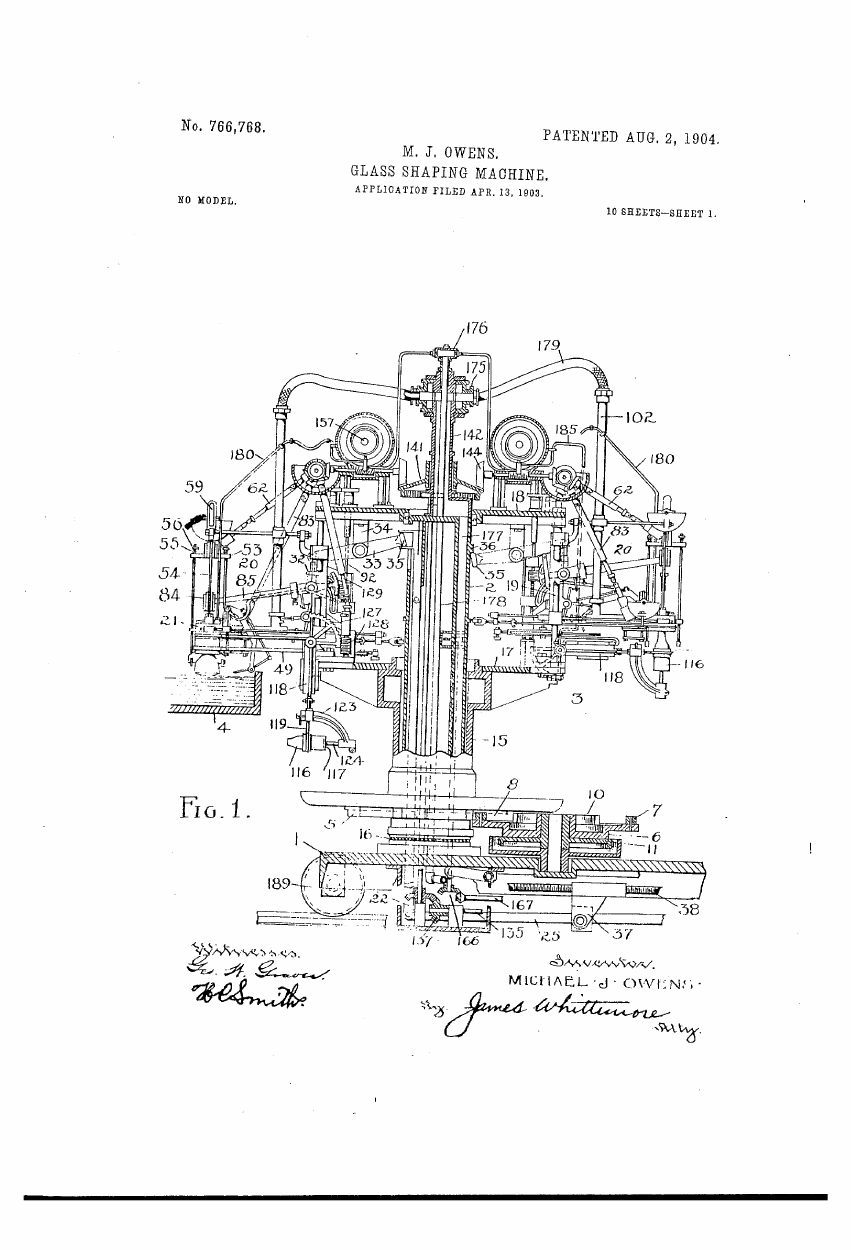
Owens mounted several complete forming units on one rotating frame.
- The frame turns continuously over the glass tank.
- Each arm gathers, forms, blows and ejects at a different point in the rotation.
- Production is therefore continuous rather than one bottle at a time.
History and context
History and context
Michael Joseph Owens went to work in a West Virginia glasshouse at about ten. He became a skilled blower, then a plant manager, and worked with the financier Edward Libbey in Toledo, Ohio. US patent 766,768, Glass-shaping machine, was granted on 2 August 1904. The Owens Bottle Machine Company eventually became Owens-Illinois, still one of the largest glass container makers in the world.
The labour consequence was enormous and genuinely double-edged. The National Child Labor Committee's photographs of small boys in glasshouses are among the images that drove American child labour reform, and Owens's machine did more to end that particular job than any statute. It also destroyed the livelihood of a highly skilled craft: the glass bottle blowers' unions, which had been strong, collapsed within a generation. Both of those are true at once, and accounts that mention only one are incomplete.
What replaced it: the individual section (IS) machine, developed in the 1920s, which splits the work across independent sections fed by a stream of measured glass gobs rather than by suction. It is more flexible and is what almost all container glass is made on today. Owens's suction principle is no longer the standard method — its importance is that it proved bottle-making could be automated at all.
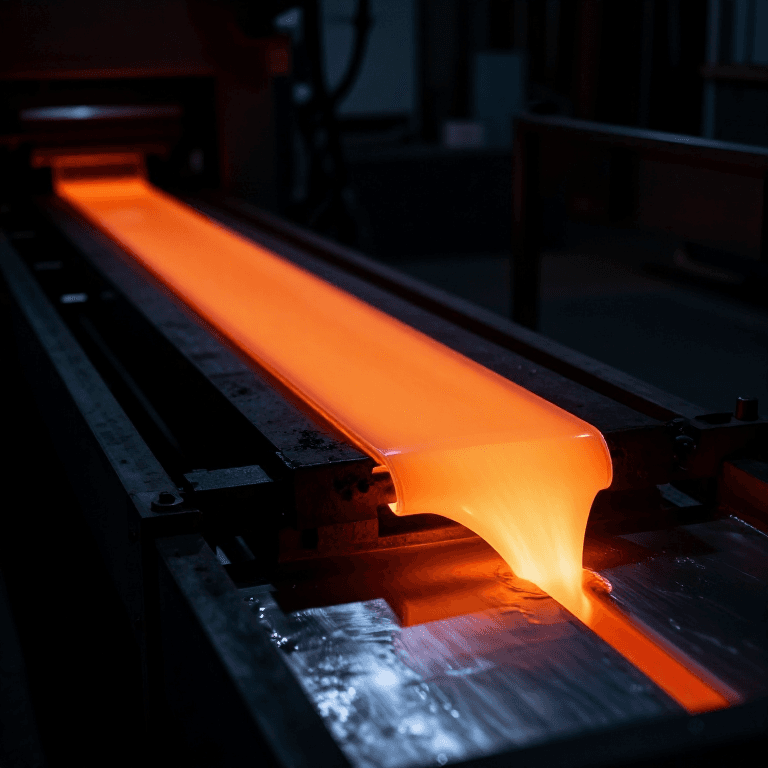
Why there is no build here. This needs a tank of glass at well over 1000 °C, vacuum, and moulds that survive it. The related blueprints on soda-lime glass and float glass cover what can honestly be shown at smaller scale.
Materiales
3- 10 kgMarcador de posición
- Marcador de posición
- Marcador de posición
Blueprints relacionados
Estos blueprints comparten conocimiento — técnicas, materiales o principios



CC0 Dominio público
Este Blueprint se publica bajo CC0. Eres libre de copiar, modificar, distribuir y usar este trabajo para cualquier propósito, sin pedir permiso.
Apoya al Maker comprando productos a través de su Blueprint, donde gana una Comisión del Maker establecida por los vendedores, o crea una nueva iteración de este Blueprint e inclúyela como conexión en tu propio Blueprint para compartir ingresos.