


Playfair Cipher
Instrucciones
Build the keyed square
Build the keyed square
A 5×5 grid holds 25 cells for 26 letters, so two must share.
- Write your keyword into the grid, skipping any repeated letters.
- Fill the rest with the unused alphabet in order.
- Combine I and J into one cell.
Materiales para este paso:
 Papel milimetrado1 pad
 Juego de lápices de grafito1 juego
Prepare the message into pairs
Prepare the message into pairs
The text must be groomed before it can be enciphered.
- Split the message into pairs of letters.
- Where a pair would be a double letter, insert an X between them.
- If the last pair is short, pad with X.
Apply the three rules
Apply the three rules
Every pair falls into exactly one case.
- Same row — replace each with the letter to its right, wrapping around.
- Same column — replace each with the letter below, wrapping around.
- Rectangle — replace each with the letter in its own row at the other letter's column.
Materiales para este paso:
 Cartulina1 paquete
Measure what the pairing changes
Measure what the pairing changes
Compare against the single-letter approaches in this catalogue.
- Encipher a long passage and tally single-letter frequencies. Chart it.
- Now tally the frequencies of PAIRS.
- Compare both against English references.
History and context
History and context
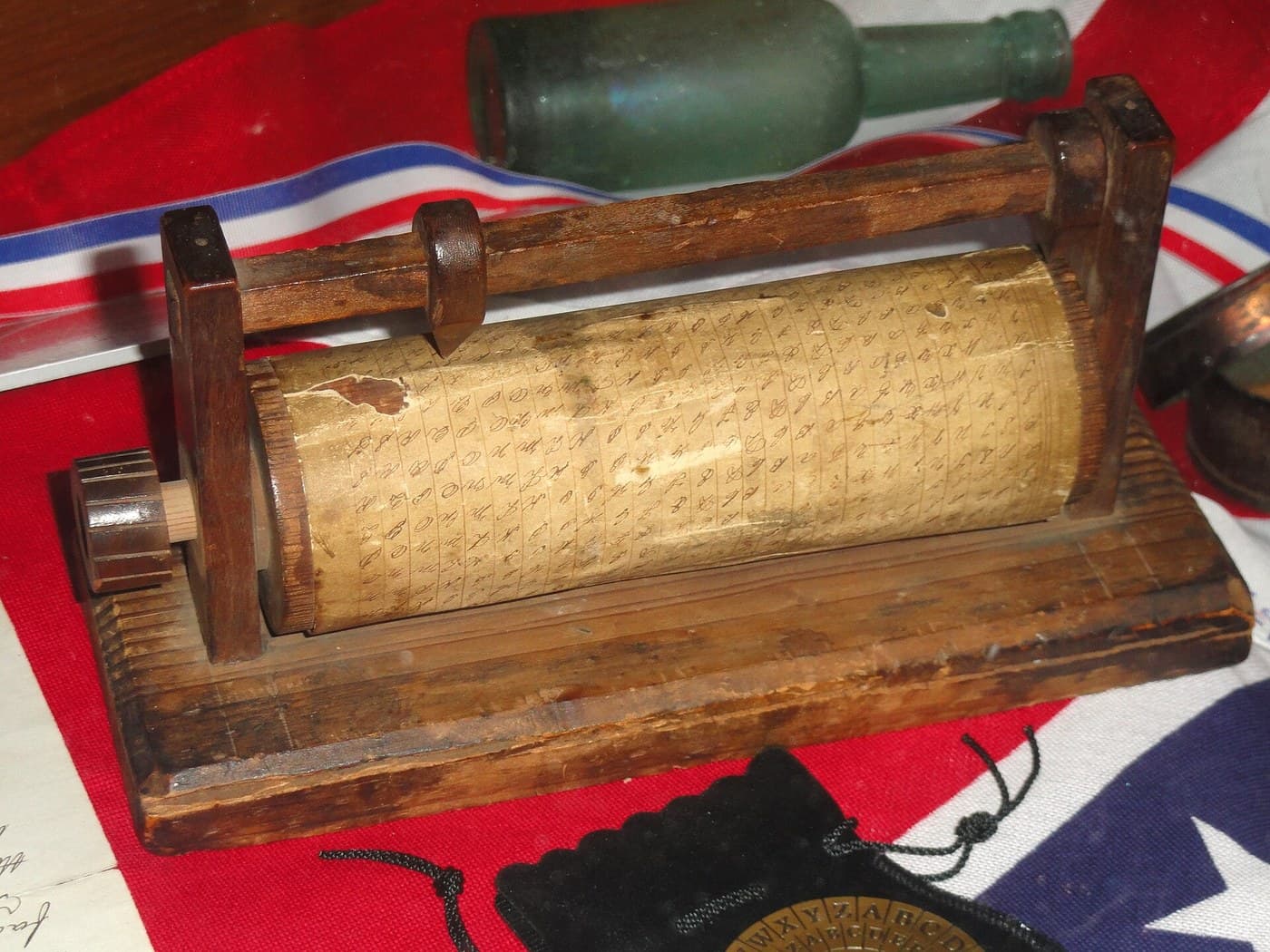
Charles Wheatstone invented it in 1854 — the same Wheatstone as the bridge and the stereoscope elsewhere in this catalogue. Lyon Playfair, Baron Playfair of St Andrews, promoted it to the Foreign Office and to the military, and his name stuck to it. The British War Office reportedly rejected it at first as too complicated for field use; Wheatstone offered to show that three out of four boys from a nearby school could learn it in fifteen minutes.
It served in the Boer War, the First World War and the Second, and Australian forces used it in the Pacific. Its niche is precise: tactical messages whose value expires within hours, sent by people with no equipment, in conditions where carrying a code book is a liability. For that region it was well chosen.
Where it sits relative to its neighbours: a fixed single-letter substitution needs very little text to read; Playfair needs substantially more because the unit is a pair; a polyalphabetic method like Vigenère moves the mapping instead; and a one-time pad removes the structure entirely. Each is a different trade between usability, key handling and how long the message must stay private — which is the useful way to compare them.
Its documented limits are the padding X's, the alphabetical tail of the grid, and the fact that a pair never enciphers to itself. All three were used by analysts, and Lord Playfair's own claim that it was unbreakable was never true — but it did not need to be. It needed to outlast the tactical value of the message, and usually did.
Materiales
3- 1 padMarcador de posición
- 1 juegoMarcador de posición
- 1 paqueteMarcador de posición
Blueprints relacionados
Estos blueprints comparten conocimiento — técnicas, materiales o principios

CC0 Dominio público
Este Blueprint se publica bajo CC0. Eres libre de copiar, modificar, distribuir y usar este trabajo para cualquier propósito, sin pedir permiso.
Apoya al Maker comprando productos a través de su Blueprint, donde gana una Comisión del Maker establecida por los vendedores, o crea una nueva iteración de este Blueprint e inclúyela como conexión en tu propio Blueprint para compartir ingresos.