ARTE
BELLEZA Y BIENESTAR
ARTESANÍA
CULTURA E HISTORIA
ENTRETENIMIENTO
MEDIO AMBIENTE
COMIDA Y BEBIDAS
INGENIERÍA INVERSA
CIENCIAS
DEPORTES
TECNOLOGÍA
TECNOLOGÍA VESTIBLE
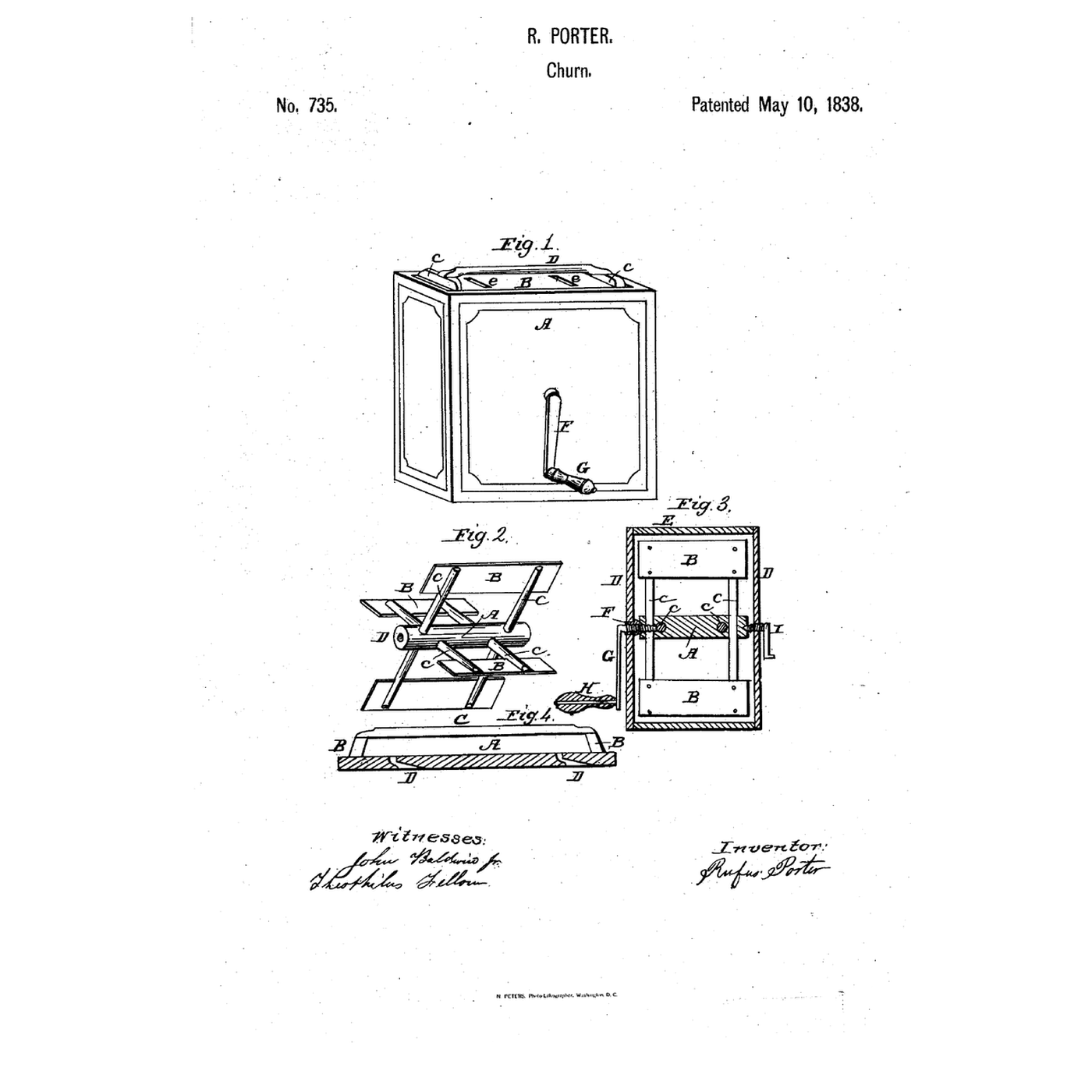

Rotary-Dasher Box Churn: Float Boards on Crossed Arms in a Curved Box
An up-and-down dash churn is slow, tiring work.
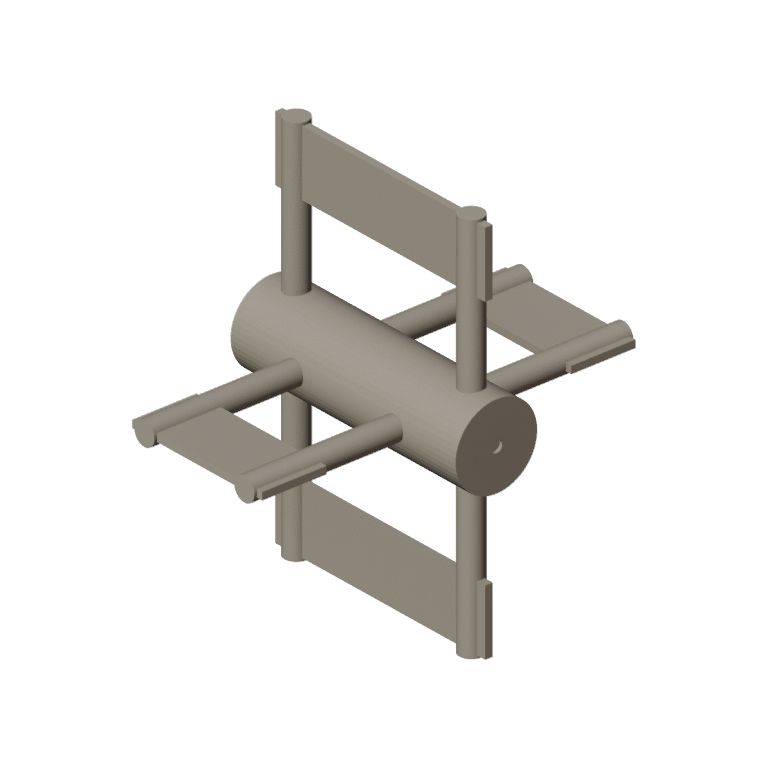
Rufus Porter of Billerica, Massachusetts, received US 735, dated 10 May 1838, for a churn: a box eighteen inches long with a bottom curved from end to end; a wooden shaft running between a hollow cone and a pointed centre screw; two parallel pairs of rods through the shaft at right angles, carrying float boards parallel with the shaft — "what is termed the rotary dasher" — turned by a crank whose twisted tenon is pressed into the shaft and comes out when the occasion requires.
This rung compares his churn's sweep with a tabletop one, then prints the dasher, builds the box, and makes butter.
Intermedio
About 5 hours, plus printing
Instrucciones
1
1
Butter yield and sweep
Butter yield and sweep
Cargando el cuaderno de Jupyter…
2
2
A board pushed through liquid before it
A board pushed through liquid before it
The embedded blueprint drives a boat with a flat paddle. Porter's float boards push through cream the same way, turning on a shaft.
3
3
Read US 735
Read US 735
"Four round bars or rods, sixteen inches long and one inch in diameter, pass through the shaft; two of these rods are parallel, and about five inches apart, each being one inch from one end of the shaft. The other two are parallel to each other, but at right angles with the first pair, and three inches apart; the four bars thus constituting eight arms."
4
4
Print the dasher
Print the dasher
Print the rotary dasher: core, two parallel pairs of arms at right angles, and four float boards (/uploads/blueprints/rotary-dasher-box-churn-dasher.stl). Print in PETG at 0.2 mm layers, 30 % infill, 4 walls; wash before first use.
Materiales para este paso:
 Filamento PETG1 pieza
Herramientas necesarias:
 Impresora 3D de filamento (FDM)
5
5
Use a box with a curved bottom
Use a box with a curved bottom
Take a food-safe storage box about 150 × 100 mm and 150 mm deep. Drill both ends on the dasher's axis, 85 mm up. Bed a plywood strip curved from end to end in its floor with silicone, as his curved bottom.
Materiales para este paso:
 Envase de HDPE1 pieza
 Tablero contrachapado1 pieza
 Sellador de silicona1 pieza
Herramientas necesarias:
 Segueta (sierra de marquetería)
 Taladro inalámbrico
 Juego de brocas
6
6
Cone, centre screw and crank
Cone, centre screw and crank
File an M5 screw to a point and run it through one end as the centre screw into the dasher's end hole. Through the other end pass a 5 mm rod into the dasher's seat as the hollow-cone bearing, bent outside into a crank.
Materiales para este paso:
 Tornillos de máquina1 pieza
 Tuerca hexagonal1 pieza
 Redondo de acero dulce1 pieza
Herramientas necesarias:
 Limas (lima de mano)
 Tornillo de banco
 Llave inglesa ajustable
7
7
The patent drawing
The patent drawing
US 735 drawing sheet, public domain (expired patent).
8
8
Make butter
Make butter
Let 500 ml of heavy cream stand until it reaches about 15 °C, checked with the thermometer. Pour it into the box, close the lid, and crank steadily; time until the butter comes. Pour off the buttermilk, add cold water, churn a few turns and pour off again until it runs clear; work in a pinch of salt and weigh the butter.
Materiales para este paso:
 Crema de leche espesa500 ml
 Sal marina gruesa1 pieza
 Agua1 pieza
Herramientas necesarias:
 Termómetro de sonda permanente
 Cronómetro
 Báscula digital de cocina
 Bol grande de acero inoxidable
9
9
A dasher that sticks, a box that leaks
A dasher that sticks, a box that leaks
Rotary-dasher box churn troubleshooting.
Flow
Loading...
10
10
History and honest limits
History and honest limits
**Rufus Porter** of Billerica, Massachusetts, received US 735, dated 10 May 1838. His box is eighteen inches long, ten wide and eighteen deep, of boards three-quarters of an inch thick; the bottom, three-eighths thick, is curved so its centre is three inches lower than its ends; a lid with ventilation apertures fits a rabbet; the float boards are eight inches long and three wide. He gave the dimensions of every part.
**Honest limits.** A storage box and a printed dasher at tabletop scale stand in for his. FDM prints hold food in their layer lines, so wash well and replace when worn. Your times and weights are the result.
Materiales
10- 1 piezaMarcador de posición
- 1 piezaMarcador de posición
- 1 piezaMarcador de posición
- 1 piezaMarcador de posición
- 1 piezaMarcador de posición
- 1 piezaMarcador de posición
- 1 piezaMarcador de posición
- 500 mlMarcador de posición
- 1 piezaMarcador de posición
- 1 piezaMarcador de posición
Herramientas requeridas
11- Marcador de posición
- Marcador de posición
- 1 vendor sell this, none ship to you yetMarcador de posición
- Marcador de posición
- Marcador de posición
- Marcador de posición
- Marcador de posición
- Marcador de posición
- Marcador de posición
- Marcador de posición
- Marcador de posición
Este plano hace
Blueprints relacionados
Estos blueprints comparten conocimiento — técnicas, materiales o principios

Churning Butter from Cream — The 5,000-Year-Old Fat Separation
por TheChef
ARTESANÍA
50
0
0
0
0
0

Carving a Wooden Paddle from a Single Piece of Hardwood — Prehistoric Watercraft Propulsion
por Woody
Carpintería
37
0
0
0
1
0
Making Aged Farmhouse Cheese in a Cheese Press — Medieval Dairy Craft
por TheChef
Comida
76
0
0
0
0
0
CC0 Dominio público
Este Blueprint se publica bajo CC0. Eres libre de copiar, modificar, distribuir y usar este trabajo para cualquier propósito, sin pedir permiso.
Apoya al Maker comprando productos a través de su Blueprint, donde gana una Comisión del Maker establecida por los vendedores, o crea una nueva iteración de este Blueprint e inclúyela como conexión en tu propio Blueprint para compartir ingresos.