ARTE
BELLEZA Y BIENESTAR
ARTESANÍA
CULTURA E HISTORIA
ENTRETENIMIENTO
MEDIO AMBIENTE
COMIDA Y BEBIDAS
INGENIERÍA INVERSA
CIENCIAS
DEPORTES
TECNOLOGÍA
TECNOLOGÍA VESTIBLE
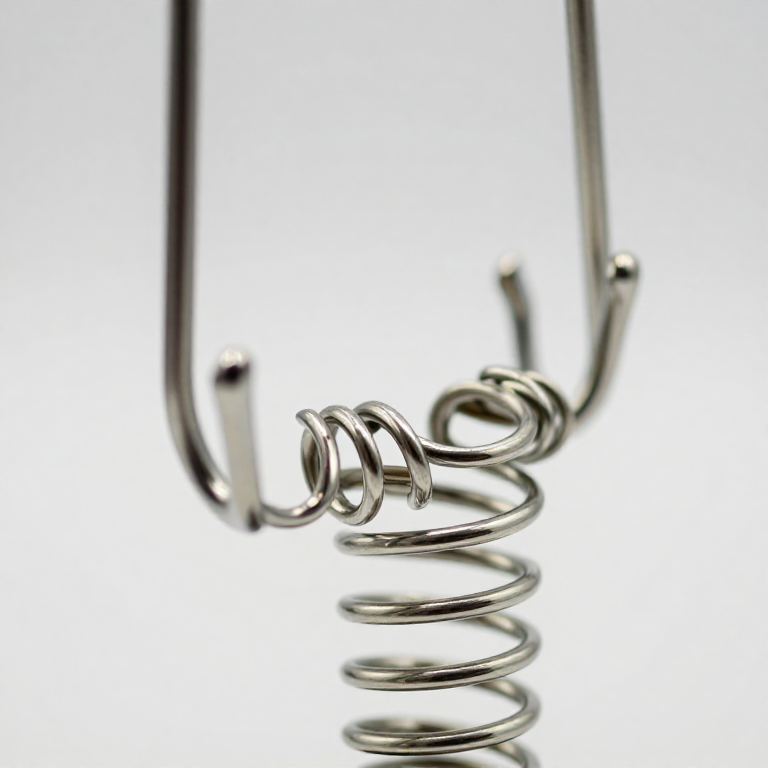


Hooke's Law — Stretch a Spring and Find Its Stiffness
A hands-on school project: hang known weights on a spring, measure how far it stretches with a ruler, and discover Hooke's law — the stretch is proportional to the force. A Python cell checks your readings and works out the spring's stiffness, and a closing compendium explains springs from mattresses to mechanical watches.
Principiante
30 minutes
Instrucciones
1
1
As the stretch, so the force
As the stretch, so the force
In 1660 Robert Hooke found how springs behave and hid it in an anagram, later revealed as 'ut tensio, sic vis' — as the extension, so the force. The pull needed to stretch a spring is proportional to how far it stretches. You will measure that straight-line law yourself.
2
2
Set up the spring
Set up the spring
Hang a spring from a firm support with a ruler fixed vertically beside it. Note where the bottom of the unstretched spring sits — that is your zero. (A force meter, which is just a spring in a tube, works too and reads the force directly.)
Materiales para este paso:
 Juego de muelles de compresión1 pieza
Herramientas necesarias:
 Regla
Regla Dinamómetro (balanza de resorte)
3
3
Hang weights and measure the stretch
Hang weights and measure the stretch
Hang a known weight on the spring and read how far the bottom has dropped on the ruler — that is the extension. Add more weight, one step at a time, recording the mass and the extension each time. Take four or five readings. Do not overload it: if you stretch a spring too far it never springs back, and Hooke's law stops working (the 'elastic limit').
Herramientas necesarias:
 Juego de tobilleras lastradas (ajustables, casero)
4
4
Check the straight line and find k
Check the straight line and find k
Cargando el cuaderno de Jupyter…
Herramientas necesarias:
 Ordenador de sobremesa
 Calculadora
5
5
Compendium: the physics of springs
Compendium: the physics of springs
What your straight line means. (1) The slope of your force-versus-stretch line IS the stiffness k, measured in newtons per metre; a stiff spring gives a steep line. (2) The energy stored in a stretched spring grows as one-half k times the stretch squared — which is why a bow or a catapult stores so much punch at full draw. (3) The law only holds up to the elastic limit; beyond it the material deforms permanently, and this is exactly how engineers test the strength of metals. (4) Springs following Hooke's law are everywhere: bathroom and kitchen scales, car and train suspensions, mattresses and trampolines, the tiny hairspring that keeps a mechanical watch ticking, and — generalised into 'Young's modulus' — the stiffness of every beam and bridge. A mass bouncing on a spring is also the textbook model of every vibration in nature.
Materiales
2- Marcador de posición
- 1 hojaMarcador de posición
Herramientas requeridas
6- Marcador de posición
- Marcador de posición
- Marcador de posición
- Marcador de posición
- Marcador de posición
- Marcador de posición
Blueprints relacionados
Estos blueprints comparten conocimiento — técnicas, materiales o principios




CC0 Dominio público
Este Blueprint se publica bajo CC0. Eres libre de copiar, modificar, distribuir y usar este trabajo para cualquier propósito, sin pedir permiso.
Apoya al Maker comprando productos a través de su Blueprint, donde gana una Comisión del Maker establecida por los vendedores, o crea una nueva iteración de este Blueprint e inclúyela como conexión en tu propio Blueprint para compartir ingresos.