Simon Says — SIK Circuit 16
Build the classic Simon Says memory game! Four colored LEDs, four buttons, and a buzzer combine into a complete interactive game with memory mode, battle mode, and a secret easter egg.
Instrucciones
Parts & Introduction
The grand finale! Simon Says is a memory game where you repeat an ever-growing sequence of colored lights and sounds. This project combines LEDs, buttons, and a buzzer into a complete game with multiple modes. It's the most complex circuit in the SIK — a great capstone project.
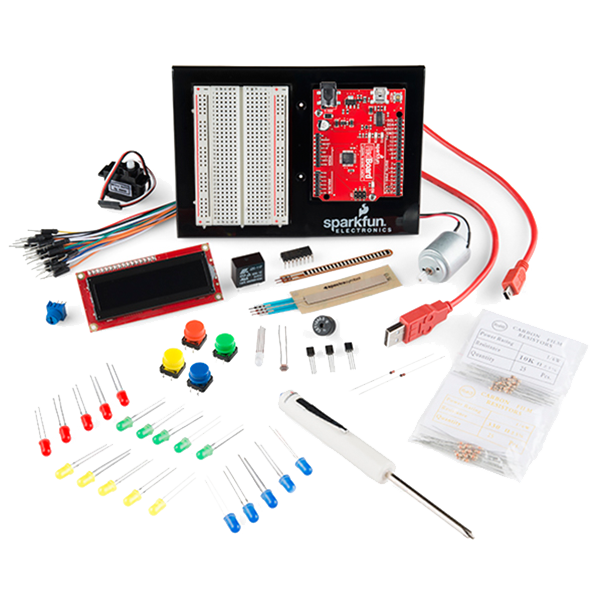
Parts Needed
- 1x Arduino Uno + USB cable
- 1x Breadboard
- 4x LEDs (red, green, blue, yellow if possible)
- 4x Push Buttons
- 1x Piezo Buzzer
- 4x 330Ω Resistors
- 17x Jumper Wires
Game Modes
- Memory Mode (default) — Follow the growing pattern. Win after 13 rounds.
- Battle Mode (hold green at startup) — Two-player mode, each player extends the sequence.
- Easter Egg (hold yellow at startup) — Plays "Stayin' Alive" with flashing LEDs!
Hardware Hookup
Hardware Hookup
Wiring Instructions
Pin Assignments
| Component | Arduino Pin |
|---|---|
| Red LED | 10 |
| Green LED | 3 |
| Blue LED | 13 |
| Yellow LED | 5 |
| Red Button | 9 |
| Green Button | 2 |
| Blue Button | 12 |
| Yellow Button | 6 |
| Buzzer pin 1 | 4 |
| Buzzer pin 2 | 7 |
- Each LED needs a 330Ω resistor between its negative leg and GND.
- Buttons use
INPUT_PULLUPmode — connect one side to the pin, other side to GND. No external resistors needed. - The buzzer uses two pins for push-pull drive (louder sound).
- Important: Make sure both GND rails on the breadboard are connected together!
Arduino Code
Arduino Code
Open the Arduino IDE and upload the following sketch to your Arduino board.
/*
SparkFun Inventor's Kit
Example sketch 16 — SIMON SAYS
Simon Says memory game. Press a button to start.
Repeat the LED sequence as it grows. Win after 13 rounds.
Hold GREEN at startup for Battle Mode (2 player).
Hold YELLOW at startup for a musical easter egg!
This code is completely free for any use.
*/
#define CHOICE_OFF 0
#define CHOICE_NONE 0
#define CHOICE_RED (1 << 0)
#define CHOICE_GREEN (1 << 1)
#define CHOICE_BLUE (1 << 2)
#define CHOICE_YELLOW (1 << 3)
#define LED_RED 10
#define LED_GREEN 3
#define LED_BLUE 13
#define LED_YELLOW 5
#define BUTTON_RED 9
#define BUTTON_GREEN 2
#define BUTTON_BLUE 12
#define BUTTON_YELLOW 6
#define BUZZER1 4
#define BUZZER2 7
#define ROUNDS_TO_WIN 13
#define ENTRY_TIME_LIMIT 3000
#define MODE_MEMORY 0
#define MODE_BATTLE 1
#define MODE_BEEGEES 2
// Note frequencies
#define NOTE_G4 392
#define NOTE_A4 440
#define NOTE_C5 523
byte gameMode = MODE_MEMORY;
byte gameBoard[32];
byte gameRound = 0;
void setup()
{
pinMode(BUTTON_RED, INPUT_PULLUP);
pinMode(BUTTON_GREEN, INPUT_PULLUP);
pinMode(BUTTON_BLUE, INPUT_PULLUP);
pinMode(BUTTON_YELLOW, INPUT_PULLUP);
pinMode(LED_RED, OUTPUT);
pinMode(LED_GREEN, OUTPUT);
pinMode(LED_BLUE, OUTPUT);
pinMode(LED_YELLOW, OUTPUT);
pinMode(BUZZER1, OUTPUT);
pinMode(BUZZER2, OUTPUT);
gameMode = MODE_MEMORY;
if (checkButton() == CHOICE_YELLOW) play_beegees();
if (checkButton() == CHOICE_GREEN)
{
gameMode = MODE_BATTLE;
setLEDs(CHOICE_GREEN);
toner(CHOICE_GREEN, 150);
setLEDs(CHOICE_RED | CHOICE_BLUE | CHOICE_YELLOW);
while(checkButton() != CHOICE_NONE) ;
}
play_winner();
}
void loop()
{
attractMode();
setLEDs(CHOICE_RED | CHOICE_GREEN | CHOICE_BLUE | CHOICE_YELLOW);
delay(1000);
setLEDs(CHOICE_OFF);
delay(250);
if (gameMode == MODE_MEMORY)
{
if (play_memory() == true)
play_winner();
else
play_loser();
}
if (gameMode == MODE_BATTLE)
{
play_battle();
play_loser();
}
}
boolean play_memory(void)
{
randomSeed(millis());
gameRound = 0;
while (gameRound < ROUNDS_TO_WIN)
{
add_to_moves();
playMoves();
for (byte currentMove = 0; currentMove < gameRound; currentMove++)
{
byte choice = wait_for_button();
if (choice == 0) return false;
if (choice != gameBoard[currentMove]) return false;
}
delay(1000);
}
return true;
}
boolean play_battle(void)
{
gameRound = 0;
while (1)
{
byte newButton = wait_for_button();
gameBoard[gameRound++] = newButton;
for (byte currentMove = 0; currentMove < gameRound; currentMove++)
{
byte choice = wait_for_button();
if (choice == 0) return false;
if (choice != gameBoard[currentMove]) return false;
}
delay(100);
}
return true;
}
void playMoves(void)
{
for (byte currentMove = 0; currentMove < gameRound; currentMove++)
{
toner(gameBoard[currentMove], 150);
delay(150);
}
}
void add_to_moves(void)
{
byte newButton = random(0, 4);
if(newButton == 0) newButton = CHOICE_RED;
else if(newButton == 1) newButton = CHOICE_GREEN;
else if(newButton == 2) newButton = CHOICE_BLUE;
else if(newButton == 3) newButton = CHOICE_YELLOW;
gameBoard[gameRound++] = newButton;
}
void setLEDs(byte leds)
{
digitalWrite(LED_RED, (leds & CHOICE_RED) ? HIGH : LOW);
digitalWrite(LED_GREEN, (leds & CHOICE_GREEN) ? HIGH : LOW);
digitalWrite(LED_BLUE, (leds & CHOICE_BLUE) ? HIGH : LOW);
digitalWrite(LED_YELLOW, (leds & CHOICE_YELLOW) ? HIGH : LOW);
}
byte wait_for_button(void)
{
long startTime = millis();
while ((millis() - startTime) < ENTRY_TIME_LIMIT)
{
byte button = checkButton();
if (button != CHOICE_NONE)
{
toner(button, 150);
while(checkButton() != CHOICE_NONE) ;
delay(10);
return button;
}
}
return CHOICE_NONE;
}
byte checkButton(void)
{
if (digitalRead(BUTTON_RED) == 0) return CHOICE_RED;
else if (digitalRead(BUTTON_GREEN) == 0) return CHOICE_GREEN;
else if (digitalRead(BUTTON_BLUE) == 0) return CHOICE_BLUE;
else if (digitalRead(BUTTON_YELLOW) == 0) return CHOICE_YELLOW;
return CHOICE_NONE;
}
void toner(byte which, int buzz_length_ms)
{
setLEDs(which);
switch(which)
{
case CHOICE_RED: buzz_sound(buzz_length_ms, 1136); break;
case CHOICE_GREEN: buzz_sound(buzz_length_ms, 568); break;
case CHOICE_BLUE: buzz_sound(buzz_length_ms, 851); break;
case CHOICE_YELLOW: buzz_sound(buzz_length_ms, 638); break;
}
setLEDs(CHOICE_OFF);
}
void buzz_sound(int buzz_length_ms, int buzz_delay_us)
{
long buzz_length_us = buzz_length_ms * (long)1000;
while (buzz_length_us > (buzz_delay_us * 2))
{
buzz_length_us -= buzz_delay_us * 2;
digitalWrite(BUZZER1, LOW);
digitalWrite(BUZZER2, HIGH);
delayMicroseconds(buzz_delay_us);
digitalWrite(BUZZER1, HIGH);
digitalWrite(BUZZER2, LOW);
delayMicroseconds(buzz_delay_us);
}
}
void play_winner(void)
{
setLEDs(CHOICE_GREEN | CHOICE_BLUE);
winner_sound();
setLEDs(CHOICE_RED | CHOICE_YELLOW);
winner_sound();
setLEDs(CHOICE_GREEN | CHOICE_BLUE);
winner_sound();
setLEDs(CHOICE_RED | CHOICE_YELLOW);
winner_sound();
}
void winner_sound(void)
{
for (byte x = 250; x > 70; x--)
{
for (byte y = 0; y < 3; y++)
{
digitalWrite(BUZZER2, HIGH);
digitalWrite(BUZZER1, LOW);
delayMicroseconds(x);
digitalWrite(BUZZER2, LOW);
digitalWrite(BUZZER1, HIGH);
delayMicroseconds(x);
}
}
}
void play_loser(void)
{
setLEDs(CHOICE_RED | CHOICE_GREEN);
buzz_sound(255, 1500);
setLEDs(CHOICE_BLUE | CHOICE_YELLOW);
buzz_sound(255, 1500);
setLEDs(CHOICE_RED | CHOICE_GREEN);
buzz_sound(255, 1500);
setLEDs(CHOICE_BLUE | CHOICE_YELLOW);
buzz_sound(255, 1500);
}
void attractMode(void)
{
while(1)
{
setLEDs(CHOICE_RED);
delay(100);
if (checkButton() != CHOICE_NONE) return;
setLEDs(CHOICE_BLUE);
delay(100);
if (checkButton() != CHOICE_NONE) return;
setLEDs(CHOICE_GREEN);
delay(100);
if (checkButton() != CHOICE_NONE) return;
setLEDs(CHOICE_YELLOW);
delay(100);
if (checkButton() != CHOICE_NONE) return;
}
}
int melody[] = {
NOTE_G4, NOTE_A4, 0, NOTE_C5, 0, 0, NOTE_G4, 0, 0, 0,
0, 0, NOTE_G4, 0, NOTE_G4, NOTE_G4, 0,
NOTE_G4, 0, 0, NOTE_G4, 0, 0,
NOTE_G4, 0, 0, 0, NOTE_G4, 0, NOTE_A4, 0, NOTE_C5, 0};
int noteDuration = 115;
int LEDnumber = 0;
void play_beegees()
{
setLEDs(CHOICE_YELLOW);
toner(CHOICE_YELLOW, 150);
setLEDs(CHOICE_RED | CHOICE_GREEN | CHOICE_BLUE);
while(checkButton() != CHOICE_NONE) ;
setLEDs(CHOICE_NONE);
delay(1000);
digitalWrite(BUZZER1, LOW);
while(checkButton() == CHOICE_NONE)
{
for (int thisNote = 0; thisNote < 32; thisNote++) {
changeLED();
tone(BUZZER2, melody[thisNote], noteDuration);
int pauseBetweenNotes = noteDuration * 1.30;
delay(pauseBetweenNotes);
noTone(BUZZER2);
}
}
}
void changeLED(void)
{
setLEDs(1 << LEDnumber);
LEDnumber++;
if(LEDnumber > 3) LEDnumber = 0;
}Test & Experiment
Test & Experiment
What You Should See
The game starts with a victory sound, then LEDs cycle in an "attract mode" pattern. Press any button to start playing:
- A random LED lights up with a tone — press the matching button.
- The sequence grows by one each round.
- Win after 13 correct rounds! Lose if you press wrong or take too long (3 seconds).
Troubleshooting
- Only half the circuit works: Make sure both GND rails on the breadboard are connected together!
- No sound: Check that both buzzer pins are in the correct rows.
- Buttons not responding: Pay close attention to which pin connects to each button. The
INPUT_PULLUPmode means buttons read LOW when pressed.
Experiments to Try
- Hold the green button during power-up for Battle Mode (2 players).
- Hold the yellow button during power-up for the Bee Gees easter egg!
- Modify
ROUNDS_TO_WINto make the game easier or harder. - Change
ENTRY_TIME_LIMITto give more or less time per button press.
Materiales
- •SparkFun Inventor's Kit - V3.2 - 1 kitNOK 999.20
- •Arduino Uno R3 - 1 pieceMarcador de posición
- •Breadboard - 1 pieceMarcador de posición
- •5mm LED - 4 piecessMarcador de posición
- •Push Button - 4 piecessNOK 11.20
- •Piezo Buzzer - 1 piece
- •330 Ohm Resistor - 4 piecessNOK 24.00
- •Jumper Wires - 17 piecessNOK 39.20
Herramientas requeridas
- Computer with Arduino IDE
CC0 Dominio público
Este Blueprint se publica bajo CC0. Eres libre de copiar, modificar, distribuir y usar este trabajo para cualquier propósito, sin pedir permiso.
Apoya al Maker comprando productos a través de su Blueprint, donde gana una Comisión del Maker establecida por los vendedores, o crea una nueva iteración de este Blueprint e inclúyela como conexión en tu propio Blueprint para compartir ingresos.