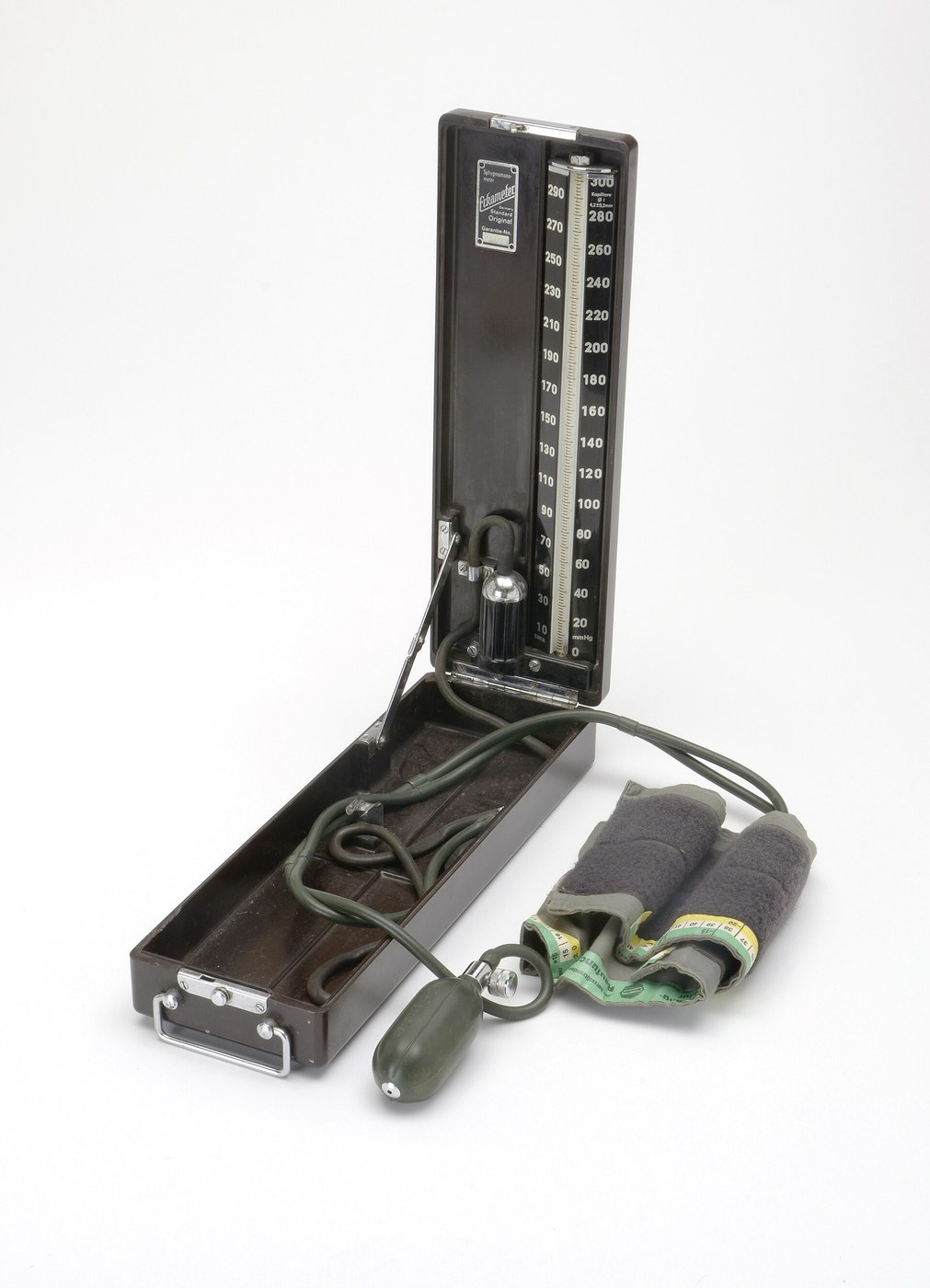


The Blood Pressure Cuff
Blood pressure is a number inside a sealed vessel you must not open. Every direct method requires putting something into an artery, which is a procedure, not a measurement you can take on a queue of people.
The cuff solves it by competing with the pressure instead of sampling it. Wrap an inflatable bladder round the arm and raise its pressure until it squeezes the artery shut. Now let it down slowly and watch for the moment flow returns — because the cuff pressure at that instant must equal the pressure inside the artery. You never measure the blood. You measure the air you used to beat it.
That gives one number. The second comes from listening, and this is the elegant part. While the cuff is partly squeezing the artery, blood forces through a narrowed opening in bursts and the flow is turbulent — which is audible as sharp tapping through a stethoscope. Turbulence needs a constriction, so the sounds exist only between the two pressures that matter.
They start when the peak of each beat first pushes past the cuff — the systolic pressure.
They stop when the artery is no longer squeezed at all and flow goes smooth and silent again — the diastolic.
The measurement is defined by the appearance and disappearance of a sound that only exists because the instrument is interfering.
Instrucciones
Make turbulence audible in a tube
Make turbulence audible in a tube
Run water steadily through a length of soft tubing and listen against it with your stethoscope from the earlier blueprint.
Now pinch the tube part-way and listen again. Then pinch it fully shut.
Expect: smooth flow quiet, partly pinched noisy, fully shut silent.
Record that pattern, because it is the entire measurement. Sound appears only in the middle state — and the two edges of that middle state are the two numbers a blood pressure reading consists of.
Materiales para este paso:
 Tubo de silicona1 m
Balance an unknown pressure with a known one
Balance an unknown pressure with a known one
Set up a sealed tube of water at an unknown head, and find its pressure by inflating a cuff or bladder against it until flow just stops, reading the applied pressure on a gauge.
Compare with the head measured directly.
Expect close agreement.
You have used a null method: rather than measuring the unknown, you increased a known quantity until it exactly cancelled it, and read the known one. Chemical balances, Wheatstone bridges and potentiometers all do this — it is usually easier to detect "equal" than to measure "how much".
Find why the cuff must fit
Find why the cuff must fit
Wrap a narrow cuff and then a wide one around the same object and inflate each until it just occludes a tube running underneath. Compare the pressures needed.
Expect the narrow cuff to need more pressure to achieve the same occlusion.
A short bladder does not transmit its pressure evenly into the deeper tissue, so more air pressure is required to reach the artery.
Consequence in practice: a cuff too small for the arm reads too high, and one too large reads low. The recommended bladder covers roughly 80% of arm circumference, and using the wrong size is one of the commonest sources of a wrong reading.
Deflate too fast and lose the answer
Deflate too fast and lose the answer
Using your tube rig, occlude fully and then release the pressure quickly, listening for the onset and end of turbulence. Repeat with a slow, controlled release of a few units per second.
Expect the fast release to make it very hard to fix the two transition points.
The heart only supplies a beat at intervals, so the instrument can only be sampled once per beat. Release faster than that and the pressure has moved on between samples.
This is why the standard is a slow controlled bleed, and why the little screw valve on the bulb is a precision component rather than an on-off tap.
Compare what an automatic monitor is actually doing
Compare what an automatic monitor is actually doing
Look at an automatic cuff and note that it has no microphone over the artery.
It cannot hear the sounds at all. Instead it measures tiny oscillations in cuff pressure caused by the artery pulsing against it, finds the pressure at which those oscillations are largest — which corresponds to mean arterial pressure — and then estimates systolic and diastolic from the shape of that curve using a manufacturer's algorithm.
Write down what that means: the automatic device measures a different thing and reports the familiar numbers by inference.
It is convenient, repeatable and unbiased by the operator. It is also why readings differ between devices, and why irregular rhythms confuse it.
History & Context
History & Context
Two people built the halves. Scipione Riva-Rocci introduced the practical inflatable arm cuff with a mercury column, giving a repeatable, non-invasive way to find the pressure at which the pulse disappeared — systolic only. A decade or so later Nikolai Korotkov added the stethoscope over the artery and described the sounds that appear and vanish, which supplied the diastolic number and turned one measurement into two. The sounds still carry his name.
Before the cuff, blood pressure was measured by putting a tube in an artery. Stephen Hales did it on a horse in the eighteenth century with a glass tube nearly three metres tall. It is a real measurement and useless as medicine. The cuff's achievement is that it made an internal quantity available without entering the body — the same move as the stethoscope, and the reason both belong in one batch.
It created a disease that has no symptoms. Hypertension usually feels like nothing. Once it could be measured cheaply in anyone, it became visible as a risk factor and then treatable — and one of the largest reductions in stroke and heart disease of the twentieth century followed from being able to find a silent number. Measurement created the category.
The unit is a fossil. Blood pressure is still reported in millimetres of mercury because the original instrument was a mercury column, and the number is literally how far the pressure would push mercury up a tube. Mercury has been removed from clinical use, but the unit stayed — an example of a measurement scale outliving its apparatus by decades.
Honest limits. A single reading is a poor guide: pressure varies through the day, with posture, with caffeine, and famously rises in a clinic. Cuff size, arm position relative to the heart, a talking patient and a fast deflation all shift the number by clinically meaningful amounts. And in atrial fibrillation, where beats are irregular, both the listening method and the automatic algorithm struggle — the instrument assumes a regularity the patient does not have.
Materiales
1- Marcador de posición
Materiales de Blueprints conectados

Blueprints relacionados
Estos blueprints comparten conocimiento — técnicas, materiales o principios

CC0 Dominio público
Este Blueprint se publica bajo CC0. Eres libre de copiar, modificar, distribuir y usar este trabajo para cualquier propósito, sin pedir permiso.
Apoya al Maker comprando productos a través de su Blueprint, donde gana una Comisión del Maker establecida por los vendedores, o crea una nueva iteración de este Blueprint e inclúyela como conexión en tu propio Blueprint para compartir ingresos.