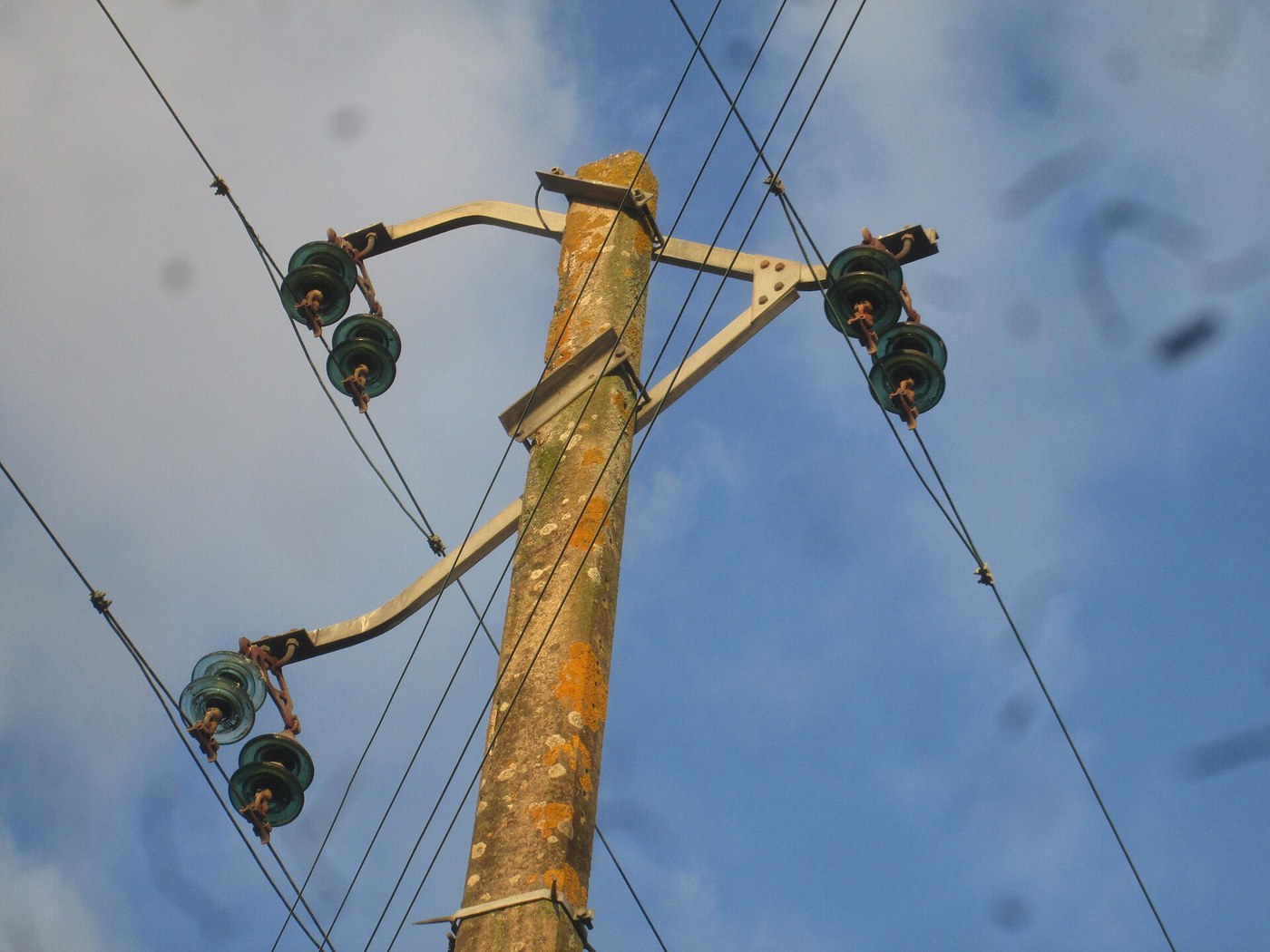


Suspension Insulator
Instrucciones
Make a disc with a cap and pin fitting
Make a disc with a cap and pin fitting
One unit, designed to be identical to every other unit.
- Form a porcelain disc with a domed upper surface and skirts beneath, with a cavity in the top and a socket below.
- Cement a metal cap into the top cavity and a metal pin into the underside.
- Ensure the pin of one unit engages the cap of the next.
- Glaze and fire fully.
- Make at least four identical units.
The porcelain is loaded in COMPRESSION between cap and pin. Porcelain is strong in compression and weak in tension, so the fitting is arranged so that the string's weight and the conductor's pull squeeze the disc rather than stretch it. Getting that load path right is why the cap-and-pin shape looks the way it does.
Identical is the point. A string is only as consistent as its units, and mass production of one small repeated part is far easier than making one large part reliably — which is the same argument that runs through interchangeable manufacture generally.Materiales para este paso:
 Arcilla de bola1 bag
 Arcilla1 bag
 Barra redonda de latón1 pieza
Herramientas necesarias:
 Horno cerámico
 Calibre digital de 6 pulgadas
 Juego de hilo y cuchilla para arcilla
 Juego de limas
Build a string and test flashover against unit count
Build a string and test flashover against unit count
The claim is that voltage capability scales with the number of discs — check whether it does.
- Test the flashover voltage of a single unit.
- Link two units and test again.
- Repeat for three and four units.
- Plot flashover voltage against number of units.
Materiales para este paso:
 Papel milimetrado1 pad
Herramientas necesarias:
 Multímetro digital de laboratorio
 Fuente de alimentación de banco ajustableCalibre digital de 6 pulgadas
Find the uneven voltage distribution along the string
Find the uneven voltage distribution along the string
The units do not share the voltage equally, and the reason is capacitance to earth.
- Energise a string of four units and measure the voltage across each individually.
- Note which unit carries the most.
- Consider that each metal cap has a small capacitance to the earthed tower as well as to the next unit.
- Sketch that as a ladder of capacitors and reason about where current flows.
The unit nearest the CONDUCTOR carries the largest share — often several times the average. Stray capacitance to the tower bleeds current away progressively along the string, so the units near the earthed end pass less current and drop less voltage. The bottom unit therefore fails first, and a string's rating is set by that worst unit rather than by the average.
This is why long strings carry a grading ring — a metal torus near the conductor end that reshapes the electric field and evens out the distribution. It looks decorative and is entirely functional.Materiales para este paso:
 Kit de condensadores cerámicos1 kitPapel milimetrado1 pad
Herramientas necesarias:
Multímetro digital de laboratorio Osciloscopio digitalCalibre digital de 6 pulgadas
Test what happens when one unit fails
Test what happens when one unit fails
Graceful degradation is the other advantage over a single-piece insulator.
- Deliberately short out one unit in a four-unit string with a wire link.
- Test the flashover voltage of the string now.
- Compare with a healthy three-unit string.
- Check that the string still supports the conductor mechanically.
Herramientas necesarias:
Multímetro digital de laboratorioFuente de alimentación de banco ajustableCalibre digital de 6 pulgadasTurning scaling into counting, and history
Turning scaling into counting, and history
Suspension insulators were introduced around 1907, with Edward Hewlett of General Electric among those credited, and they made high-voltage transmission possible. Line voltages climbed from tens of kilovolts to hundreds within a few decades, and the insulator was no longer the limiting factor — the string simply got longer.
The design move is worth naming: a scaling problem became a counting problem. Rather than making one component bigger as requirements grow, make many identical small components and use more of them. The same move appears in the wire rope, in stacked battery cells, in multi-stage vacuum pumps, and in every parallel array of devices. Its virtues are always the same — one manufacturing problem to solve once, easy extension, and individual replacement.
Both forms remain in service. Pin insulators still carry distribution lines at moderate voltages, where a single unit is small and cheap and the conductor sitting on top is convenient. Suspension strings carry transmission lines. Neither replaced the other; they occupy different parts of the same network, which is the usual outcome when two designs have genuinely different strengths.
Its honest limits: the uneven voltage distribution from step 3, which caps how long a useful string can be and requires grading rings; more metalwork and more joints, each a potential corrosion site; and greater length, so towers must be taller. The polymer long-rod insulators that began replacing porcelain from the 1970s attack exactly those points.
Materiales
5- 1 bagMarcador de posición
- 1 bagMarcador de posición
- 1 piezaMarcador de posición
- 1 padMarcador de posición
- Marcador de posición
Herramientas requeridas
7- Marcador de posición
- Marcador de posición
- Marcador de posición
- Marcador de posición
- Marcador de posición
- Marcador de posición
- 1 vendor sell this, none ship to you yetMarcador de posición
Este plano hace
Blueprints relacionados
Estos blueprints comparten conocimiento — técnicas, materiales o principios


CC0 Dominio público
Este Blueprint se publica bajo CC0. Eres libre de copiar, modificar, distribuir y usar este trabajo para cualquier propósito, sin pedir permiso.
Apoya al Maker comprando productos a través de su Blueprint, donde gana una Comisión del Maker establecida por los vendedores, o crea una nueva iteración de este Blueprint e inclúyela como conexión en tu propio Blueprint para compartir ingresos.