ARTE
BELLEZA Y BIENESTAR
ARTESANÍA
CULTURA E HISTORIA
ENTRETENIMIENTO
MEDIO AMBIENTE
COMIDA Y BEBIDAS
INGENIERÍA INVERSA
CIENCIAS
DEPORTES
TECNOLOGÍA
TECNOLOGÍA VESTIBLE
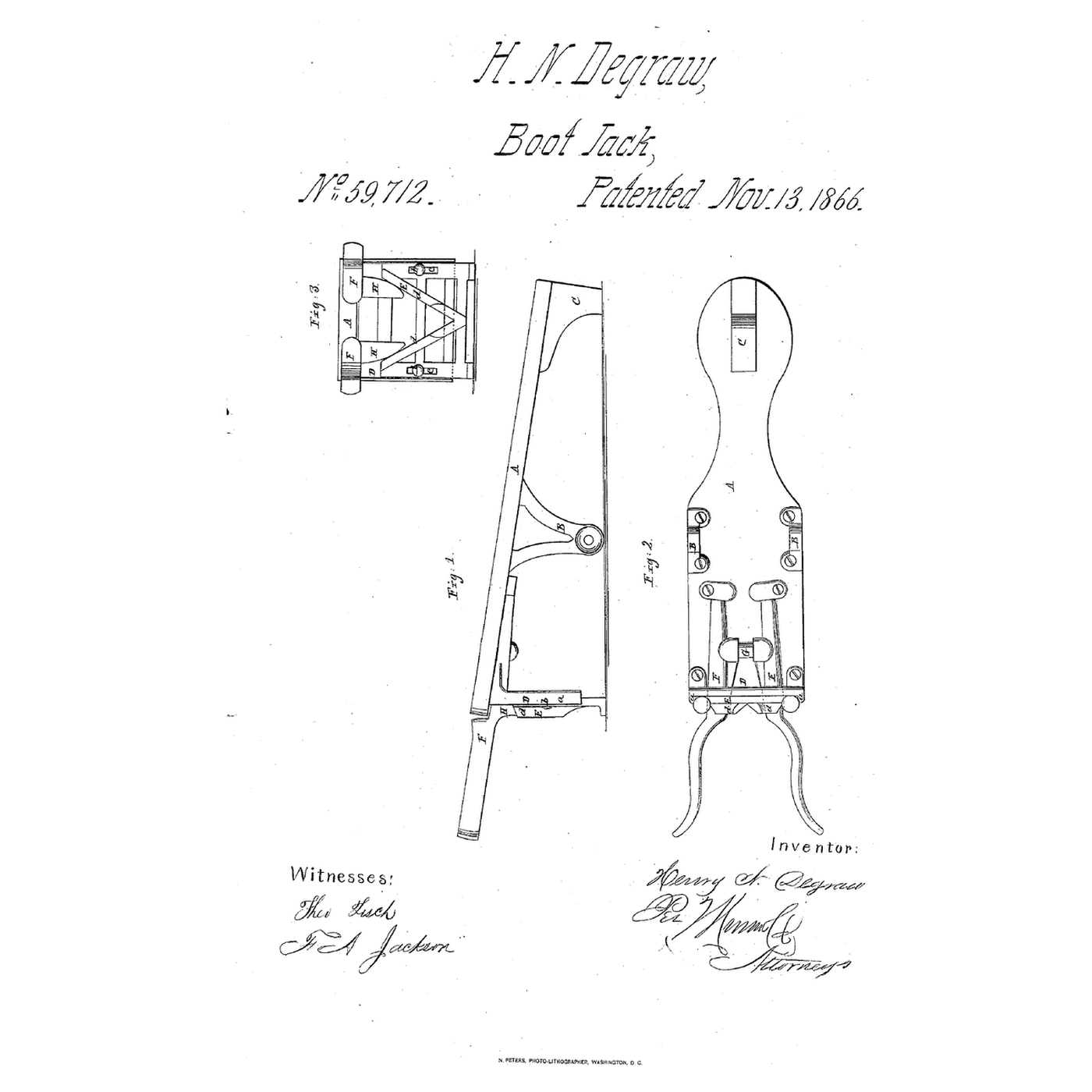


The Boot-Jack: Jaws That Close When You Stand on It
Tall, tight boots are hard to pull off alone. A boot-jack holds the heel of one boot while the other foot stands on it.
Henry N. DeGraw of Newburg, New York, assignor to himself and Henry Wright, received US 59,712, dated 13 November 1866, for a boot-jack whose pivoted jaws "may by the pressure of one foot on the foot-piece be made to grasp the heel of the boot on the other foot, so that said foot may be readily withdrawn therefrom." Pendants on the jaws bear on inclined bars; an india-rubber spring spreads them again when the foot lifts.
This rung works out the squeeze the wedge gives and the pull friction can hold, then builds a wooden model with elastic-band springs.
Principiante
About 2 hours
Instrucciones
1
1
Wedge squeeze and friction grip
Wedge squeeze and friction grip
Cargando el cuaderno de Jupyter…
2
2
A small push, a large squeeze
A small push, a large squeeze
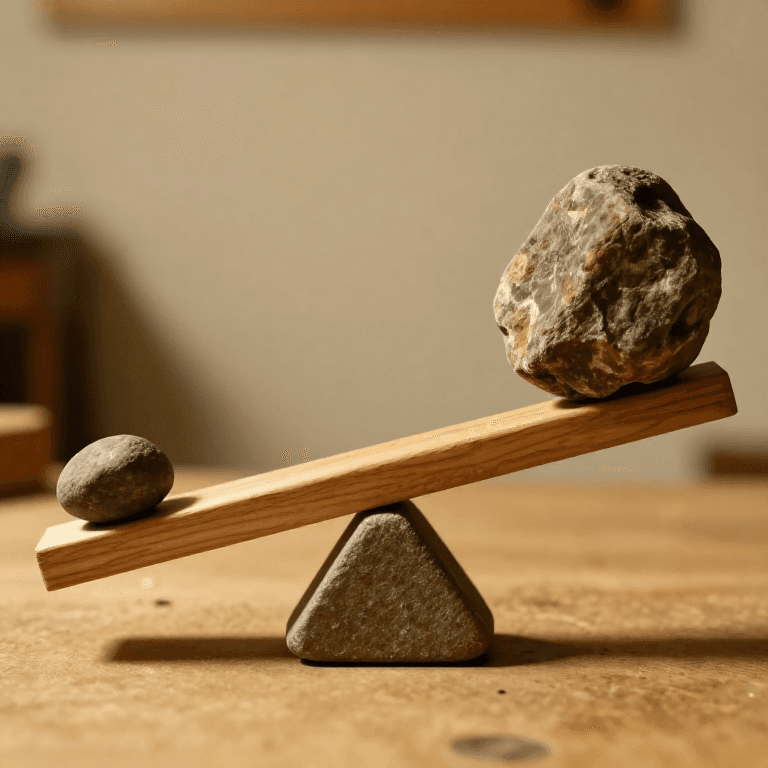
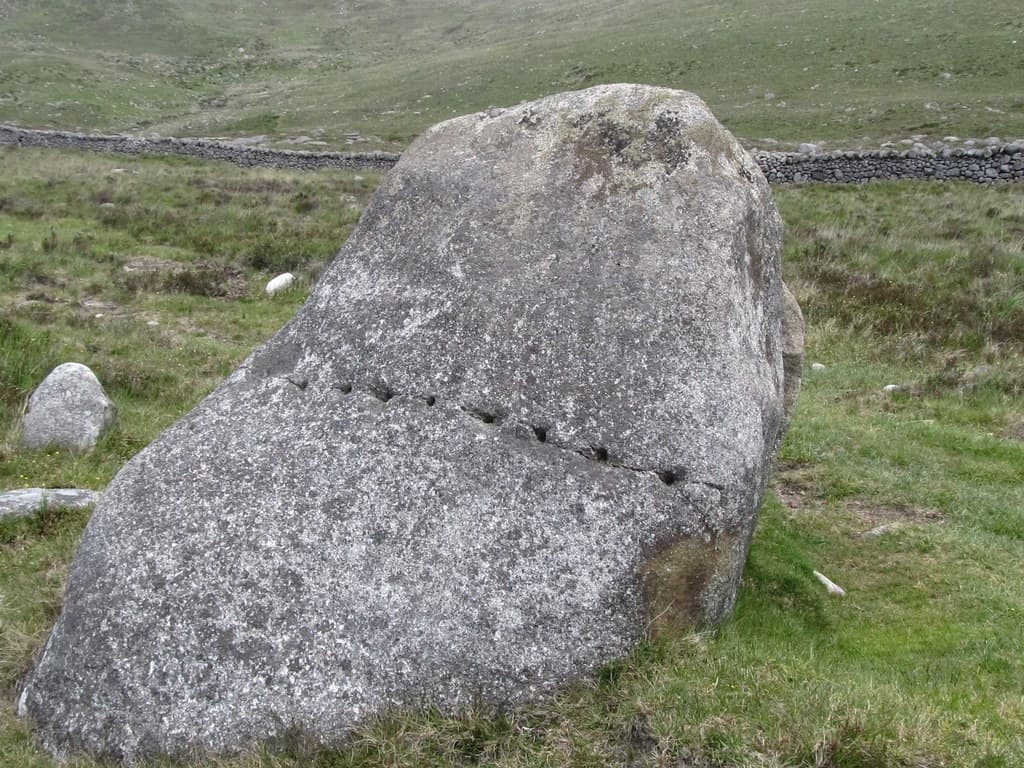
The jack's inclined bars are wedges. The embedded blueprint splits stone with feathers and wedges on the same principle.
3
3
Read US 59,712
Read US 59,712
"This invention relates to a new and improved boot-jack of that class which are provided with movable or pivoted jaws; and it consists in a novel and improved manner of applying the jaws to the foot-piece and arranging certain parts therewith, whereby the jaws may by the pressure of one foot on the foot-piece be made to grasp the heel of the boot on the other foot, so that said foot may be readily withdrawn therefrom."
"The device is used by placing the heel of the boot from which the foot is to be withdrawn between the outer curved parts of the jaws F F, and placing the other foot on the foot-piece A, and pressing upon the latter in a downward and forward direction, so as to force down the frame D and the foot or toe end of the foot piece A, and in consequence of the pendants H of the jaws bearing against the oblique or inclined bars d d of the frame E, the two jaws F F will be pressed toward each other and made to grasp firmly the heel of the boot, so that the foot can be readily drawn from it. On taking the foot from the foot-piece the spring G will distend the jaws F F".
4
4
Build a gripping jack
Build a gripping jack
Cut a pine board about 35 cm long as the foot-piece and screw a short block under its middle so the toe end rises. From plywood cut two curved jaws that meet around a heel; pivot each on a screw under the toe end. Glue two strips in a V under the front, so pressing the board down pushes the jaws' tails along the strips and closes the jaws. Stretch elastic bands between the jaws to spread them.
Try it with a boot: heel in the jaws, other foot on the board. Then hang a bag of known weight from a boot held in the jaws while someone stands on it, adding weight until it slips.
Materiales para este paso:
 Tabla de pino1 pieza
 Tablero contrachapado1 pieza
 Gomas elásticas4 piezas
 Tornillos para madera1 pieza
Herramientas necesarias:
 Segueta (sierra de marquetería)
 Taladro inalámbrico
 Juego de brocas
 Juego de destornilladores
 Sacabotas
5
5
A boot-jack that slips or will not let go
A boot-jack that slips or will not let go
Boot-jack troubleshooting.
Flow
Loading...
6
6
History and honest limits
History and honest limits
**Henry N. DeGraw** of Newburg, New York, assignor to himself and Henry Wright, received US 59,712, dated 13 November 1866 (no filing date is printed on patents of that period). He notes "quite a large number having been recently manufactured and sold."
**Honest limits.** The patent gives no angles or forces. Body mass, the share pressed forward, bar angles, friction and the pull a boot needs are examples.
Materiales
4- 1 piezaMarcador de posición
- 1 piezaMarcador de posición
- 4 piezasMarcador de posición
- 1 piezaMarcador de posición
Herramientas requeridas
5- Marcador de posición
- 1 vendor sell this, none ship to you yetMarcador de posición
- Marcador de posición
- Marcador de posición
- Marcador de posición
Blueprints relacionados
Estos blueprints comparten conocimiento — técnicas, materiales o principios


CC0 Dominio público
Este Blueprint se publica bajo CC0. Eres libre de copiar, modificar, distribuir y usar este trabajo para cualquier propósito, sin pedir permiso.
Apoya al Maker comprando productos a través de su Blueprint, donde gana una Comisión del Maker establecida por los vendedores, o crea una nueva iteración de este Blueprint e inclúyela como conexión en tu propio Blueprint para compartir ingresos.