

The Cantilever Bridge
Arches and beams both need something underneath them while they are being built. Over a deep, fast estuary that something is unaffordable or impossible. The cantilever bridge is the structure that answers the question: what can you build if you are never allowed to put anything in the water?
The answer is to build outward from each pier in both directions at once, keeping the two arms balanced so the pier is never asked to hold an unbalanced load, and then to drop a short suspended span into the gap where the two arms nearly meet. Nothing ever stands on the riverbed. Every stage of construction is a complete, stable structure in its own right.
Underneath the engineering is a piece of mathematics that is easy to miss and is the actual invention. A continuous beam running over three or more supports is statically indeterminate: equilibrium alone does not tell you the reactions, you need the stiffness of the beam as well. Worse, if one pier settles by a few millimetres, the forces everywhere change — and you cannot stop a pier settling.
Heinrich Gerber saw that inserting hinges at the right points makes the whole thing statically determinate again. The reactions then follow from equilibrium alone, they can be computed exactly by hand, and settlement of a pier changes nothing. His Bavarian patent of 1866, Balkenträger mit freiliegenden Stützpunkten, was first built in 1867 over the Regnitz at Bamberg and on the Main at Haßfurt, and the Gerberträger — Gerber beam — went round the world under his name.
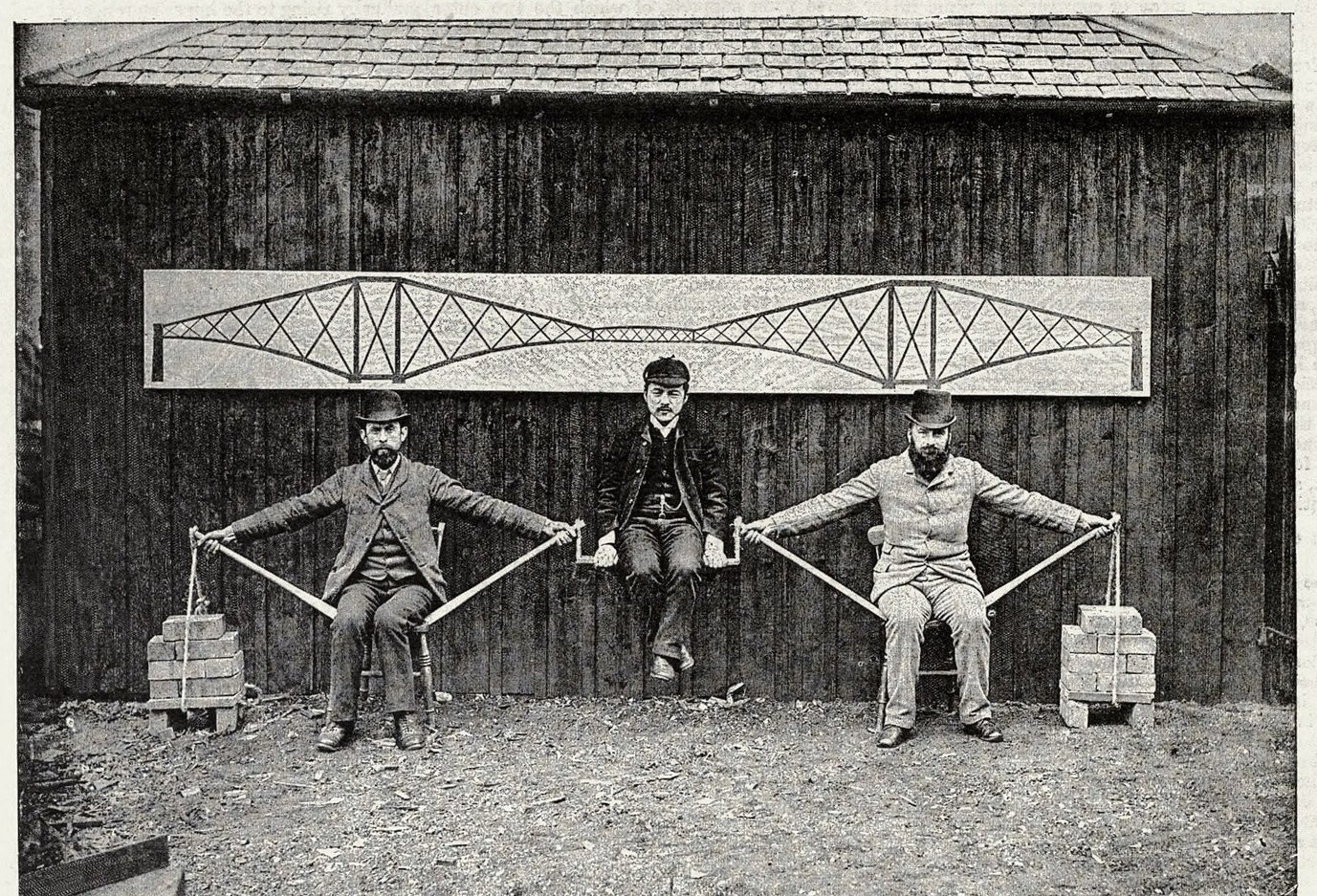
The Forth Bridge, opened 4 March 1890, is the form at full scale: main spans of 1,709 feet. Build the demonstration Fowler and Baker used in 1887, then measure why the hinges matter.
Instrucciones
Build the human cantilever
Build the human cantilever
Sit two people on chairs facing each other, a gap between them. Each holds a stick out towards the other with the outstretched arm, and anchors a second stick down to a weight on the floor beside the chair.
Sit a third, lighter person on a board slung between the two inner stick ends.
Nobody is holding a beam across the gap, yet the load is carried.
Materiales para este paso:
 Surtido de espigas de madera1 juego
Name the force in every member
Name the force in every member
With the load in place, have each seated person report what they feel. The outstretched arm and its stick are being squeezed. The anchor stick to the counterweight is being pulled.
Write the sign of every member on a sketch.
The top members of a cantilever arm are in tension and the bottom in compression — the exact reverse of a simply supported beam, and the reason cantilever bridges look inside-out.
Materiales para este paso:
 Papel milimetrado1 pieza
Build a three-support beam and weigh the reactions
Build a three-support beam and weigh the reactions
Lay one continuous stiff strip across three supports, each support standing on its own kitchen scale. Zero the scales, then place a known load at mid-span of one bay.
Record all three readings and check they sum to the applied load.
You cannot get these three numbers from equilibrium alone — two equations, three unknowns. The beam's own stiffness decided the split.
Herramientas necesarias:
 Báscula digital de cocina
Settle one pier by a millimetre
Settle one pier by a millimetre
Slip a thin shim under the centre support, or take one away, changing its height by one or two millimetres. Do not touch the load.
Read all three scales again.
Expect them to change substantially.
Nothing was added and nothing was removed. The structure loaded itself, purely because a support moved — and on a real bridge in a real riverbed, supports move.
Herramientas necesarias:
Báscula digital de cocinaCut in the hinges and repeat
Cut in the hinges and repeat
Replace the continuous strip with the Gerber arrangement: two anchored arms, and a separate short suspended span resting freely on the arm ends. Load it in the same place.
Now shim the centre support again and re-read the scales.
Expect the readings to be essentially unchanged.
That is the whole patent in one measurement. With the hinges in, the reactions follow from equilibrium alone and settlement cannot induce force.
Herramientas necesarias:
Báscula digital de cocinaBuild it out over an imaginary river
Build it out over an imaginary river
Erect the model in the real construction sequence. Add one bay to the left arm, then one to the right, alternating, so the pier is never loaded unevenly. Place the suspended span only at the very end.
Try it wrong: build one arm three bays out before starting the other.
Expect the unbalanced version to tip or need holding.
Balance is not an aesthetic; it is the construction method. Nothing ever touched the floor between the piers.
History & Context
History & Context
Gerber's patent is a mathematical device, not a shape. Balkenträger mit freiliegenden Stützpunkten — girder with free-standing support points — was granted in Bavaria in 1866 and first built in 1867 at Bamberg over the Regnitz and at Haßfurt over the Main. Before computers, a statically indeterminate structure had to be solved by iterative hand methods that were slow, error-prone and dependent on assumed stiffnesses. Gerber's hinges turned an unsolvable-in-practice problem into arithmetic, and made the answer independent of how much the ground moved. Both benefits mattered; the second one still does.
The Forth Bridge was built in the shadow of a disaster. The Tay Bridge collapsed in a gale on 28 December 1879, taking a train and its passengers with it. Thomas Bouch had already been commissioned to build a suspension bridge over the Forth; that design was abandoned. John Fowler and Benjamin Baker replaced it with a cantilever in steel — visibly, demonstratively, conservatively massive, with wind loading taken far more seriously than Bouch had taken it. It opened on 4 March 1890 with two main spans of 1,709 ft and a total length of 8,296 ft, and is a UNESCO World Heritage Site.
The photograph in step 1 is real and it is 1887. Baker and Fowler staged the living-model demonstration to explain the principle publicly, with two men on chairs holding sticks and bricks — and the man sitting in the middle, playing the suspended span, was Kaichi Watanabe, one of the first Japanese engineering students in Britain. He is almost always cropped out or left unnamed in the retellings. He went home and worked on Japan's railways.
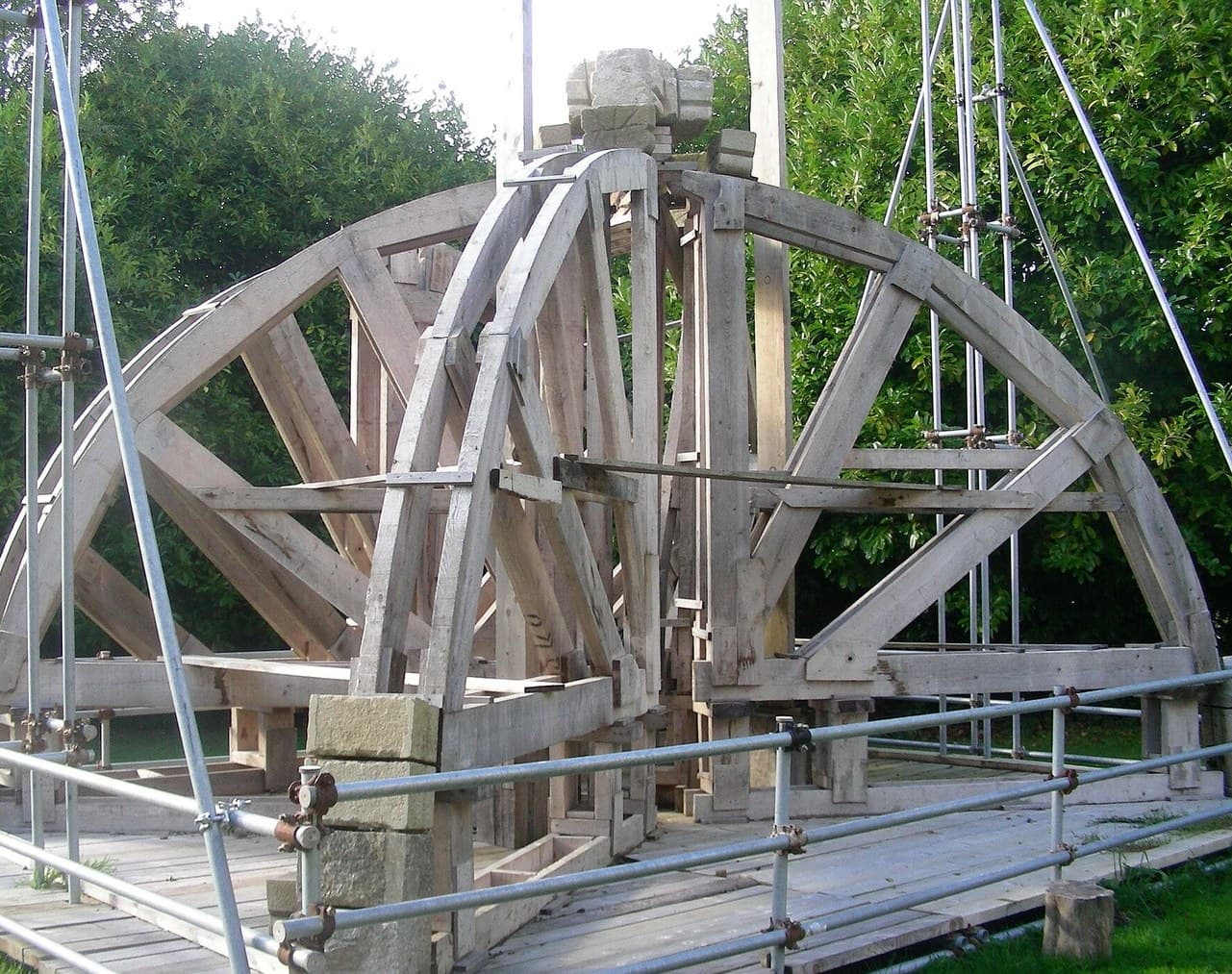
Cantilever construction outlived the cantilever bridge. Steel cantilever trusses fell out of favour — they are heavy, they have enormous numbers of joints to inspect and paint, and the 1907 Quebec Bridge collapse, which killed 75 men, was a cantilever failing during erection from an underestimated dead load. But balanced cantilever construction is now completely standard in prestressed concrete: segments are cast or placed outward from each pier in matched pairs, exactly as in step 6, and the deck closes at mid-span. The bridge type became rare; the method of building without falsework became universal.
The honest limits. A cantilever arm is at its most highly stressed during construction, before the suspended span closes and before the far anchor is complete — which is when Quebec failed, twice. The anchor arms must be held down, so the end piers work in uplift and are often ballasted with concrete or kentledge. Steel cantilevers carry a large permanent maintenance cost in joints and paint. And the hinges that make the mathematics easy are also mechanical bearings: they move, they wear, they need inspecting, and a seized hinge quietly turns the structure back into the indeterminate one Gerber was avoiding.
Materiales
2- 1 juegoMarcador de posición
- 1 piezaMarcador de posición
Materiales de Blueprints conectados


Blueprints relacionados
Estos blueprints comparten conocimiento — técnicas, materiales o principios

CC0 Dominio público
Este Blueprint se publica bajo CC0. Eres libre de copiar, modificar, distribuir y usar este trabajo para cualquier propósito, sin pedir permiso.
Apoya al Maker comprando productos a través de su Blueprint, donde gana una Comisión del Maker establecida por los vendedores, o crea una nueva iteración de este Blueprint e inclúyela como conexión en tu propio Blueprint para compartir ingresos.