ARTE
BELLEZA Y BIENESTAR
ARTESANÍA
CULTURA E HISTORIA
ENTRETENIMIENTO
MEDIO AMBIENTE
COMIDA Y BEBIDAS
INGENIERÍA INVERSA
CIENCIAS
DEPORTES
TECNOLOGÍA
TECNOLOGÍA VESTIBLE


The Crawler Track: Laying Down a Road to Carry the Machine
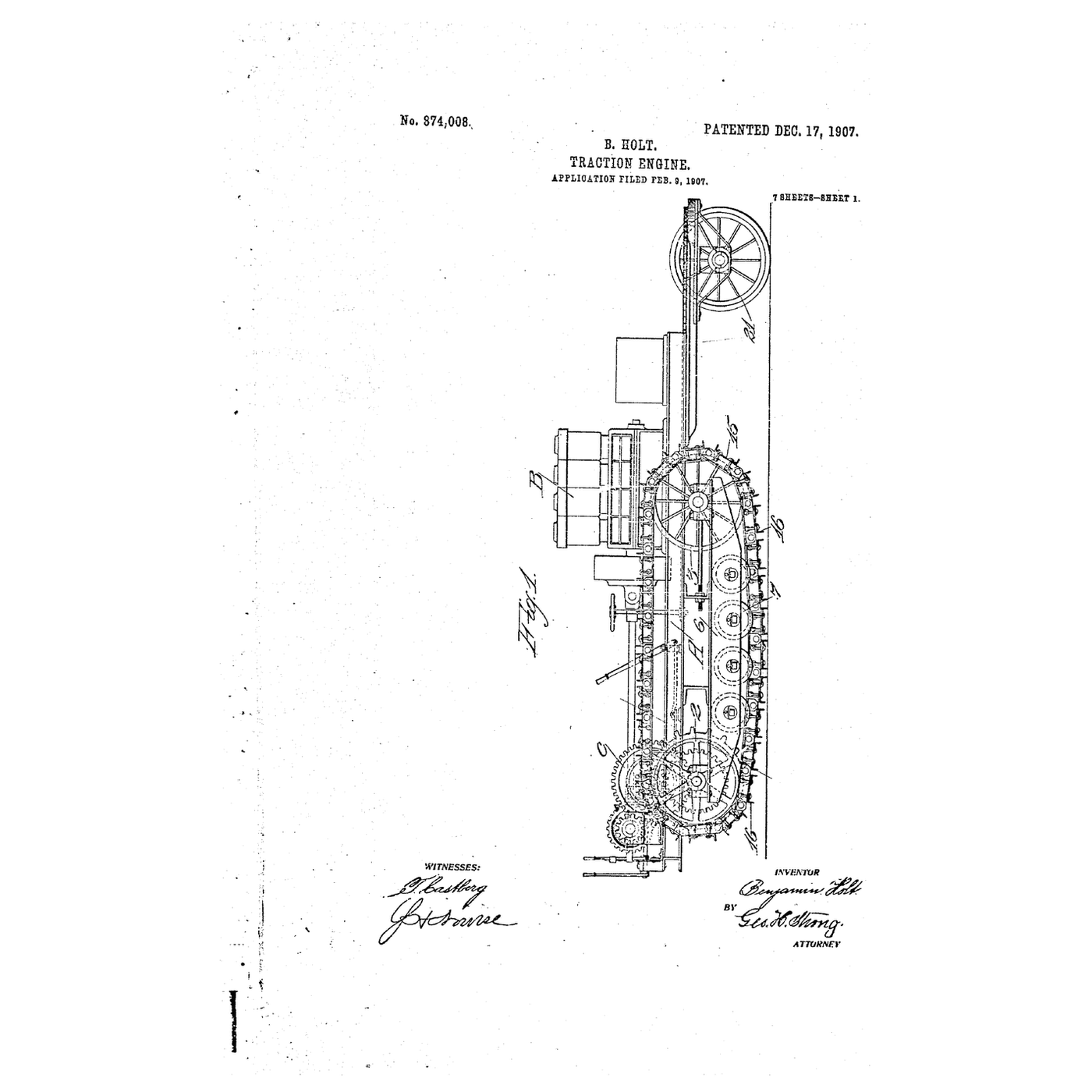
Heavy steam traction engines sank in the soft peat of California's Sacramento–San Joaquin delta. Benjamin Holt of Stockton replaced the rear wheels with what his patent calls "endless traveling platforms": chains of links carrying broad transverse shoes, running round sprocket wheels, so the machine laid down its own track and rolled along it.
US 874,008, filed in February 1907 and granted 17 December 1907, describes the whole machine: the shoes, the lubricated link joints sealed against grit, bearing wheels that ride on the inside of the chain, and a differential or clutches so that it steers by driving one side harder than the other.
This rung measures what a track does to ground pressure, works out skid steering and sprocket shake, and tests wheel against track in a tray of sand.
Intermedio
About 4 hours
Instrucciones
1
1
Ground pressure, skid steering and sprocket shake
Ground pressure, skid steering and sprocket shake
Cargando el cuaderno de Jupyter…
2
2
Read Holt's track off the patent
Read Holt's track off the patent
Sheet 6 of US 874,008 shows the track in outline: an endless belt of links round two sprocket wheels, with the transverse shoe that each link carries.
What the specification specifies, in order:
- **Links** made male and female, pinned with bolts turning in sleeves, "entirely protected from grit and dirt", with channels to inject lubricant.
- **Transverse shoes** riveted across the links, "a sufficiently broad support to prevent the apparatus … from sinking into the ground"; for very soft ground, wider supplementary shoes bolted on, with upturned flanges for grip on slippery ground.
- **Bearing wheels** running on the inside edges of the chain between the sprockets, arranged on a curve convex downwards so the machine turns more easily than on a flat run.
- **A differential or clutch mechanism** so that power "may be transmitted to either of the driving sides", assisting turning; the front of the machine rides on a steering wheel.

3
3
Why track links wear the way chains do
Why track links wear the way chains do
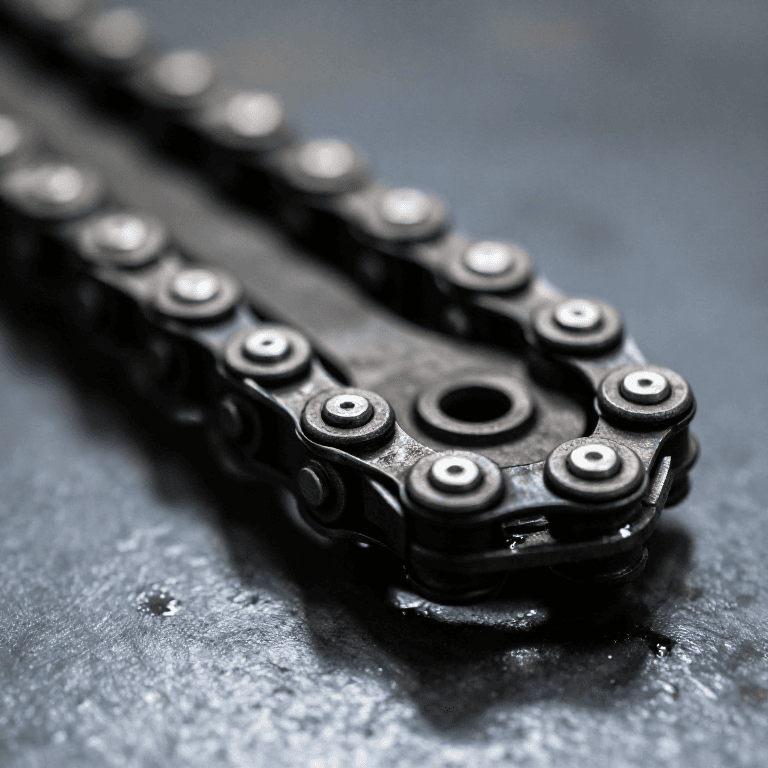
A track is a very large roller chain running in dirt. The embedded blueprint measures chain stretch and sprocket wear; the same pin-and-bush wear decides when a track is worn out.
4
4
Wheel against track in a sand tray
Wheel against track in a sand tray
Fill a tray 60 mm deep with dry fine sand and level it with a straightedge.
Build two carriers of the same weight on balsa decks: one on four toy wheels, one on two 'tracks' — loops of nylon webbing round a pair of 12 mm dowels each, with a balsa slat under each loop so the webbing is supported along its length, as Holt's bearing wheels support his. Load both to 2 kg with weights.
Stand each on the sand for one minute and measure sinkage with the depth rod of a caliper at four points. Then push each 300 mm with a spring scale and read the force. The wheels sink deeper and need more force to push, because they are always climbing out of the rut they have just made; the tracks leave a shallow print. Calculate each carrier's ground pressure from its contact area and set it beside the sinkage.
Materiales para este paso:
 Arena fina10 kilogram
 Plancha de madera de balsa2 piezas
 Espigas de madera dura4 piezas
 Cincha de nailon1 metro
 Kit de ejes y ruedas para juguetes (metal y goma)1 pieza
Herramientas necesarias:
 Peso
Peso Calibre digital de 6 pulgadas
 Dinamómetro (balanza de resorte)
 Regla
Regla Pistola de cola caliente
5
5
Diagnosing a track that is going wrong
Diagnosing a track that is going wrong
Track wear shows itself in a few distinct ways.
Flow
Loading...
6
6
History and context
History and context
**Benjamin Holt** of Stockton, California, built combine harvesters and steam traction engines. He tested his first track-type machine in 1904 and was granted **US 874,008**, *Traction-Engine*, on 17 December 1907. Holt's company adopted the name Caterpillar, and merged with its rival C. L. Best in 1925 to form the Caterpillar Tractor Company.
Tracks were proposed before Holt, but his was a working machine built in numbers for soft farmland.
**Honest limits.** Tracks are heavier, slower and dearer than wheels, and they wear fast on hard roads. Skid steering scuffs the ground and wastes power in the turn. Low average ground pressure does not make compaction vanish: the pressure under each roller is higher than the average, and total load still compacts deeper soil layers.
Materiales
5- 10 kilogramMarcador de posición
- 2 piezasMarcador de posición
- 4 piezasMarcador de posición
- 1 metroMarcador de posición
- Kit de ejes y ruedas para juguetes (metal y goma)10% de comisión1 piezaMarcador de posición
Herramientas requeridas
5- Marcador de posición
- Marcador de posición
- Marcador de posición
- Marcador de posición
- Marcador de posición
Blueprints relacionados
Estos blueprints comparten conocimiento — técnicas, materiales o principios

CC0 Dominio público
Este Blueprint se publica bajo CC0. Eres libre de copiar, modificar, distribuir y usar este trabajo para cualquier propósito, sin pedir permiso.
Apoya al Maker comprando productos a través de su Blueprint, donde gana una Comisión del Maker establecida por los vendedores, o crea una nueva iteración de este Blueprint e inclúyela como conexión en tu propio Blueprint para compartir ingresos.