ARTE
BELLEZA Y BIENESTAR
ARTESANÍA
CULTURA E HISTORIA
ENTRETENIMIENTO
MEDIO AMBIENTE
COMIDA Y BEBIDAS
INGENIERÍA INVERSA
CIENCIAS
DEPORTES
TECNOLOGÍA
TECNOLOGÍA VESTIBLE
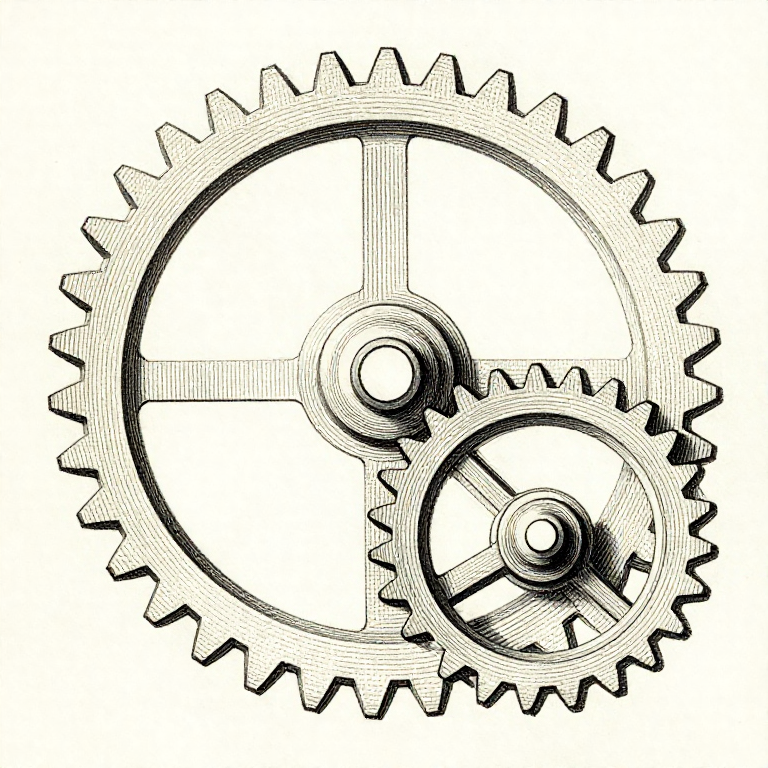


Tooth Count and Ratio: One Extra Tooth Changes Everything
A gear pair's ratio is the ratio of its tooth counts, exactly. That exactness is the reason gears are used at all where a belt or a chain would be simpler: the relationship cannot slip and cannot drift.
Two consequences of counting teeth rather than measuring diameters are worth knowing before choosing any pair. **Tooth counts that share a common factor** make the same teeth meet over and over, concentrating wear; making them coprime spreads it. And **below a minimum tooth count** the cutter undercuts the root, weakening the tooth — which is the reason the standard pressure angle changed.
Both are decisions made when the numbers are chosen, and neither can be corrected afterwards.
Intermedio
3 hours
Instrucciones
1
1
Speed, torque and direction
Speed, torque and direction
**Speed goes down by the ratio and torque goes up by the same factor**, less the losses. A gear pair is a lever that keeps turning, and the power through it is nearly constant — a spur pair is 98 to 99% efficient.
**Two external gears turn in opposite directions.** Always. Three in a row turn in the order opposite, same, opposite.
**An idler gear reverses the direction and changes the ratio not at all.** Its tooth count cancels out of the calculation completely. An idler exists to fill a gap, to fix a direction, or to take a load — never to change a ratio.
**An internal gear turns the same way as its pinion**, because the pinion is inside it. That is what makes epicyclic trains compact and it is why they can achieve ratios a simple pair cannot.
**Ratios above about 6:1 in one pair are awkward**, because the wheel becomes very large relative to the pinion. Beyond that, two stages in series multiply and stay compact — a 36:1 reduction as two 6:1 stages is far smaller than as one pair.
Materiales para este paso:
 Juego de engranajes rectos (acero, 20 dientes)2 piezas
Herramientas necesarias:
 Regla
Regla2
2
Ratios, hunting teeth and the minimum count
Ratios, hunting teeth and the minimum count
Cargando el cuaderno de Jupyter…
Herramientas necesarias:
 Ordenador de sobremesa
3
3
Choosing the pair
Choosing the pair
**Start from the ratio you need**, then look for a pair of tooth counts that gives it, are both above the undercut minimum, are coprime if possible, and land at a convenient centre distance.
Those four wants conflict, and the order to relax them is usually: exact ratio last, coprime next, centre distance next, minimum tooth count never.
**An approximate ratio is often fine.** A 3:1 reduction as 17:51 is exact and as 17:50 is within 2% and hunting. For a drive where the output speed is not critical, the second is the better gear pair.
**Where it IS critical** — a clock, a dividing head, a screw-cutting lathe — the ratio must be exact and the hunting tooth is given up. The change gear set on a lathe exists precisely to build exact awkward ratios, and its gears are chosen for their factors rather than for their wear.
**Pinion on the fast shaft.** The small gear goes on the high-speed side, because it is the one that makes the most tooth engagements per minute and therefore accumulates the most cycles. It is also the one that will be replaced first, and the smaller gear is cheaper.
**Write down what was chosen and why.** The next person to open the gearbox has to know whether 50 was chosen or merely available.
Materiales para este paso:
Juego de engranajes rectos (acero, 20 dientes)1 piezaHerramientas necesarias:
 Calibre digital de 6 pulgadasOrdenador de sobremesa
 Juego de engranajes de cambio
4
4
Compound trains, and the odometer problem
Compound trains, and the odometer problem
**A compound train** puts two gears on one shaft so that the ratios multiply. Four gears on three shafts gives the product of two pairs, and that is how any large reduction is made in a reasonable space.
**The rule:** multiply the driven tooth counts, divide by the driver tooth counts. Idlers cancel out; gears sharing a shaft do not.
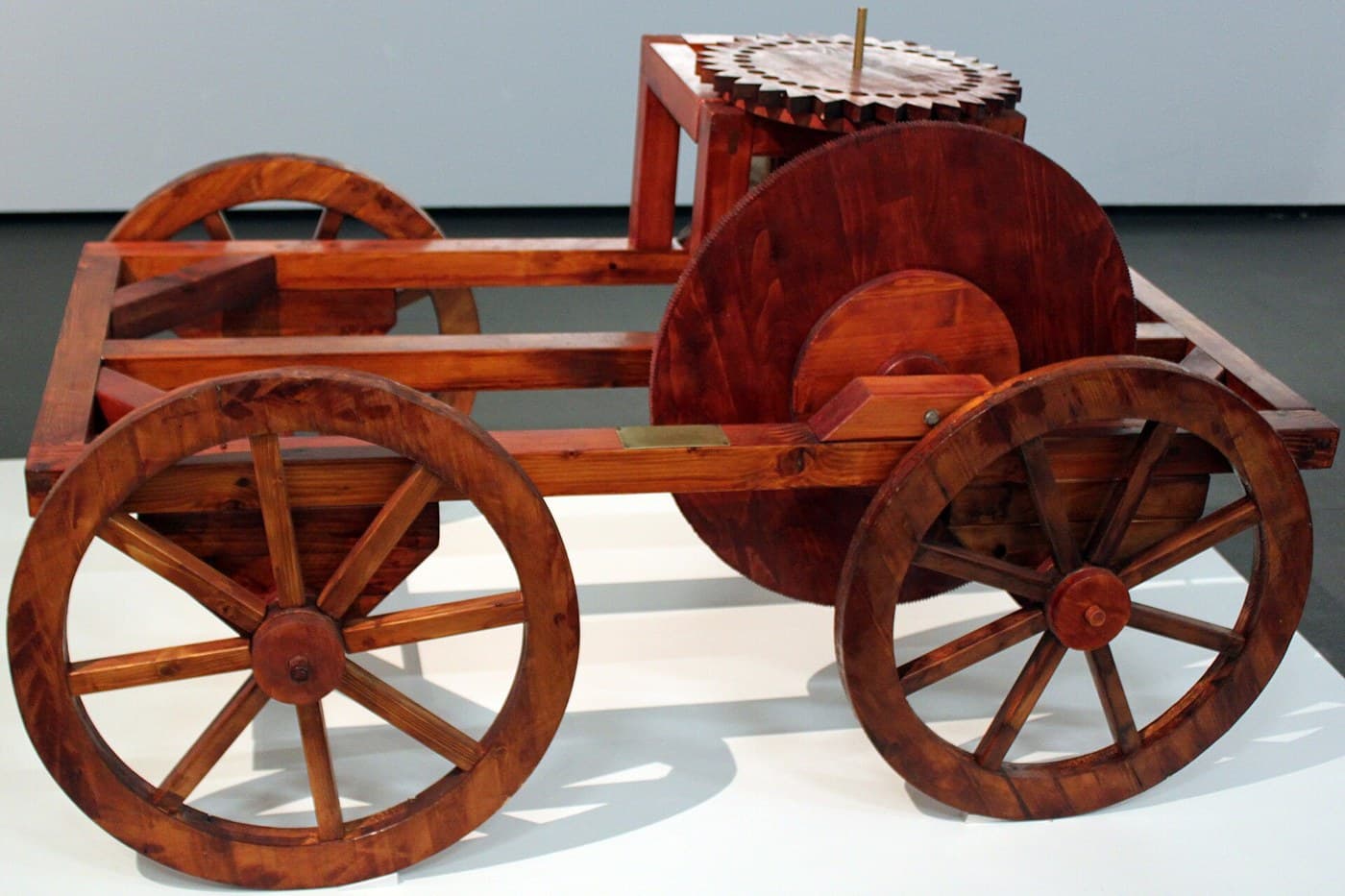
**Very large ratios have a specific use**, and the catalogue's Roman odometer is the original: a reduction so large that one turn of the output corresponds to a mile of travel. The same problem recurs in clocks, in dividing heads and in anything that counts.
**Worm and wheel gives an enormous ratio in one stage** — 40:1 or more, because a single-start worm advances the wheel by one tooth per turn. The cost is efficiency: a worm drive can be under 50% efficient, most of the loss as heat in sliding friction.
**That inefficiency is sometimes the point.** A worm drive with a lead angle below the friction angle is **self-locking**: the wheel cannot drive the worm backwards at all. That is why worm gears are in hoists, jacks and anything that must not run back when the power is removed. Efficiency lost, safety gained, and the trade is deliberate.
Materiales para este paso:
 Conjunto de tornillo y rueda sinfín (acero y bronce)1 pieza
Herramientas necesarias:
Ordenador de sobremesaJuego de engranajes de cambioMateriales
2- Marcador de posición
- Marcador de posición
Blueprints relacionados
Estos blueprints comparten conocimiento — técnicas, materiales o principios

CC0 Dominio público
Este Blueprint se publica bajo CC0. Eres libre de copiar, modificar, distribuir y usar este trabajo para cualquier propósito, sin pedir permiso.
Apoya al Maker comprando productos a través de su Blueprint, donde gana una Comisión del Maker establecida por los vendedores, o crea una nueva iteración de este Blueprint e inclúyela como conexión en tu propio Blueprint para compartir ingresos.