ARTE
BELLEZA Y BIENESTAR
ARTESANÍA
CULTURA E HISTORIA
ENTRETENIMIENTO
MEDIO AMBIENTE
COMIDA Y BEBIDAS
INGENIERÍA INVERSA
CIENCIAS
DEPORTES
TECNOLOGÍA
TECNOLOGÍA VESTIBLE
Two-Dimensional Paper Chromatography
Charlie

Creado por

Charlie

23. septiembre 2026DE
18
0
0
0
0

Two-Dimensional Paper Chromatography

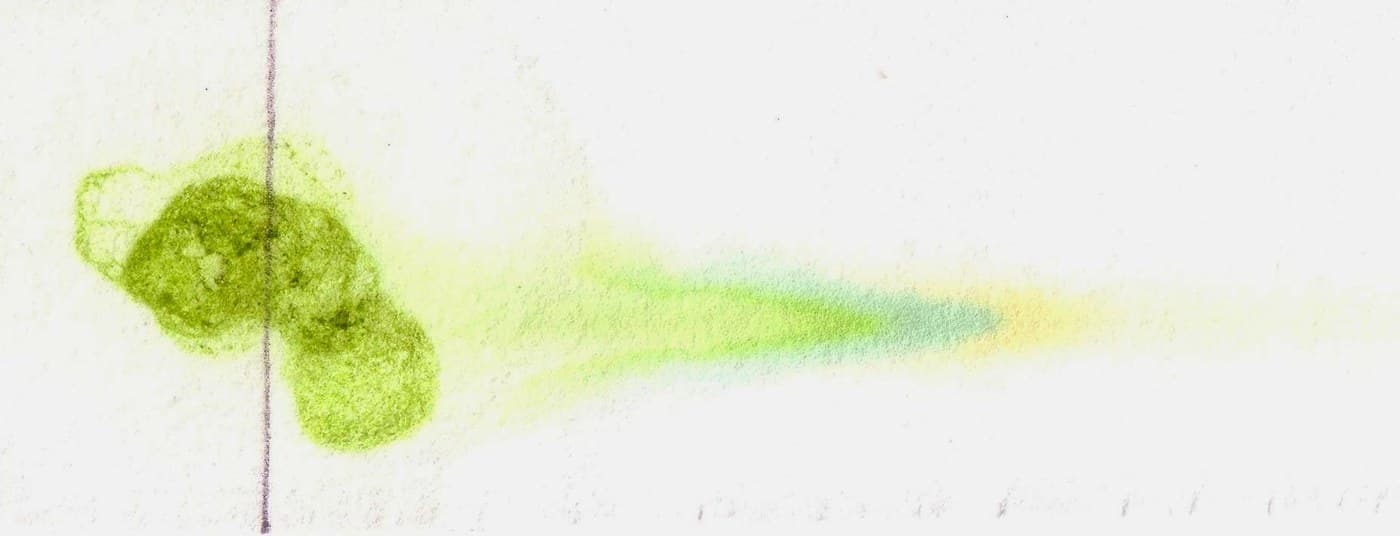
Paper chromatography, already published here, has a hard limit: two substances that happen to travel at the same speed in your solvent land in the same place, and no amount of care will pull them apart. They are not unresolved because the technique is sloppy — they are unresolved because you asked one question and got one answer. In 1944 Consden, Gordon and Martin at the Wool Industries Research Association asked a second question of the same sheet. Run the paper as usual, dry it, turn it ninety degrees, and run it again in a DIFFERENT solvent. A pair that matched in the first solvent will almost never match in the second, so the spots that were one become two. It is the cheapest large increase in resolving power in analytical chemistry, it needs no equipment you do not already have, and it separated the amino acids of a protein hydrolysate well enough to start the work that sequenced insulin.
Intermedio
1 day

Instrucciones

1

Cut a square, and mark the origin in PENCIL

Cut a square of chromatography or good filter paper, about 15 by 15 cm. Mark a pencil dot 2 cm in from two adjacent edges. That corner is your origin. Pencil, never pen: graphite is carbon and does not move in any solvent, while ink is a mixture of dyes that will run up the paper and contaminate the very thing you are trying to read. Handle the sheet by its edges from now on — a fingerprint deposits amino acids and oils that show up as their own spots, which is a genuinely common way to get a confusing result.

Materiales para este paso:

Papel de cromatografíaPapel de cromatografía4 piezas

Herramientas necesarias:

ReglaRegla
2

Spot small, spot repeatedly, dry between

Touch a loaded capillary briefly to the origin, let it dry completely, and repeat five or six times on the same dot. The aim is a concentrated spot under 3 mm across. Loading it all at once gives a wide wet blot that spreads before it ever starts to travel, and every spot downstream inherits that width. Repeated small applications with drying between build up the quantity without the diameter — and in a two-dimensional run, where the spot has to survive being developed twice, that discipline pays double.

Materiales para este paso:

Colorante alimentarioColorante alimentario1 botella

Herramientas necesarias:

Tubo capilar de vidrioTubo capilar de vidrio
3

Run the first dimension

Stand the sheet in a closed jar with a shallow depth of your first solvent — a butanol/acetic acid/water mixture is the classic — with the origin edge down and the origin ABOVE the liquid line. Let the front climb to about 2 cm from the top, then take it out and mark the front in pencil immediately. The jar must be closed and ideally lined with damp paper, so the atmosphere is saturated with solvent vapour. In an open vessel, solvent evaporates from the paper face as fast as it climbs, the front becomes ragged and every Rf you measure is wrong. Mark the front at once: it vanishes as the sheet dries and cannot be recovered.

Materiales para este paso:

Ácido acético (glacial)Ácido acético (glacial)10 ml
Etanol de laboratorio, 95 %Etanol de laboratorio, 95 %100 ml

Herramientas necesarias:

Tarro de vidrioTarro de vidrio
ReglaRegla
4

Dry it thoroughly — this is the step people rush

Hang the sheet and let it dry completely, for an hour or more, until it has no smell of the first solvent at all. Any solvent left in the paper joins the second run and makes a mixed mobile phase you did not design, so your second-dimension Rf values are not reproducible and the whole point of the exercise is lost. Acetic acid is particularly stubborn. If the sheet smells, it is not dry, whatever it looks like.
5

Turn ninety degrees and run the second solvent

Rotate the sheet a quarter turn so the edge that was at the side is now at the bottom, and develop it in a clearly different solvent — phenol-water, or simply a much more aqueous mixture than the first. 'Different' has to mean different in KIND, not just in strength. A second solvent that separates by the same property as the first only stretches the pattern along a diagonal and separates nothing new. The pair you want attacks a different property: one sorting mainly by polarity, the other by size or by acidity.

Materiales para este paso:

Alcohol isopropílico al 99 %Alcohol isopropílico al 99 %100 ml
Bicarbonato de sodioBicarbonato de sodio5 g

Herramientas necesarias:

Tarro de vidrioTarro de vidrio
6

Develop the invisible spots

If your sample is not coloured, drop a few iodine crystals into a closed jar with the dry sheet and wait. The violet vapour settles into any organic spot and turns it brown. Iodine is the most forgiving visualiser there is: it stains almost any organic compound, it needs no spray or heat, and the stain FADES as the iodine evaporates, so the sheet is unharmed and can be stained again. Circle every spot in pencil while the colour is there, because in twenty minutes it will not be. Handle the crystals with gloves and keep the jar closed — iodine vapour is an irritant.

Materiales para este paso:

Cristales de yodoCristales de yodo2 g

Herramientas necesarias:

Tarro de vidrioTarro de vidrio
Guantes de nitriloGuantes de nitrilo
7

The resolving power you just bought

Cargando el cuaderno de Jupyter…

Herramientas necesarias:

ReglaRegla
8

Record the map, not just the picture

Measure each spot's distance from the origin along both edges, divide each by the corresponding solvent front distance, and write the pair of Rf values beside it. A photograph of a stained sheet is unrepeatable — the stain fades and the paper yellows. A table of Rf pairs is a fingerprint you can compare against a run you do next year, or against someone else's, provided you record the solvents and the temperature with it. That table, not the sheet, is what the next rung in this batch and every published method actually exchange.

Herramientas necesarias:

ReglaRegla

Materiales

7

Herramientas requeridas

4

CC0 Dominio público

Este Blueprint se publica bajo CC0. Eres libre de copiar, modificar, distribuir y usar este trabajo para cualquier propósito, sin pedir permiso.

Apoya al Maker comprando productos a través de su Blueprint, donde gana una Comisión del Maker establecida por los vendedores, o crea una nueva iteración de este Blueprint e inclúyela como conexión en tu propio Blueprint para compartir ingresos.

Discusión

(0)

Iniciar sesión para unirte a la discusión

Cargando comentarios...