
Understanding Aluminum Extraction from Bauxite — The Metal More Precious Than Gold
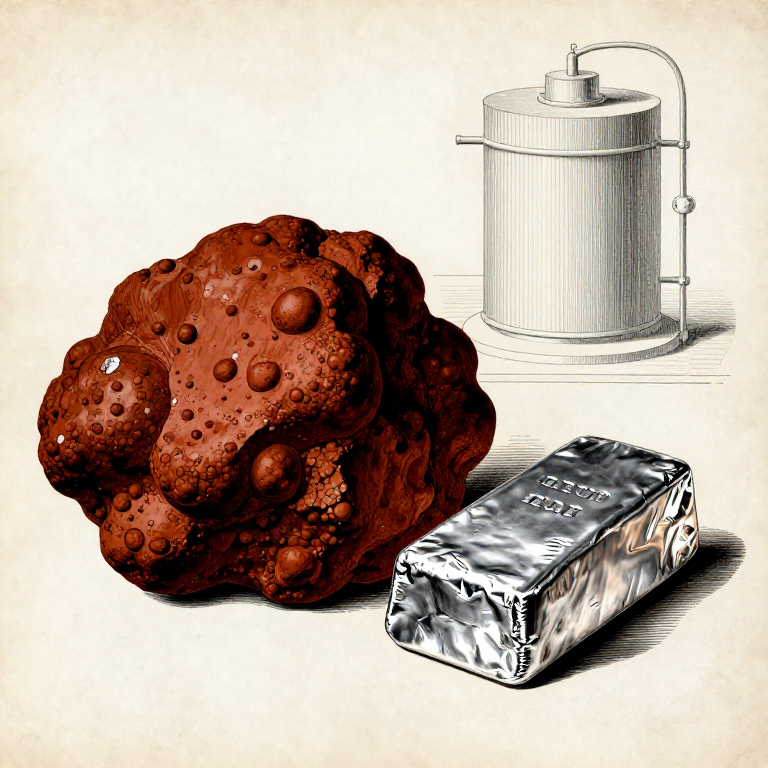
Aluminum (Al, element 13) is the most abundant metal in the Earth's crust at 8.1% by mass — more common than iron. Yet it was one of the last metals to be isolated, and for decades after its discovery it was more expensive than gold. Napoleon III reportedly reserved his aluminum dinner plates for his most honored guests, while lesser guests ate from gold.
The reason for this paradox is the same as titanium's: aluminum oxide (Al₂O₃, corundum) is extraordinarily stable. Carbon cannot reduce it at any achievable temperature. Hans Christian Ørsted first produced impure aluminum in 1825 by reacting aluminum chloride with potassium amalgam. Friedrich Wöhler improved the method in 1827 using pure potassium. Henri Sainte-Claire Deville developed a sodium-reduction process in 1854 that made small-scale production possible, but aluminum remained a precious metal at $1,200 per kilogram (more than silver).
The breakthrough came in 1886 when Charles Martin Hall (USA) and Paul Héroult (France) independently and simultaneously discovered that aluminum oxide dissolves in molten cryolite (Na₃AlF₆) and can be electrolyzed at approximately 960 °C to produce liquid aluminum metal. The Hall-Héroult process slashed the price of aluminum from $12/kg to $0.60/kg within a decade and remains the sole commercial production method today.
NOTE: Like titanium, aluminum cannot be extracted by traditional smelting. This blueprint is primarily educational — it explains the chemistry, demonstrates why carbon reduction fails, describes the Hall-Héroult process, and includes a small-scale electrolysis demonstration using aluminum compounds.
Instrucciones
Understand aluminum's properties and paradox of abundance
Understand aluminum's properties and paradox of abundance
Aluminum (Al, element 13) is a soft, lightweight, silvery-white metal with a density of only 2.70 g/cm³ — one-third that of steel. Its melting point is 660 °C, it is non-magnetic, an excellent conductor of electricity (about 60% of copper's conductivity per cross-section, but better per unit weight), and it is highly malleable and ductile. Modern civilization runs on aluminum: aircraft, beverage cans, window frames, electrical transmission lines, foil, and engine blocks.
The paradox of aluminum is stark: it constitutes 8.1% of the Earth's crust by mass (third after oxygen and silicon), yet it was essentially unknown as a metal before 1825. Every other abundant metal — iron (5.0%), calcium (3.6%), magnesium (2.1%) — was either used in antiquity or identified relatively early. Aluminum's extreme chemical reactivity locked it into oxide and silicate minerals so tightly that no traditional metallurgical technique could free it.
Aluminum oxide (Al₂O₃, known as corundum in its crystalline form) has a Gibbs free energy of formation of −1582 kJ/mol — one of the most thermodynamically stable oxides known. The Ellingham diagram shows that reducing Al₂O₃ with carbon requires temperatures above approximately 2000 °C, and even then the product is aluminum carbide (Al₄C₃), not metallic aluminum. Electrolysis — using electrical energy to force the reduction — was the only practical solution.
Identify bauxite — the only commercial aluminum ore
Identify bauxite — the only commercial aluminum ore
Bauxite is not a single mineral but a rock — a mixture of aluminum hydroxide minerals: gibbsite (Al(OH)₃), boehmite (γ-AlO(OH)), and diaspore (α-AlO(OH)), mixed with iron oxides, silica, and clay minerals. Bauxite typically contains 40–60% Al₂O₃. It forms by intense tropical weathering (laterization) of aluminum-rich rocks over millions of years — rainwater dissolves and removes silica and other soluble components, concentrating the insoluble aluminum hydroxides.
Bauxite is a soft (Mohs 1–3), earthy rock ranging in color from white to deep red-brown depending on iron oxide content. It has a characteristic pisolitic texture — it often contains small, rounded concretions (1–5 mm) of aluminum hydroxide cemented together, giving a pebbly or granular appearance. It feels rough and slightly chalky, and it crumbles or breaks into earthy fragments.
Major deposits are found in tropical and subtropical regions: Guinea (the world's largest reserves), Australia, Brazil, Jamaica, India, and Indonesia. Bauxite deposits form at or near the surface, often as thick blankets over weathered igneous or metamorphic rock. They are typically strip-mined.
Herramientas necesarias:
 Martillo de geólogo
 Lupa de mano 10x
Understand the Bayer process — purifying alumina from bauxite
Understand the Bayer process — purifying alumina from bauxite
Before electrolysis, bauxite must be purified to alumina (Al₂O₃). Karl Josef Bayer patented this process in 1888. The Bayer process exploits the amphoteric nature of aluminum hydroxide — it dissolves in strong alkali but iron oxide does not.
Crushed bauxite is digested in hot, concentrated sodium hydroxide solution (NaOH, 150–250 °C under pressure). The aluminum hydroxide dissolves as sodium aluminate: Al(OH)₃ + NaOH → NaAlO₂ + 2H₂O. Iron oxides (Fe₂O₃), titanium dioxide (TiO₂), and silica remain undissolved and are filtered off as 'red mud' — a caustic, iron-rich waste that is one of the major environmental challenges of aluminum production.
The clear sodium aluminate solution is cooled and seeded with fine gibbsite crystals. Aluminum hydroxide precipitates: NaAlO₂ + 2H₂O → Al(OH)₃↓ + NaOH. The precipitated Al(OH)₃ is filtered, washed, and calcined (heated to 1050–1100 °C) to produce anhydrous alumina (Al₂O₃) — a white, sandy powder with a melting point of 2072 °C. This alumina is the feedstock for the Hall-Héroult electrolysis cell.
Understand the Hall-Héroult electrolysis process
Understand the Hall-Héroult electrolysis process
The Hall-Héroult process dissolves purified alumina in molten cryolite (Na₃AlF₆) at approximately 960 °C — far below alumina's melting point of 2072 °C. The cryolite acts as a solvent for the alumina, creating an ionic liquid through which electric current can pass. The electrolysis reactions are:
Cathode (reduction): Al³⁺ + 3e⁻ → Al (liquid). Anode (oxidation): 2O²⁻ → O₂ + 4e⁻ (the oxygen reacts with the carbon anode: C + O₂ → CO₂). The overall cell reaction: 2Al₂O₃ + 3C → 4Al + 3CO₂.
The process uses enormous amounts of electricity — approximately 13–16 kWh per kilogram of aluminum produced. A single smelter may consume as much electricity as a small city. This is why aluminum smelters are always located near cheap hydroelectric power: Iceland, Norway, Quebec, Tasmania, and the Pacific Northwest became aluminum production centers specifically because of their abundant hydroelectricity.
Charles Martin Hall was 22 years old and working in a woodshed behind his family home in Oberlin, Ohio when he made his discovery on February 23, 1886. Paul Héroult, also 22, independently made the same discovery in France the same year. Both men were born in 1863 and died in 1914 — an extraordinary coincidence of parallel lives and simultaneous discovery.
Demonstrate carbon reduction failure with aluminum oxide
Demonstrate carbon reduction failure with aluminum oxide
OUTDOORS ONLY. To demonstrate why traditional smelting cannot produce aluminum, mix 50 grams of alumina powder (Al₂O₃, available as polishing compound or from calcined aluminum hydroxide) with 25 grams of finely powdered charcoal in a clay crucible. Heat to maximum temperature in a charcoal furnace (1200–1400 °C) for 2 hours.
After cooling, break open the crucible. You will find no metallic aluminum — only a dark mass containing unreduced alumina mixed with carbon and possibly small amounts of aluminum carbide (Al₄C₃). If any aluminum carbide formed (it requires temperatures above 1700 °C and is unlikely in a charcoal furnace), it can be detected by adding the product to water — Al₄C₃ reacts with water to produce methane gas (CH₄): Al₄C₃ + 12H₂O → 4Al(OH)₃ + 3CH₄↑. Bubbling indicates carbide formation.
This experiment demonstrates the fundamental thermodynamic barrier: the carbon-alumina system does not produce metallic aluminum at any temperature achievable in a charcoal furnace. Compare this with copper, lead, or tin — where carbon reduction works easily below 1200 °C. The Ellingham diagram explains why: the Al₂O₃ stability line lies below the CO line at all practical temperatures.
Materiales para este paso:
 Polvo de alúmina (óxido de aluminio)50 grams
 Carbón vegetal25 gramsCarbón vegetal3 kg
Herramientas necesarias:
 Crisol de arcilla profundo
 Horno de carbón vegetal
 Fuelle
 Mascarilla antipolvo
 Guantes de cuero de manopla larga
Demonstrate the amphoteric nature of aluminum
Demonstrate the amphoteric nature of aluminum
Aluminum's amphoteric chemistry — reacting with both acids and bases — is the foundation of the Bayer process and can be demonstrated at small scale. Dissolve a small piece of aluminum foil (1–2 grams) in 50 ml of dilute hydrochloric acid (10%). The aluminum dissolves with vigorous hydrogen gas evolution: 2Al + 6HCl → 2AlCl₃ + 3H₂↑. The solution becomes clear — this is aluminum chloride (AlCl₃).
Now dissolve a second piece of aluminum foil in 50 ml of dilute sodium hydroxide solution (10% NaOH). Aluminum also dissolves, again with hydrogen gas evolution: 2Al + 2NaOH + 6H₂O → 2Na[Al(OH)₄] + 3H₂↑. This demonstrates that aluminum reacts with both acids and bases — the definition of an amphoteric metal. Most metals dissolve in acid but not in alkali; aluminum dissolves in both.
To the acid solution, add NaOH dropwise: a white precipitate of aluminum hydroxide (Al(OH)₃) forms. Continue adding NaOH — the precipitate redissolves as sodium aluminate forms. This precipitation-and-redissolution demonstrates exactly the chemistry Bayer exploited: aluminum hydroxide dissolves in excess alkali, while iron hydroxide (which would form a brown precipitate that does not redissolve) is left behind. This selectivity is how the Bayer process separates aluminum from iron impurities in bauxite.
Materiales para este paso:
 Ácido clorhídrico50 ml
 Hidróxido de sodio en disolución al 10 %100 ml
Herramientas necesarias:
 Vaso de precipitados de vidrio refractario
 Vial de vidrio para muestras
 Guantes de nitrilo
 Gafas de seguridad estancas
Understand corundum — aluminum oxide as gemstone
Understand corundum — aluminum oxide as gemstone
Aluminum oxide in its crystalline form — corundum (α-Al₂O₃) — is one of the most remarkable minerals. With Mohs hardness 9, it is the second hardest natural substance after diamond. Corundum is used industrially as an abrasive (emery, alumina grinding wheels, sandpaper) and structurally as a high-temperature ceramic.
When corundum contains trace impurities, it produces gemstones of extraordinary beauty. Approximately 1% chromium (Cr³⁺) produces ruby — the most valuable colored gemstone per carat. Approximately 0.1% titanium (Ti⁴⁺) and iron (Fe²⁺) together produce blue sapphire through an intervalence charge transfer mechanism. Other trace elements produce yellow, pink, orange (padparadscha), green, and purple sapphires. All are corundum — the same mineral, differing only in parts-per-thousand impurity levels.
This connection to aluminum is rarely appreciated: the aluminum in your window frames and beverage cans is the same element that forms rubies and sapphires. The difference is entirely in crystal structure and trace impurities. Synthetic corundum (Verneuil process, flame-fusion growth) has been produced since 1902 and is used for watch bearings, laser rods (ruby laser), and optical windows. Understanding aluminum's oxide chemistry connects industrial metallurgy to gemology to advanced optics.
Document findings and understand aluminum's transformative impact
Document findings and understand aluminum's transformative impact
Document your experiments: the carbon reduction failure, the amphoteric chemistry demonstration, and observations of bauxite specimens if collected. Record the contrasts with successful carbon reductions of other metals in this series — aluminum's resistance to traditional metallurgy illustrates a fundamental boundary in chemistry that divided elements into 'accessible' (pre-1800) and 'inaccessible' (post-1800) categories.
Aluminum's impact on civilization after the Hall-Héroult process was transformative. Aviation would be impossible without aluminum — the Wright Flyer used an aluminum engine block in 1903, and every aircraft since has been primarily aluminum. The beverage can (invented 1959), aluminum foil (1910), and aluminum electrical conductors (which carry over 90% of long-distance electrical transmission) all depend on cheap aluminum. World production exceeds 65 million tonnes per year.
The environmental cost is significant: the Hall-Héroult process consumes approximately 13–16 kWh per kilogram of aluminum, and the Bayer process generates 1–2 tonnes of caustic red mud per tonne of alumina. However, aluminum is infinitely recyclable — recycling requires only 5% of the energy of primary production, making recycled aluminum one of the most energy-efficient materials in existence. Understanding the full extraction chain — from bauxite to Bayer to Hall-Héroult — explains why aluminum recycling is so valuable and why it matters.
Materiales
4- Marcador de posición
- 3 kgMarcador de posición
- 50 mlMarcador de posición
- Marcador de posición
Herramientas requeridas
12- Marcador de posición
- Marcador de posición
- Marcador de posición
- Marcador de posición
- Marcador de posición
- Marcador de posición
- Marcador de posición
- Marcador de posición
- Marcador de posición
- Marcador de posición
- Marcador de posición
- Marcador de posición
Materiales de Blueprints conectados
CC0 Dominio público
Este Blueprint se publica bajo CC0. Eres libre de copiar, modificar, distribuir y usar este trabajo para cualquier propósito, sin pedir permiso.
Apoya al Maker comprando productos a través de su Blueprint, donde gana una Comisión del Maker establecida por los vendedores, o crea una nueva iteración de este Blueprint e inclúyela como conexión en tu propio Blueprint para compartir ingresos.